The Rarity of Focus: A Deep Dive into Meaningful Productivity
Golden Hook & Introduction
SECTION
Prof. Eleanor Hart: Have you ever ended a day feeling completely exhausted, your brain buzzing from a constant barrage of emails, notifications, and meetings, only to look back and realize you accomplished nothing of real substance? You were busy, but were you productive?
Shayma: That feeling is almost universal, isn't it? It’s like running on a hamster wheel. You expend so much energy, but you haven't actually moved forward. It's a modern paradox.
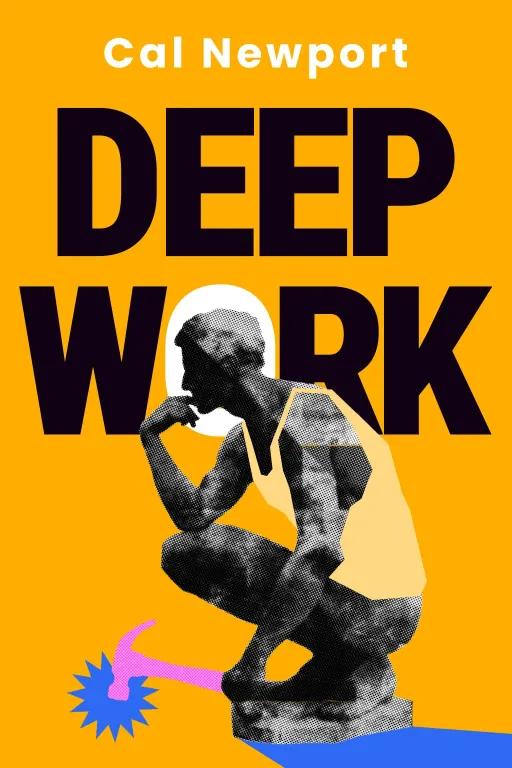
Prof. Eleanor Hart: It truly is. And our guest today, the curious and analytical Shayma, has put her finger right on it. We're diving into Cal Newport's "Deep Work," a book that offers a radical counter-narrative to this feeling. It argues that the secret to value in our economy isn't frantic, shallow busyness, but its exact opposite: the rare and powerful ability to focus without distraction.
Shayma: I'm so glad we're talking about this. The premise is fascinating because it feels so counter-cultural.
Prof. Eleanor Hart: Exactly. And that's why today we'll dive deep into this from two powerful perspectives. First, we'll explore why deep work has become a rare and valuable superpower in our economy. Then, we'll uncover the surprising and profound connection between deep focus and living a truly meaningful life.
Deep Dive into Core Topic 1: The Lost Art of Focus
SECTION
Prof. Eleanor Hart: So let's start with that first idea, Shayma: this distinction Newport makes between 'deep' and 'shallow' work. He defines Deep Work as professional activities performed in a state of distraction-free concentration that push your cognitive capabilities to their limit. This is the work that creates new value, improves your skills, and is hard to replicate.
Shayma: And shallow work is the opposite, right? The logistical tasks, the emails, the meetings that are often done while distracted and don't create much new value. The things that make us feel busy.
Prof. Eleanor Hart: Precisely. The administrative noise. To understand the power of creating an environment for deep work, I want to take us back to 1922. Picture this: the influential psychiatrist Carl Jung, feeling the need to retreat from his busy practice and the shadow of his former mentor, Sigmund Freud, buys a piece of land on the remote shores of Lake Zurich. There, he begins to build a simple, two-story stone house. He calls it the Tower.
Shayma: Just the name, 'the Tower,' sounds so solitary and imposing.
Prof. Eleanor Hart: It was. There was no electricity, no running water. He relied on oil lamps and a fireplace. And in this tower, he built a private office, a retiring room, where he kept the only key. He would rise at seven, have a simple breakfast, and then spend two hours of uninterrupted, silent time writing. He said, "In my retiring room I am by myself... no one else is allowed in there except with my permission." After writing, he would meditate or walk in the surrounding woods.
Shayma: So he engineered his environment entirely for focus. He built a fortress against distraction.
Prof. Eleanor Hart: He did. And it was in the quiet solitude of the Bollingen Tower that Jung developed some of his most revolutionary ideas—the concepts of archetypes, the collective unconscious—the very foundations of analytical psychology. He became one of the most influential thinkers of the twentieth century, in large part because he committed to this radical act of deep work.
Shayma: That story is so powerful, Eleanor, but it also feels like a fairy tale from another century. Our modern offices—the open floor plans, the constant ping of instant messaging, the expectation of immediate email responses—they seem designed for the exact opposite. As an analytical thinker, I have to ask: why is there such a disconnect between the proven value of this kind of work and the way we structure our professional lives today?
Prof. Eleanor Hart: That is the million-dollar question, isn't it? Newport calls it the 'Metric Black Hole.' It's hard to draw a straight line on a balance sheet from "uninterrupted thinking time" to "quarterly profits." So, businesses default to what they measure: activity. Emails sent, meetings attended. We've created a culture where busyness has become a proxy for productivity, even if it's the enemy of real value creation.
Shayma: So we're rewarding the appearance of work over the substance of it. And in doing so, we're actively discouraging the very thing that, as Jung's story shows, produces breakthroughs. That's a sobering thought.
Deep Dive into Core Topic 2: The Architecture of a Meaningful Life
SECTION
Prof. Eleanor Hart: It is. And what's even more fascinating, and this is where the book really elevates itself, is that Newport argues the benefits of deep work go far beyond just professional output. It's about the very quality of our lives. This brings us to our second key idea: focus as a path to fulfillment.
Shayma: So it's not just about being a better worker, but about living a better life?
Prof. Eleanor Hart: Exactly. And the evidence for this is compelling. Let me tell you another story. This one is about a science writer named Winifred Gallagher. In her late forties, she received a devastating cancer diagnosis. It was a particularly nasty and advanced form. As she went through the grueling treatment, she had an epiphany. She wrote, "This disease wanted to monopolize my attention, but as much as possible, I would focus on my life instead."
Shayma: Wow. So in the face of this overwhelming negative reality, she made a conscious choice about where to place her focus.
Prof. Eleanor Hart: She did. She chose to focus on good movies, walks with her dog, a perfect martini. And she found that this choice dramatically improved her subjective experience of life, even in the midst of immense suffering. This led her to research the science of attention, and she came to a profound conclusion, which became the title of her book: "Rapt." She concluded, "Who you are, what you think, feel, and do, what you love—is the sum of what you focus on." A workday spent frantically switching between shallow concerns—emails, social media, gossip—trains your brain to exist in a state of frazzled anxiety. A day with a large portion of it spent in deep focus on a meaningful challenge, however, builds a world rich with meaning and satisfaction.
Shayma: That connects so beautifully to the work of the psychologist Mihaly Csikszentmihalyi and his concept of 'flow.' He found that the best moments in our lives aren't when we're passive or relaxing, but when our mind or body is stretched to its limits in a voluntary effort to accomplish something difficult and worthwhile.
Prof. Eleanor Hart: Yes! That's the psychological argument. Deep work is an activity perfectly suited to generating a state of flow.
Shayma: So, putting these ideas together, it's not just about feeling good in the moment of 'flow.' Gallagher's story suggests that the very of deep focus—of choosing where to direct our attention—actually rewires our brain to find more satisfaction in life overall. It’s an upward spiral. The more you practice deep work, the more skilled you become at directing your attention, and the more meaning and satisfaction you derive from your life, both in and out of work.
Prof. Eleanor Hart: That's the powerful connection. It transforms deep work from a mere productivity technique into a practice for crafting a life of meaning. As Newport concludes, "A deep life is a good life."
Synthesis & Takeaways
SECTION
Shayma: It's a powerful re-framing. We started by talking about deep work as a rare skill for economic success, like a secret weapon in your career. But where we've ended up is so much more profound. It's about the architecture of a fulfilling existence.
Prof. Eleanor Hart: It truly is. We have these two powerful, intertwined ideas: deep work as a rare professional asset in a distracted world, and deep work as a direct source of personal meaning. It’s not an either/or. They feed each other. The satisfaction from deep work fuels your desire to do more of it, which in turn produces more value.
Shayma: It really makes you reconsider what 'productivity' even means. We're so obsessed with efficiency and life-hacking, trying to cram more shallow tasks into our day. But this book suggests that's entirely the wrong goal.
Prof. Eleanor Hart: So, as we close, what's the one thought you'd leave our listeners with, Shayma?
Shayma: I think it's that you don't need to build a stone tower like Carl Jung to begin. The principle is what matters. So maybe the most practical question we can ask ourselves isn't 'how can I get more done?' but rather, 'What is one small, shallow habit I could consciously set aside this week, to create just one small, sacred space for deep thought?' Even thirty minutes. Because it seems the rewards aren't just in what you produce, but in who you become in the process.