The Focused Advocate: Mastering Deep Work for Social Impact
Golden Hook & Introduction
SECTION
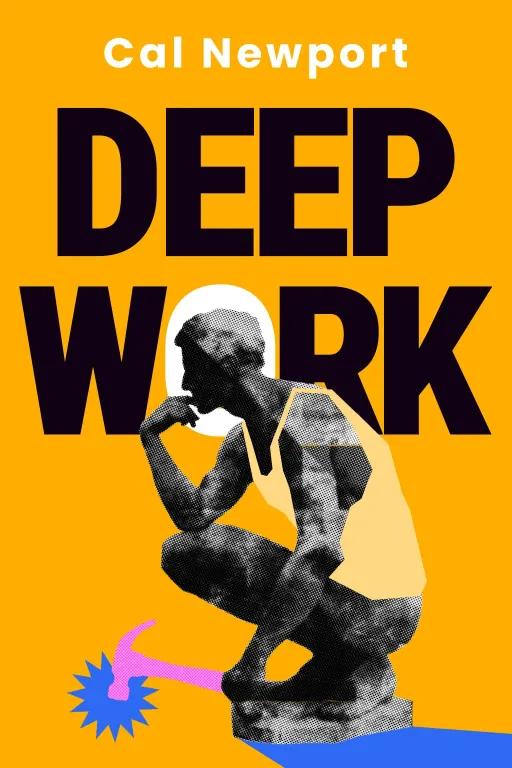
Nova: Imagine you are on a mission to change the world. You are designing health initiatives, planning educational programs, and fighting for gender equality. But every thirty seconds, your phone pings. An email slides into your inbox. A group chat lights up. How can we solve the most complex human challenges of our time when our attention is constantly being sliced into tiny, superficial fragments? Welcome to another episode of our show. Today, we are diving into Cal Newport's groundbreaking book, Deep Work: Rules for Focused Success in a Distracted World. And we have a truly incredible guest with us to unpack this. Theresa Ayeshung is an anatomist, a project manager, and the founder and executive director of the ComfortHer Foundation, a wonderful non-profit dedicated to empowering young people. Theresa, it is so wonderful to have you here.
Theresa Ayeshung: Thank you, Nova. It is an absolute pleasure to be here. You know, when I first read Newport's definition of deep work, it immediately resonated with me. In the non-profit space, we are constantly driven by a deep passion to create sustainable impact. But passion alone isn't enough. We need serious cognitive bandwidth to design effective programs, write grants, and analyze health data. Yet, we are often drowning in what Newport calls shallow work, like endless emails, coordination meetings, and social media updates. It is a constant tug-of-war between our desire to make a deep impact and the shallow distractions of daily operations.
Nova: Oh, absolutely. We all feel that tug-of-war, don't we? It's like trying to swim upstream in a river of notifications. Today, we are going to tackle this book from two key angles. First, we'll explore the deep cognitive and economic value of focus, looking at how our brains actually build capacity when we eliminate distractions. And second, we'll discuss practical, actionable rules to architect a deep life, including how to set firm boundaries and manage that overwhelming administrative drag. So, Theresa, let's start with the science and the core idea. Newport defines deep work as professional activities performed in a state of distraction-free concentration that push our cognitive capabilities to their limit. As an anatomist, how does that definition strike you?
Theresa Ayeshung: It strikes me as incredibly accurate from a neurological standpoint. When we perform deep work, we aren't just getting things done; we are actually training our brains. Newport points to neuroscience research suggesting that intense, focused attention on a specific task triggers a process called myelination. Myelin is a fatty tissue that wraps around our nerve fibers, acting like electrical insulation. When we focus intensely on a single skill or problem, we repeatedly fire specific neural circuits. This signals the brain to strengthen those pathways with more myelin, allowing the electrical signals to travel faster and more efficiently. So, when we allow ourselves to be constantly distracted, we are essentially preventing our brains from building those high-speed neural highways. We are keeping our cognitive networks slow and fragmented.
Nova: Wow, that is a beautiful way to put it. High-speed neural highways versus slow, fragmented country roads. I love that. And it really highlights why deep work is becoming a superpower in our modern economy. Newport actually introduces what he calls the Deep Work Hypothesis. He argues that the ability to perform deep work is becoming increasingly rare at the exact same time it is becoming increasingly valuable. Those who cultivate this skill will thrive, while those who don't might find themselves left behind.
Theresa Ayeshung: Exactly. And as an INFJ, or what we call the Advocate personality type, I tend to look at this through the lens of long-term vision and systemic change. In the social impact sector, we are trying to solve deep, systemic issues like educational inequality and gender disparities. These aren't problems you can solve with quick, shallow tasks. They require deep, analytical thinking, creative synthesis, and long-term planning. If we, as leaders and advocates, lose our capacity for deep concentration, we lose our ability to create truly transformative solutions. We end up just reacting to immediate crises rather than building sustainable systems.
Deep Dive into Core Topic 1
SECTION
Nova: That is such a profound point, Theresa. We can't solve deep problems with shallow thinking. To illustrate this, Newport shares some fascinating historical stories. One of my favorites is about the famous psychiatrist Carl Jung. Back in the early 1920s, Jung was at a critical turning point in his career. He had recently broken away from his mentor, Sigmund Freud, and needed to develop his own groundbreaking theories on analytical psychology. But his life in Zurich was incredibly busy. He had a thriving clinical practice, patients relying on him, and a bustling social life. He realized he couldn't do the deep thinking he needed in that environment. So, what did he do? He retreated to a small village called Bollingen, near Lake Zurich, and built a simple, two-story stone house he called the Tower. It had no electricity, no running water, and he kept the key with him at all times. He would go there for days at a time to write, meditate, and walk in the woods. That isolated, distraction-free environment was where he produced the work that made him one of the most influential thinkers of the twentieth century.
Theresa Ayeshung: I love that story of Jung's Bollingen Tower. It shows that even a century ago, brilliant minds recognized that deep thinking requires a dedicated physical and mental sanctuary. In our work at the ComfortHer Foundation, we obviously can't all go build stone towers in the woods, as lovely as that sounds. But the principle remains the same. We have to create our own version of the Tower. Whether that is a dedicated quiet hour in the office, a physical space where devices are banned, or simply blocking out a morning on our calendars where we are completely offline. It is about intentionally designing an environment that signals to our brain: now is the time to go deep.
Nova: Yes, we need to build our own digital towers. And you know, Newport contrasts Jung's approach with a major modern challenge: the rise of open offices and instant messaging tools. He mentions companies like Facebook building massive ten-acre open floor plans to encourage serendipitous collaboration. But the research shows a dark side to this constant connectivity. Newport points to a study by business professor Sophie Leroy on a concept called attention residue. Theresa, this is a game-changer. Leroy found that when you switch from Task A to Task B, your attention doesn't immediately follow. A residue of your cognitive focus remains stuck thinking about the first task. So, if you are working on a complex project proposal, and you quickly check your email or answer a Slack message, you aren't just losing the thirty seconds it took to read that message. You are carrying a cognitive drag, a residue, back to your proposal, which severely diminishes your performance.
Theresa Ayeshung: That concept of attention residue is so eye-opening, Nova. It explains why we can spend a whole day sitting at our desks, constantly busy, and yet feel completely exhausted and unproductive at the end of it. We think we are multitasking, but we are actually just subjecting our brains to constant cognitive whiplash. In project management, this is incredibly dangerous. If I am switching between reviewing budget spreadsheets, responding to volunteer inquiries, and posting on social media, my brain is constantly operating in a state of semi-distraction. I am never giving my full cognitive capacity to any of those tasks. For a non-profit, that means we might make critical errors in our data, write less compelling grant proposals, or miss key strategic opportunities.
Nova: It really is a silent productivity killer. And Newport backs this up with some staggering data. He references a McKinsey study showing that the average knowledge worker spends more than sixty percent of their workweek engaged in electronic communication and internet searching. In fact, close to thirty percent of their time is dedicated to reading and answering emails alone. Think about that. Nearly a third of our working lives is spent just managing our inboxes. That is a massive amount of human potential being funneled into shallow logistics rather than deep, creative work.
Theresa Ayeshung: It is heartbreaking, honestly. Especially when you think about the social sector, where resources are already so tight. If our team members are spending thirty percent of their time on email coordination, that is thirty percent less time they are spending directly mentoring youth, developing health curricula, or advocating for policy changes. It shows that managing our attention isn't just a personal productivity hack; it is an organizational and ethical responsibility. We have to find ways to drain the shallows so we can focus on what truly matters.
Deep Dive into Core Topic 2
SECTION
Nova: Exactly. It's about aligning our daily actions with our deepest values. And that naturally leads us to the second key area we need to talk about: the practical rules to actually make this happen. Newport doesn't just leave us with the theory; he gives us a concrete roadmap. One of the most powerful concepts he introduces is fixed-schedule productivity. This is the idea of setting a firm, non-negotiable limit on your work hours, say, finishing every day by five-thirty PM, and then working backward to ruthlessly prioritize and optimize your tasks to fit within that boundary.
Theresa Ayeshung: I find that strategy incredibly empowering. Newport shares the story of Radhika Nagpal, a computer science professor at Harvard. Now, academia is notorious for its grueling, seventy-hour workweeks, especially for junior faculty trying to earn tenure. But Nagpal decided to reject that conventional wisdom. She set a strict limit of fifty hours a week for work, determined to preserve her personal happiness and family time. She worked backward from that constraint, setting drastic quotas on shallow tasks. She limited her travel, capped the number of papers she would review, and focused intensely on her core research during her working hours. And the result? She earned tenure on schedule and became a full professor, producing world-class research while maintaining a healthy, balanced life.
Nova: That is such an inspiring story. It completely busts the myth that we have to burn ourselves out to be successful. By putting a hard cap on our time, we force ourselves to say no to the trivial and yes to the wildly important. It's like a positive constraint that breeds creativity and efficiency. But Theresa, how do we handle the inevitable pushback? In your role as a founder and project manager, you have so many stakeholders, from donors to community members. How do we protect our time without seeming unresponsive or uncaring?
Theresa Ayeshung: It requires a shift in how we communicate. Newport suggests several strategies to become hard to reach, and they are highly practical. One is implementing a sender filter on our email. This means setting clear expectations on our contact pages, letting people know what kinds of messages we will respond to and when. For example, on our foundation's website, we can clearly state our response times or provide FAQs so people can find answers without needing to email us directly. Another strategy is adopting a process-centric approach to email. Instead of sending quick, open-ended messages like, "Let's meet to discuss this," which trigger a chain of five more emails just to schedule a time, we should write emails that outline a complete process. We can say, "Here is the proposal. Let's meet on Tuesday at ten AM or Thursday at two PM. If those times work, please send a calendar invite. If not, please suggest two alternatives, and I will confirm." It closes the loop and prevents that constant back-and-forth.
Nova: Oh, process-centric emails are a lifesaver. They take a little more effort to write initially, but they save so much cognitive energy in the long run. They prevent those open loops that cause attention residue. And Newport also talks about the importance of a strict shutdown ritual at the end of the workday. He suggests taking ten or fifteen minutes to review your task list, make a plan for any incomplete items, and then literally say a phrase like, "Shutdown complete," to signal to your brain that work is over. This helps overcome the Zeigarnik effect, which is our brain's natural tendency to keep worrying about unfinished tasks.
Theresa Ayeshung: Yes, the Zeigarnik effect is so powerful. Our brains hate open loops. If we don't consciously close them with a plan, they will keep spinning in the background of our minds all evening, ruining our rest. As an advocate, I know how easy it is to carry the weight of our mission home with us. We worry about the youth we are serving, the funding we need, the programs we are running. But a shutdown ritual allows us to step away completely, recharge our mental batteries, and return the next day with fresh energy and focus. It is about recognizing that rest is not a luxury; it is a prerequisite for deep, high-quality work.
Nova: It really is. Newport actually has a section called "Be Lazy," where he argues that regular, substantial freedom from professional concerns is essential for cognitive restoration. He points to Attention Restoration Theory, which shows that our capacity for directed attention is a finite resource. Just like a muscle, it gets fatigued with use. Spending time in nature, engaging in unstructured leisure, or simply letting our minds wander is how we replenish that resource. So, taking a break isn't wasting time; it's actively restoring our ability to focus.
Theresa Ayeshung: That is a beautiful perspective. It reminds me of my training in anatomy. Every muscle in the human body requires a phase of relaxation to function optimally. If you keep a muscle constantly contracted, it eventually spasms and fails. Our brains are no different. We need that cognitive relaxation to perform at our best.
Synthesis & Takeaways
SECTION
Nova: That is a perfect anatomical metaphor, Theresa. Constant contraction leads to spasms and failure. We need that release. As we start to wrap up our conversation today, let's synthesize some of these key takeaways. We've talked about how deep work is a rare and valuable skill that actually rewires our brains through myelination. We've explored the dangers of attention residue and constant task-switching. And we've discussed practical rules like fixed-schedule productivity, process-centric communication, and the shutdown ritual. If you had to leave our listeners, especially those working in social impact, education, or non-profits, with one key piece of advice from this book, what would it be?
Theresa Ayeshung: I would encourage them to embrace the idea that a deep life is a good life. It is easy to get caught up in the culture of busy-ness, to feel like we have to be constantly connected, constantly responding, and constantly visible to prove our value. But true, sustainable impact is built in the deep spaces. By protecting our attention, by setting firm boundaries, and by dedicating ourselves to focused, high-value work, we aren't just becoming more productive. We are honoring our mission, respecting our cognitive health, and building a more purposeful, fulfilling life. I would challenge everyone listening to start small. Pick one hour tomorrow, turn off your notifications, close your browser tabs, and dedicate that hour to one wildly important task. See how it feels to give your full, undivided mind to your work.
Nova: That is a beautiful and powerful challenge, Theresa. Start with just one hour. Build that mental sanctuary. Thank you so much for joining us today and sharing your incredible insights. Your perspective as an anatomist and a non-profit leader has brought so much depth to this conversation.
Theresa Ayeshung: Thank you, Nova. It has been an absolute joy. Here's to living a more focused and impactful life.
Nova: And to all our listeners out there, thank you for tuning in. Remember, in a world full of noise, your focus is your greatest asset. Protect it, cultivate it, and use it to build something beautiful. Until next time, keep shining, keep focusing, and take care of yourselves.