** The Architect of Focus: An Entrepreneur's Blueprint for Deep Work
Golden Hook & Introduction
SECTION
Socrates: jayy-marie, as an entrepreneur, you know the feeling. Your to-do list is a mile long, you're answering emails at midnight, you're constantly. But at the end of the week, do you ever look back and wonder, 'What did I actually?' What if that feeling of being busy is actually the biggest threat to your success?
jayy-marie: That question hits hard. It's the central paradox of being an entrepreneur, isn't it? You're wearing all the hats, putting out fires, and the motion feels like progress. But motion isn't always forward momentum. It's a trap I think we all fall into.
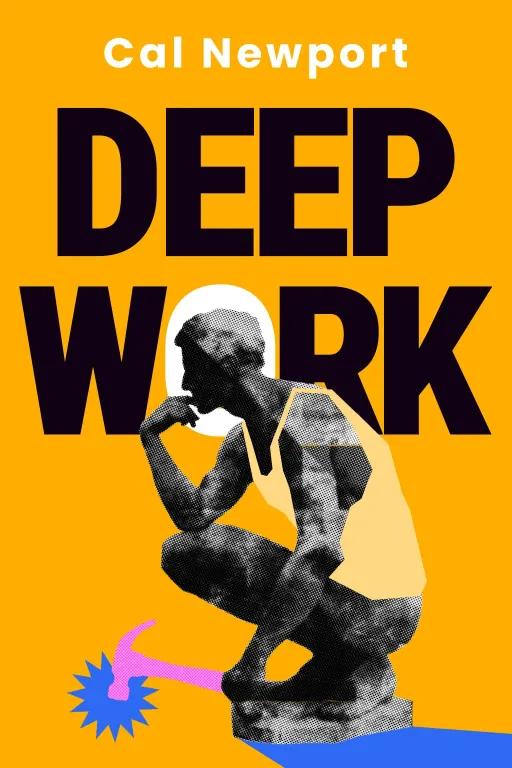
Socrates: It's a trap. And that's the core question in Cal Newport's game-changing book, 'Deep Work.' He argues that our entire professional world is conspiring to keep us in that state of reactive motion. So today, we're going to unpack his blueprint for professional reinvention from three angles. First, we'll diagnose the modern epidemic of 'shallow work' and why being busy feels productive but often isn't.
jayy-marie: The diagnosis is the first step. You can't fix a problem you don't understand.
Socrates: Exactly. Then, we'll explore a powerful new philosophy for deciding what's truly worth your time—a way to filter out the noise. And finally, we'll unpack a 4-step execution plan to make deep work a reality in your own life. This isn't just theory; it's a system. Ready to build a new blueprint?
jayy-marie: Let's do it. I'm ready to move from just being busy to actually building.
Deep Dive into Core Topic 1: The Productivity Mirage
SECTION
Socrates: Perfect. So let's start with that diagnosis. Newport draws a sharp line in the sand between two types of work. On one side, he has 'Deep Work.' This is when you're in a state of distraction-free concentration, pushing your cognitive limits. It's what creates new value, improves your skills, and produces things that are hard to replicate.
jayy-marie: That’s the work that actually grows a business. Developing a new marketing strategy, writing compelling copy, analyzing complex customer data. The stuff that requires you to shut the door and think.
Socrates: Precisely. But then there's the other side: 'Shallow Work.' These are the non-cognitively demanding, logistical tasks. Think answering most emails, posting on social media, sitting in on status meetings. They're often done while distracted, they don't create much new value, and anyone can be trained to do them quickly.
jayy-marie: The administrative quicksand. It feels urgent, but it's rarely important.
Socrates: And here's the terrifying part. A McKinsey study found that the average knowledge worker spends over 60 percent of their week on electronic communication and internet searching. Nearly 30 percent of their time is just on email. That's the reality for most of us. We are drowning in the shallows. Newport tells this incredible story about a guy named Jason Benn. He was a financial consultant whose job was so shallow, he realized he could write a simple script to automate his entire role.
jayy-marie: Wow. That's a brutal moment of self-awareness. To realize a machine could do your job better than you.
Socrates: It was his wake-up call. He quit, moved back home, and decided to reinvent himself as a computer programmer. But he struggled. He was so used to distraction he couldn't focus. So, he took a drastic step. He locked himself in a room with nothing but textbooks and notecards. No phone, no computer, no internet. For two months, he forced himself into a state of deep work. He then went to a coding bootcamp and, because he had trained his focus, he flew past his peers. He landed a high-paying developer job at a startup, completely transforming his career and income.
jayy-marie: That story is powerful because it's not just about learning a skill; it's about learning how to. He had to un-wire his brain from distraction first. In marketing, this is a constant battle. The industry glorifies shallowness. It's all about being 'on'—responding to comments in real-time, jumping on the latest trend, being visible. These are all vanity metrics. They feel like work, you can point to the activity, but they rarely connect to the things that matter, like revenue or customer loyalty. That's the productivity mirage.
Socrates: The productivity mirage. I love that term. You're generating a lot of heat and light, but no real power. You're mistaking busyness for business.
jayy-marie: Exactly. And as an entrepreneur, if you're stuck in that mirage, you're not building a business. You're just maintaining a hamster wheel.
Deep Dive into Core Topic 2: The Craftsman's Filter
SECTION
Socrates: So if we're all stuck on this hamster wheel, how do we get off? Newport argues we fall into it because we use the wrong filter for what we allow into our day. He calls it the 'any-benefit' mindset. You know, 'I should be on this social media platform because I get a client,' or 'I should check my email constantly because something be urgent.'
jayy-marie: It's a mindset driven by FOMO—fear of missing out. It justifies any activity as long as there's a sliver of potential upside, completely ignoring the massive downside of fractured attention.
Socrates: Exactly. So he proposes a much more rigorous, more powerful alternative: the craftsman's approach to tool selection. And the story he uses to illustrate this is just brilliant. It's about a farmer named Forrest Pritchard. He runs a successful, modern farm, and he had to decide whether to own a hay baler. The 'any-benefit' logic says, 'Of course! You have a farm, you need hay, a baler makes hay. It's a useful tool.'
jayy-marie: Seems logical on the surface.
Socrates: But Pritchard was a craftsman. He didn't ask if the tool was useful; he asked if it was for his most important goal. And his most important goal wasn't making hay—it was the long-term health of his soil. So he did a deep analysis. He calculated the cost of the baler, the fuel, the maintenance, the repairs. But most importantly, he calculated the. The hours he'd spend baling hay were hours he couldn't spend on more profitable activities, like managing his livestock or selling at farmers' markets.
jayy-marie: And the soil health?
Socrates: That was the kicker. He realized that when he hay from other farms, he was importing their nutrients onto his land in the form of manure from his animals. Buying hay actually made his soil healthier. So, he sold the hay baler. He rejected a perfectly good tool because it didn't serve his primary objective.
jayy-marie: That is a perfect business analogy. As an entrepreneur, you have to be that ruthless. The 'hay baler' for a marketing entrepreneur could be a specific social media platform. The 'any-benefit' argument is, 'We might get followers.' But the craftsman approach forces you to ask, 'What is the true cost of my time and attention on this platform versus its actual, measurable impact on my primary goal?' You have to define your 'soil health.' For me, that might be qualified lead generation or customer lifetime value.
Socrates: So what's a 'hay baler' you've seen in the marketing world? A tool that seems useful but ultimately distracts from the 'soil health'?
jayy-marie: Oh, easily. For many small businesses, it's trying to be on every single social media platform. TikTok, Instagram, Facebook, X, LinkedIn... The 'any-benefit' logic is that you should be everywhere your customers are. But the craftsman approach reveals that the time and creative energy it takes to produce mediocre content for five platforms is a massive opportunity cost. You'd be far better off creating outstanding, high-value content for the one platform where your ideal customers engage and convert. It's about choosing to be a master of one, not a jack-of-all-trades.
Deep Dive into Core Topic 3: The Execution Engine
SECTION
Socrates: I love that framing—defining your 'soil health.' But once you've made those tough philosophical choices, once you've decided to sell the hay baler, how do you execute on that new focus? This is where Newport's advice gets incredibly practical. He borrows a framework from the business world called The 4 Disciplines of Execution, or 4DX.
jayy-marie: A system. This is what an analytical mind craves. An idea is great, but a system is what makes it real.
Socrates: Precisely. And it's beautifully simple. We'll just focus on the first two disciplines. Discipline 1 is: Focus on the Wildly Important. This means identifying a small number of truly game-changing goals. Not ten, not five. One or two. The things that, if you achieve them, everything else gets easier.
jayy-marie: It cuts through the clutter. It forces you to say no to good ideas to make room for the great ones.
Socrates: Then comes Discipline 2: Act on the Lead Measures. Newport makes a critical distinction here. Most of us focus on 'lag measures'—the results we want, like 'increase revenue by 20%.' The problem is, you can't directly control revenue. It behind your actions. A 'lead measure,' on the other hand, is something you control that has a predictive impact on your goal.
jayy-marie: So it's the input you control, not the output you hope for.
Socrates: You got it. And Newport gives his own experience as the case study. One academic year, his Wildly Important Goal, his WIG, was to publish five peer-reviewed papers. The lag measure was the number of accepted papers. But his was simple: the number of hours spent in a state of deep work on his research. He put a scoreboard on his wall and tracked the hours every week. He knew if he hit his deep work hours, the papers would follow.
jayy-marie: And what happened?
Socrates: He didn't publish five papers. He published. He more than doubled his previous average. The system worked because it focused his energy on the one activity that produced the most value.
jayy-marie: This is brilliant because it gamifies focus. As a solo entrepreneur, you don't have a boss setting goals. So you have to create your own game. A WIG could be 'Launch a new flagship service by Q3.' The lag measure is the revenue from that service. But the measure, the thing I can control every single day, is 'spend 10 hours a week in deep work developing the service and its marketing plan.' That's a system you can actually build a habit around. It's not about willpower; it's about process.
Synthesis & Takeaways
SECTION
Socrates: Exactly. It's about process, not just good intentions. And that's the journey Newport takes us on. So, to bring it all together, we've gone from diagnosing the 'productivity mirage' of shallow work, to adopting a 'craftsman's filter' to choose our tools and tasks, and finally to installing an 'execution engine' with 4DX to make it all happen. It's a complete blueprint for reinvention.
jayy-marie: It really is. It's about moving from being a frantic operator, pulled in a million directions, to being a calm, focused architect of your work and your life. You're not just reacting to the day; you're designing it with intention.
Socrates: A perfect summary. So, as we close, what's the one thought you'd want to leave our listeners with?
jayy-marie: For anyone listening, especially if you're building something of your own, the challenge isn't just to work hard. It's to work deep. So my question to you is this: What is the one 'wildly important goal' you have for the next 90 days? And what is the one lead measure—the specific, trackable deep work—that will get you there? Forget everything else. Start there. That's how you begin to build.