The 90-Day Deep Work Sprint: A Business Analyst's Guide to Career and Personal Mastery
Golden Hook & Introduction
SECTION
Nova: Imagine you have a week to deliver a game-changing strategic analysis. But your calendar is a battlefield of back-to-back meetings, and your inbox is a constant flood of 'urgent' requests. By Friday, you've been incredibly, but have you produced real? This tension between being busy and being effective is at the heart of our conversation today.
Kehinde Olayiwola: That hits so close to home, Nova. It's the daily reality for so many of us, especially in the tech world. You're swimming in tasks, but you're not sure if you're actually moving forward.
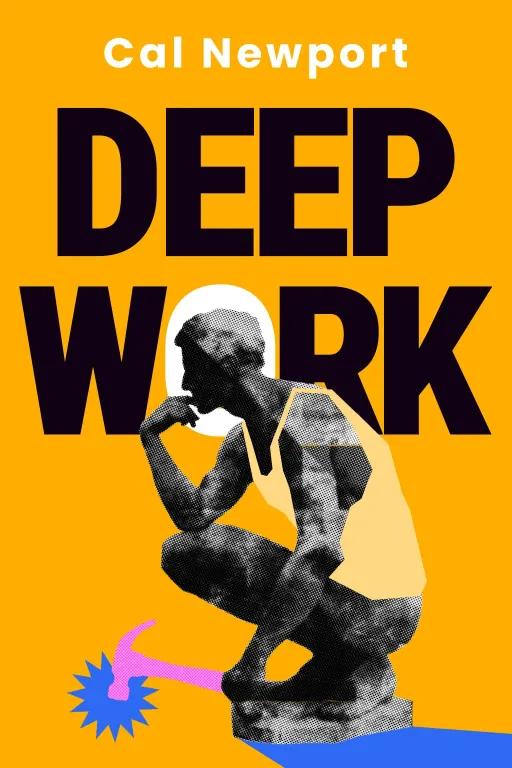
Nova: Exactly! And that's why I'm so excited to have you here, Kehinde. As a Business Analyst who's passionate about growth, you've set this incredible goal for yourself: a 90-day sprint to level up your spiritual discipline, career, and communication skills. Today, we're diving into Cal Newport's "Deep Work" to build a 90-day action plan for that exact journey. We'll tackle this from three angles. First, we'll uncover why deep work is the superpower you need for career growth. Then, we'll design a daily ritual to make it a habit. And finally, we'll get tactical on how to drain the shallows and reclaim your focus. Ready to dive in?
Kehinde Olayiwola: Absolutely. I'm ready to find the signal in the noise.
Deep Dive into Core Topic 1: The Deep Work Hypothesis: Your Undervalued Superpower
SECTION
Nova: Fantastic. So, let's start with that tension we talked about—busy versus productive. In the tech world, what does that look like for you?
Kehinde Olayiwola: It's a constant juggle. There's the pressure to be responsive on Slack, to be in every planning meeting, to keep Jira boards updated. All of that feels like work. It feels productive. But at the end of the day, I know my real value as a Business Analyst comes from synthesizing complex information and delivering a strategic insight that no one else saw. And that kind of thinking... it just can't happen in five-minute gaps between meetings.
Nova: You've just perfectly described the core idea of this book. Newport splits the world into two types of work. First, there's 'Shallow Work.' These are the non-cognitively demanding, logistical tasks, often done while distracted. Think answering most emails, attending status update meetings, and yes, updating that Jira board. They're easy to replicate and don't create much new value.
Kehinde Olayiwola: That's 100% the stuff that fills the calendar.
Nova: Right? But then there's 'Deep Work.' Newport defines this as professional activities performed in a state of distraction-free concentration that push your cognitive capabilities to their limit. This is what creates new value, improves your skills, and is hard to replicate. It's the work that gets you promoted. And Newport's big argument, the Deep Work Hypothesis, is that this skill is becoming both increasingly rare and increasingly valuable.
Kehinde Olayiwola: So as more people get pulled into the vortex of shallow work, the few who can resist it and go deep have a massive advantage.
Nova: A massive advantage. There's this incredible story in the book about a guy named Jason Benn. He was a financial consultant who realized his job was so simple it could be automated with an Excel script. It was a classic shallow work job. He felt unfulfilled and knew he had to make a change. So he quit, moved back home, and decided to become a computer programmer.
Kehinde Olayiwola: That's a huge leap. I know many people in tech who've made similar career pivots. It's not easy.
Nova: Not at all. And at first, he really struggled. He tried to study but was constantly distracted by the internet, by his phone. So he did something radical. He locked himself in a room with nothing but textbooks and notecards. No phone, no computer, no internet. Just pure, undistracted focus. He did this intensely for two months before attending a coding bootcamp.
Kehinde Olayiwola: Wow. He created his own monastery of learning.
Nova: He did! And the result? He crushed it. He excelled at the bootcamp because he had trained his brain to concentrate so intensely. He landed a high-paying developer job at a tech start-up, completely transforming his career and income. He became a true believer in deep work because he lived its power.
Kehinde Olayiwola: That's a powerful story. It really illustrates the difference between passively consuming information and actively, deeply learning a new skill. But it also sounds so extreme. How does this apply when your job, especially in an agile tech environment, collaboration and you can't just lock yourself in a room for two months?
Deep Dive into Core Topic 2: Choosing Your Depth Philosophy: The 'How' Behind the 'What'
SECTION
Nova: That's the perfect question, Kehinde, because Newport argues it's not about becoming a hermit. It's about choosing a philosophy that fits your life. This is where we get into the 'how,' and it's crucial for your 90-day plan. He outlines four main philosophies. There's the 'Monastic' approach, like Jason Benn or a novelist who avoids all distraction. Probably not for us.
Kehinde Olayiwola: Definitely not for a Business Analyst.
Nova: Then there's 'Bimodal,' where you might take a few days or a week for a deep dive, like Bill Gates's famous "Think Weeks." Also great, but can be hard to schedule. And the 'Journalistic' approach, for people who can drop into deep work on a moment's notice, which Newport says is very difficult to master. But the one I think is most powerful for most of us is the 'Rhythmic' philosophy.
Kehinde Olayiwola: Rhythmic. Tell me more.
Nova: The Rhythmic approach is about making deep work a simple, regular habit. The goal is to remove the friction of deciding to do it. You just do it. The book tells the story of Brian Chappell, a doctoral candidate who was also working a full-time job and had a young family. He was completely overwhelmed.
Kehinde Olayiwola: Sounds familiar.
Nova: He decided the only way to finish his dissertation was to build a rhythm. So, every single weekday morning, he would wake up and work from 5:00 AM to 7:30 AM. No exceptions. That was his protected, deep work time. The chain of red X's on his calendar became a source of motivation. He wasn't relying on inspiration or waiting for a free moment to appear. He created it, consistently.
Kehinde Olayiwola: I love that. It connects so well with the idea of 'Spiritual Discipline' in my 90-day plan. It reframes discipline not as a chore, but as the act of creating a sacred space for what's most important. It's like setting an appointment with your own growth, and it feels much more sustainable than just relying on willpower, which we all know is finite.
Nova: That's beautifully put. An appointment with your own growth. And by making it a rhythm, a ritual, you conserve that precious willpower for the work itself, not for the fight to start the work. For your 90-day sprint, what could a rhythmic practice look like?
Kehinde Olayiwola: It could be the first 90 minutes of every workday. Before opening Slack, before checking email. That time is dedicated solely to the most important strategic task of the day. Or, like Chappell, it could be an hour before anyone else in the house is awake, focused on upskilling or a personal development goal. The consistency is the key.
Deep Dive into Core Topic 3: Draining the Shallows: Reclaiming Your Time and Attention
SECTION
Nova: Exactly! And once you've created that sacred space, the next step is to defend it. This brings us to Newport's most aggressive rule: Drain the Shallows. This is about systematically reducing the amount of shallow work in your life to make more room for the deep.
Kehinde Olayiwola: This is the part I'm most curious about. It feels like the shallows are constantly trying to invade.
Nova: They are! And one of the most powerful strategies Newport offers is 'Fixed-Schedule Productivity.' He tells the story of Radhika Nagpal, a professor at Harvard. In academia, there's this intense "hustle culture" where working nights and weekends is seen as a badge of honor.
Kehinde Olayiwola: Sounds a lot like the tech industry.
Nova: Precisely. But Nagpal decided that was a recipe for burnout. She made a radical commitment: she would not work past 5:30 PM. Ever. This constraint forced her to be absolutely ruthless about her time. She asked herself, "What is the highest-value use of my time right now?" She cut down on travel, said no to low-impact committees, and became incredibly efficient. The result? She earned tenure ahead of schedule and became a star in her field, all while preserving her evenings and weekends.
Kehinde Olayiwola: That's incredible. The constraint actually created more productivity, not less. It forced her to drain the shallows.
Nova: It's a total mindset shift. And a very practical tool for this is how you handle communication, especially email. Newport suggests a 'process-centric' approach. Instead of an email that just says, "Thoughts on this?", which creates an endless back-and-forth, you take a moment to think about the entire process.
Kehinde Olayiwola: So instead of just passing the ball, you're defining the entire game.
Nova: Perfect analogy! Your reply should be, "This is an interesting idea. Here's the next step: I will draft a one-page proposal by Wednesday. Then, let's you and I meet for 30 minutes on Thursday to review it and decide on a final plan. Here's a link to my calendar." You've just replaced a dozen potential emails with one.
Kehinde Olayiwola: This is brilliant. From a communication skills perspective, it's a game-changer. It's clear, it's action-oriented, and it respects everyone's time. It turns communication from a reactive chore into a proactive project management tool. You're not just answering a question; you're closing a loop and freeing up your mental RAM.
Nova: You're closing the loop! That's the goal. You're taking control of the shallow work so it doesn't control you.
Synthesis & Takeaways
SECTION
Nova: So, as we wrap up, let's bring it all together for this 90-day sprint. It feels like a clear, three-step plan. First, we have to truly believe in the Deep Work Hypothesis—that this skill is our career superpower.
Kehinde Olayiwola: Absolutely. You have to buy into the 'why' before you can commit to the 'how'.
Nova: Second, we build a 'Rhythmic' ritual. We create that sacred, consistent space for deep work, making it an appointment with our own growth.
Kehinde Olayiwola: And that addresses the discipline piece. It's about building a sustainable system, not just trying harder.
Nova: And finally, we defend that time by draining the shallows. We use strategies like fixed-schedule productivity and process-centric communication to take back control.
Kehinde Olayiwola: Which directly hones our communication and leadership skills by making us more intentional and effective. It all ties together.
Nova: It really does. So, as a final thought for our listeners, what's one piece of advice you'd give to someone inspired to start their own deep work journey today?
Kehinde Olayiwola: I think for anyone on a similar journey, maybe the first step isn't to add more to your plate. It's to ask: What's one shallow task—one recurring meeting I can decline, one type of email I can batch—that I can drain from my schedule tomorrow to make space for what truly matters? Start by subtracting, not adding. That's where the real power begins.