Focus & Flow: Building a Deep Work Habit for Career and Grad School
Golden Hook & Introduction
SECTION
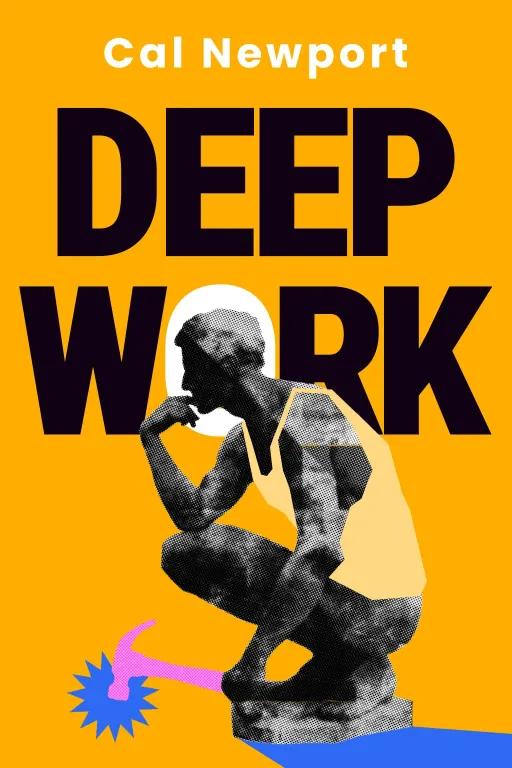
Nova: Have you ever finished a long, frantic day at work, looked back, and wondered... 'What did I accomplish?' You answered a hundred emails, you ran between meetings, you put out fires... but did you move the needle on the things that truly matter for your career or your big goals? It's a feeling so many of us have, especially when we're trying to build something meaningful. In his groundbreaking book 'Deep Work,' Cal Newport argues this isn't a personal failing; it's a systemic problem. He calls it the battle between 'deep work' and 'shallow work'.
İrem Tapcı: That feeling is so familiar. It's the modern condition, I think. You feel productive because you're busy, but are you really making progress?
Nova: Exactly. And that's why I'm so excited to have you here today, İrem. As someone at the start of a demanding career in healthcare and with ambitions for a master's degree, you're living right at the center of this challenge.
İrem Tapcı: I'm ready to find some solutions. I'm tired of feeling like my attention is a pinball in a machine.
Nova: Well, you've come to the right place. Today, we're going to turn Newport's ideas into an actionable blueprint. We'll dive deep into this from two main perspectives. First, we'll explore the crucial difference between 'deep' and 'shallow' work and why it's the secret currency of the modern economy. Then, we'll get intensely practical and discuss how to build a personalized system to make deep work a consistent, automatic part of your life. Ready to get started?
İrem Tapcı: Let's do it.
Deep Dive into Core Topic 1: The Great Divide: Recognizing Deep vs. Shallow Work
SECTION
Nova: So İrem, let's start there. Newport gives us these two powerful definitions. 'Deep Work' is when you're in a state of distraction-free concentration, pushing your cognitive limits. Think of a surgeon in a complex operation or a researcher having a breakthrough. And then there's 'Shallow Work'—the non-demanding, logistical stuff, often done while distracted, like answering most emails. How does that distinction land with you, thinking about your world in healthcare?
İrem Tapcı: It lands perfectly. It gives a name to something I feel every day. There's so much shallow work in healthcare—endless charting, responding to non-urgent pages, coordinating schedules. It feels important in the moment, but it's not the work that helps a patient get better or helps me grow as a professional. The deep work is when I have a quiet moment to really analyze a patient's chart to see a pattern, or when I'm learning a complex new diagnostic protocol. That's the stuff that requires my full brain, and it's also the most satisfying.
Nova: And it's getting harder and harder to find time for that, right? Newport points to a McKinsey study that found the average knowledge worker spends over 60 percent of their week on electronic communication and internet searching. Sixty percent! That's a tidal wave of shallowness.
İrem Tapcı: That number is staggering, but honestly, not surprising. It feels like that. You're constantly context-switching, and your brain never gets a chance to settle into that deeper gear.
Nova: It reminds me of this incredible story Newport tells about a financial consultant named Jason Benn. He was stuck in a dead-end job that was easily automated, filled with those shallow tasks we're talking about. He realized his only way out was to learn a hard, valuable skill: computer programming. But he was so wired for distraction from his job that he just couldn't focus.
İrem Tapcı: I can imagine. It's like his focus muscle had atrophied.
Nova: Totally. So he took this radical step. He quit his job, moved back home with his parents, and locked himself in a room with just textbooks and notecards. No phone, no internet, no distractions. For two months, he forced his brain to do nothing but deep, focused learning. He was essentially putting his brain through a deep work bootcamp.
İrem Tapcı: Wow, that's an extreme measure. But I get why he did it. He was trying to fundamentally rewire his brain.
Nova: And it worked! He went to a top coding bootcamp and, because he had trained his ability to concentrate so intensely, he flew past his peers. He landed a high-paying developer job at a tech start-up and completely changed his life's trajectory. He didn't just get a new job; he built a new capacity for learning and creating value.
İrem Tapcı: That's so powerful. It's not just about being more productive in your current job, it's about building the capacity to make a leap, like he did. For me, that leap is a master's degree. I can't just 'fit in' studying for the GREs or researching programs between notifications and emails. I need to create that same kind of focused, sacred space, even if it's just for an hour a day. Jason Benn's story shows that the ability to do that is the real asset.
Nova: That's the core of the Deep Work Hypothesis: the ability to focus is becoming rarer at the exact same time it's becoming more valuable. So if you can cultivate it, you have a massive advantage.
İrem Tapcı: It's like a superpower.
Deep Dive into Core Topic 2: From Intention to Action: Building Your Personal Deep Work System
SECTION
Nova: Exactly! And that brings us to the most important part of Newport's argument, and the second big idea for today. Knowing deep work is valuable is the easy part. The hard part is to actually do it in the real world.
İrem Tapcı: Right. Good intentions aren't a strategy. I've tried the 'I'll just be more focused today' approach. It lasts about ten minutes.
Nova: You and everyone else! Newport says our willpower is like a muscle that gets tired. If you rely on it to fight distraction all day, it'll be exhausted by 10 AM. So, just 'trying to focus' is a losing game. We don't need more willpower; we need a better system. He lays out a few 'philosophies' for this, which are like operating models for your life.
İrem Tapcı: I like that—an operating model. It feels very analytical and systems-driven, which is what I'm aiming for.
Nova: Perfect. So, there's the philosophy, where you basically become a hermit like a reclusive novelist. Not very practical for most of us, especially in healthcare. But then there are two that I think are really relevant for you. The first is the philosophy.
İrem Tapcı: Rhythmic. Tell me more.
Nova: Newport tells the story of Brian Chappell, a doctoral candidate who was also working a demanding full-time job and had a young family. He was completely overwhelmed. His solution was to create a simple, unbreakable rhythm. He decided he would work on his dissertation from 5:00 AM to 7:30 AM every single weekday morning. No exceptions.
İrem Tapcı: So he didn't have to decide each day. The decision was already made.
Nova: Precisely! The habit did the heavy lifting, not his willpower. He removed the friction of starting. That consistent, rhythmic effort is what allowed him to finish a massive project on top of an already full life. As an INFJ, you probably appreciate that kind of structure and routine. Does that Rhythmic idea—creating a simple, repeatable chain of deep work—feel like something you could build?
İrem Tapcı: Absolutely. The idea of not having to use willpower to to study is a game-changer. It becomes automatic. The mental energy I'd spend debating with myself—'Should I study now? Maybe later? I'm a little tired'—can instead go directly into the work itself. It's so much more efficient.
Nova: It really is. And you can make it visual. Newport talks about a productivity hack from the comedian Jerry Seinfeld, who wanted to write jokes every day. He got a big wall calendar and for every day he wrote, he put a big red 'X' over that day. After a few days, you have a chain.
İrem Tapcı: And your only job is to not break the chain.
Nova: You got it. It's so simple, but it's a powerful psychological motivator. It turns an abstract goal like 'study more' into a tangible, satisfying process of building that chain.
İrem Tapcı: I can see myself doing that. A calendar on my wall for GRE prep. It makes the progress visible and creates positive momentum. It's a system, not just a wish. And what was the other philosophy you mentioned?
Nova: The other one is the philosophy. This is where you divide your time into distinct chunks. For example, you might dedicate a few full days a month to nothing but deep work, and be completely open and collaborative the rest of the time. The psychologist Carl Jung did this. He had his busy clinical practice in Zurich, but he would regularly retreat to a stone tower he built in the woods, with no electricity, to do his deep thinking and writing.
İrem Tapcı: That sounds amazing. It's like creating your own personal 'monastery' for short periods. I could see that being useful for a master's program—maybe taking a weekend a month to just immerse myself in a big research project, totally offline. It feels less about a daily grind and more about intense sprints.
Nova: Exactly. It's about finding the model that fits your life and your personality. The key is that you have to consciously choose one. You can't just hope deep work will happen.
Synthesis & Takeaways
SECTION
Nova: So, as we wrap up, it really comes down to two things, doesn't it? First, consciously valuing deep work by clearly seeing the difference between it and the shallow noise that fills our days.
İrem Tapcı: Yes, and understanding that shallow work isn't harmless. It actively drains the energy we need for the work that truly matters.
Nova: And second, building a simple, repeatable system to make deep work happen automatically, because willpower alone will always fail us. Whether it's the daily rhythm or the bimodal sprint, you need an architecture for your focus.
İrem Tapcı: I think the key is not to get overwhelmed. Reading this, you could feel like you need to change everything about your life tomorrow. But that's not the message I'm taking away.
Nova: What is the message for you, then?
İrem Tapcı: The most powerful first step seems to be choosing one wildly important goal—for me, it's my master's prep—and building just one, small, non-negotiable ritual around it. Maybe it's just 45 minutes every morning before my shift. Start small, build the chain, and let that success build momentum.
Nova: I love that. It's so practical and achievable. A perfect final thought.
İrem Tapcı: So I guess the question for everyone listening is: What is your one deep work goal, and what's the one simple rhythm you can start tomorrow to make it a reality?
Nova: A brilliant question to end on. İrem, thank you so much for helping us unpack these powerful ideas.
İrem Tapcı: It was my pleasure. I feel more focused already.