Coding in the Deep: How Junior Devs Can Master Complex Systems Without Memorizing a Thing
Golden Hook & Introduction
SECTION
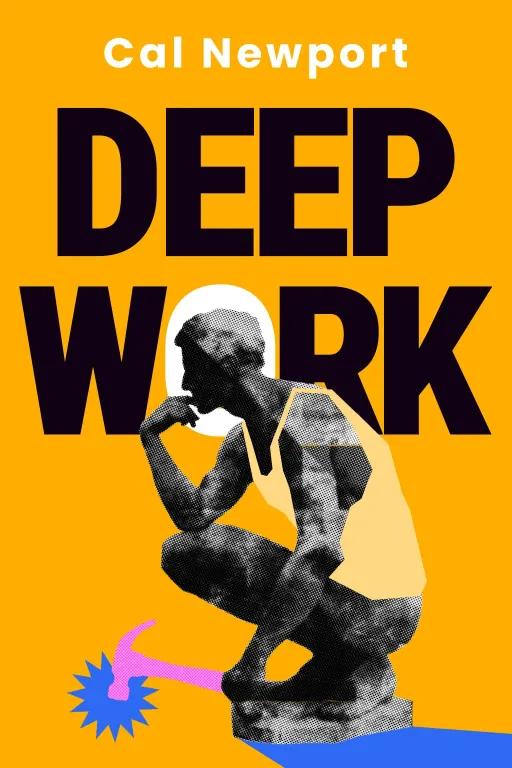
Albert Einstein: Imagine a magnifying glass, my friends. If you hold it under the sun and move it around constantly, from leaf to leaf, what happens? Nothing at all. But if you hold it perfectly still, focusing those wild, scattered rays of light onto a single point, you create fire. The human mind is no different. Today, we are exploring Cal Newport's masterpiece, Deep Work, and we are going to tackle this book from three distinct angles. First, we will look at why deep focus is the ultimate superpower for mastering complex technical systems. Second, we will explore how to train your brain to embrace boredom and build cognitive stamina. And finally, we will discuss how to design a daily routine that protects your mind from the constant noise of the digital world. Joining me today is Jayasree, a brilliant new software engineer who is navigating the vast, often overwhelming landscape of modern technology. Welcome, Jayasree.
Jayasree: Thank you, Albert. It is an absolute honor to be here with you. You know, that magnifying glass analogy really strikes a chord with me. As a junior developer, I feel like my attention is constantly being pulled in a dozen different directions. There are new frameworks to learn, bugs to fix, Slack notifications popping up, and the constant temptation to just memorize syntax instead of truly understanding the underlying architecture. It is easy to feel like you are constantly moving the magnifying glass without ever starting a fire.
Albert Einstein: Ah, yes. The temptation of the superficial. We live in a world that celebrates the shallow, yet all true progress, all real understanding, happens in the depths. Newport defines deep work as professional activities performed in a state of distraction-free concentration that push your cognitive capabilities to their limit. These efforts create new value, improve your skill, and are incredibly hard to replicate. In contrast, shallow work is the logistical, non-cognitively demanding stuff, like answering emails or copy-pasting code snippets without knowing how they work. It is easy to replicate, and it does not make you a better thinker.
Jayasree: That distinction is so critical. In software engineering, it is the difference between being a code monkey who just pieces together pre-written blocks and being an engineer who can design elegant, scalable systems. I want to build that deep, intuitive understanding. I want to be curious and experiment, but the sheer volume of information out there makes me feel like I have to rush and memorize everything just to keep up.
Albert Einstein: A common trap, my friend. Memorization is merely a filing cabinet in an empty room. True understanding is building the house itself. You cannot build a house by running around collecting random bricks. You must sit, focus, and lay each brick with absolute precision. Let us dive into how we can actually train our minds to do just that.
Deep Dive into Core Topic 1
SECTION
Albert Einstein: Let us begin with our first core topic: why deep work is the absolute engine of skill acquisition and elite performance. Newport shares a fascinating story about a man named Jason Benn. Now, Jason was a financial consultant who realized his job was highly vulnerable to automation. He decided he needed to learn a highly valuable, complex skill: computer programming. But when he first started, he found himself completely unable to concentrate. He was so used to the constant distractions of the modern world that his mind would wander after just a few minutes of reading a textbook.
Jayasree: I can relate to that so much. When you are trying to learn a new programming language or understand a complex codebase, the cognitive load is immense. If your brain is conditioned to seek a quick hit of dopamine every time you hit a difficult patch, you naturally want to open a new tab, check social media, or look for an easy answer on Stack Overflow.
Albert Einstein: Exactly. The brain is highly adaptable, but it is also lazy. It prefers the path of least resistance. What Jason Benn did was remarkable. He recognized this weakness and decided to treat his concentration like a muscle. He locked himself in a room with no computer, no phone, just textbooks and notecards. He forced himself to sit with the difficulty. Over the course of two months, he gradually rebuilt his capacity to focus. He eventually attended a coding bootcamp and absolutely excelled because he had trained his brain to learn deeply. He went from being a distracted consultant to a highly successful, well-paid software developer.
Jayasree: What I love about Jason's story is that it shows focus is not an innate talent. It is a trained habit. As a software engineer, I often have to debug complex systems where the root cause of an issue is buried deep within layers of abstraction. If I am constantly switching tasks, I lose the mental model I have built up of how the data flows through the system.
Albert Einstein: Ah, you have hit upon a profound scientific truth, Jayasree. In psychology, this is known as attention residue. A researcher named Sophie Leroy conducted some brilliant experiments on this. She found that when you switch from Task A to Task B, your attention does not immediately follow. A residue of your cognitive focus remains stuck on Task A. So, if you are coding, and you quickly check a Slack message, even if you return to your code immediately, a part of your brain is still processing that message. You are working with a fractured mind. Your cognitive capacity is severely degraded.
Jayasree: That explains why I feel so exhausted at the end of a day filled with meetings and quick interruptions, even if I did not write much code. My brain is constantly trying to clear that attention residue. It is like trying to drive a car while constantly shifting between first gear and reverse. You burn a lot of fuel, but you do not actually go very far.
Albert Einstein: A beautiful analogy. And there is a neurological component to this as well. When you focus intensely on a specific task without distraction, you trigger a process called myelination. Myelin is a fatty tissue that wraps around your neural pathways, acting like insulation on an electrical wire. The more myelin you build around a specific circuit, the faster and more effortlessly the signals can travel. But myelination only occurs when you stimulate that circuit repeatedly and intensely, free from distraction. If you are constantly switching tasks, you never trigger that growth. You remain a novice.
Jayasree: Wow, so deep work actually physically rewires your brain to be better at the task you are focusing on. That is incredibly empowering. It means that if I want to become a better problem solver, the key is not working longer hours, but working with absolute, undivided intensity during the hours I do work.
Albert Einstein: Precisely. High-quality work produced is a simple equation: time spent multiplied by the intensity of focus. If your intensity of focus is near zero because of distractions, it does not matter how many hours you spend at your desk. You will produce mediocre results. But if you can maximize that intensity, you can achieve in two hours what others take a week to accomplish.
Deep Dive into Core Topic 2
SECTION
Albert Einstein: This brings us to our second core topic: how do we actually train our brains to achieve this level of intensity? Newport argues that we must embrace boredom. You see, most people treat distraction as a temporary break from focus. They say, I will focus for an hour, and then I will take a quick break to check my phone. But Newport says we have it completely backward. We should be taking breaks from focus, not breaks from distraction.
Jayasree: That is a radical shift in perspective. What does he mean by that?
Albert Einstein: Think of it this way. If every time you feel a tiny bit of boredom or cognitive strain, you immediately soothe your brain with a quick glance at your phone, you are conditioning your brain to expect on-demand distraction. You are strengthening the neural pathways of distraction. When it comes time to do deep work, your brain will not be ready, because it has been trained to crave novelty every few minutes. To combat this, Newport suggests scheduling your internet use in advance. If you decide you will only use the internet between 2:00 PM and 2:15 PM, then you must remain completely offline outside of that block, even if you feel stuck or bored.
Jayasree: That sounds incredibly challenging, especially for a developer who relies on the internet for documentation and APIs. But I can see the value. It forces you to struggle with the problem yourself first, to think through the logic, rather than immediately searching for a quick fix. It builds that curiosity and confidence I have been looking for.
Albert Einstein: Yes, the struggle is where the growth happens. If you always bypass the struggle by looking up the answer, you never build the mental models required for true expertise. Another powerful strategy Newport suggests is what he calls Roosevelt dashes, named after Theodore Roosevelt. When Roosevelt was a student at Harvard, he had an incredibly diverse range of interests, from boxing to naturalism. To maintain honor grades despite his busy schedule, he would set extremely tight, artificial deadlines for his studies. He would look at a task that would normally take four hours and give himself only two. This forced him to work with blistering, absolute intensity.
Jayasree: I love that idea. We often expand our work to fill the time we have allocated for it. If I give myself all day to solve a bug, I will probably take all day, and I will get distracted along the way. But if I set a timer for ninety minutes and treat it like a sprint, my brain will naturally lock out all distractions because of the urgency.
Albert Einstein: Yes, it is like a cognitive workout. You are pushing your focus to its absolute limit, which in turn expands your capacity for focus in the future. And for those times when you are away from your desk, Newport suggests a practice called productive meditation. The goal is to take a period where you are occupied physically but not mentally, like walking, jogging, or even showering, and focus your attention entirely on a single, well-defined professional problem.
Jayasree: Oh, I do this sometimes without realizing it. I will go for a walk when I am stuck on a piece of code, and suddenly the solution will just click. But I usually let my mind wander. Doing it intentionally sounds like a great way to practice problem-solving away from the screen.
Albert Einstein: It is indeed. But the key is discipline. When you practice productive meditation, your mind will inevitably try to wander to other things, like what you want to eat for dinner or an email you forgot to send. Your job is to gently but firmly bring your attention back to the problem at hand, over and over again. It is like doing mental reps. You are training your brain to resist distraction and maintain a single line of thought.
Jayasree: This is so different from the way we are usually taught to learn. We are told to memorize, to study for exams, to consume as much information as possible. But these strategies are all about training the process of thinking itself. It is about becoming comfortable with cognitive discomfort.
Albert Einstein: Yes, because comfort is the enemy of depth. If you are always comfortable, you are likely operating in the shallow end of the pool. To reach the depths, you must be willing to swim against the current of your own lazy impulses.
Synthesis & Takeaways
SECTION
Albert Einstein: As we wrap up our conversation today, let us synthesize what we have discussed. Deep work is not just a productivity hack. It is a pragmatic, essential skill for anyone who wants to thrive in our modern, distracted economy. For someone like you, Jayasree, at the start of your career in technology, cultivating this skill will set you apart from the crowd. It will allow you to master complex systems quickly, solve difficult problems creatively, and find deep, lasting satisfaction in your work.
Jayasree: This has been such an eye-opening discussion, Albert. I realize now that if I want to build confidence and curiosity, I have to stop treating my attention as something that just happens to me. I have to take active control of it. I am going to start by scheduling my internet blocks and trying out those Roosevelt dashes to inject some intensity into my coding sessions. And I will definitely practice productive meditation during my daily walks.
Albert Einstein: Wonderful. Remember, a deep life is a good life. It is a life rich with productivity, meaning, and a sense of craftsmanship. Do not be afraid to let the small, shallow things go. Protect your mind, cherish your curiosity, and hold that magnifying glass perfectly still.
Jayasree: Thank you, Albert. I feel ready to start my own fire.
Albert Einstein: And to our listeners, we leave you with this question to ponder: What is the one wildly important goal in your life right now that deserves your absolute, undivided attention, and what distractions are you willing to ruthlessly eliminate to achieve it? Until next time, keep wondering, keep exploring, and keep diving deep.