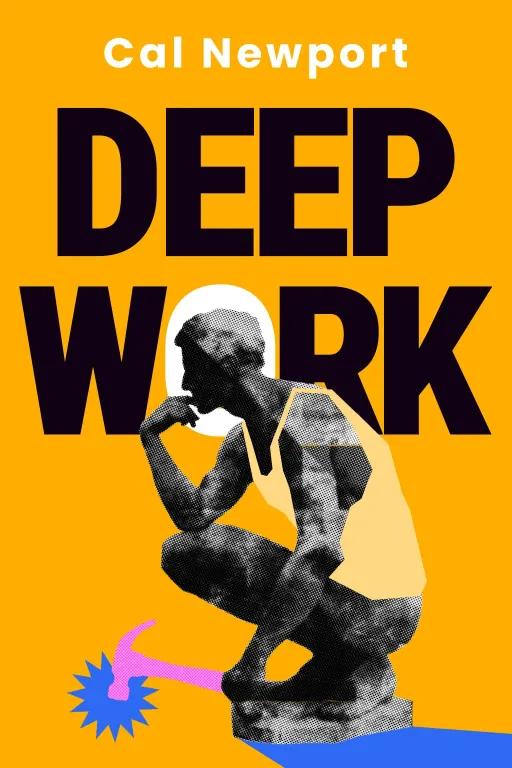
Unlocking Deep Work: The Focus Framework for Analytical Minds
Golden Hook & Introduction
SECTION
Nova: Did you know the average knowledge worker checks their email 77 times a day? And that each interruption takes over 20 minutes to fully recover from? We're not just distracted; we're actively sabotaging our strategic thinking.
Atlas: Wow. Seventy-seven times? That number is honestly a gut punch. I feel like I'm constantly being pulled in a dozen different directions, and that recovery time... I've never actually calculated that cost. It sounds like a new form of professional paralysis.
Nova: It absolutely is. And it's precisely the problem our discussion today aims to tackle. We're diving into a book that offers a powerful counter-narrative and a practical solution: "Deep Work" by Cal Newport. What's fascinating about Newport is his background; he's a computer science professor at Georgetown, which immediately lends a rigorous, evidence-based foundation to his ideas, rather than just another self-help guru. He lives and breathes the necessity of sustained focus in his own research and writing.
Atlas: Okay, so it’s not just another fad. I’m curious, though, does the book offer a real solution, or is it more of that "just try harder" productivity hype? Because for someone who has to untangle complex data or design a multi-year strategy, the idea of "deep work" sometimes feels out of reach.
The Erosion of Deep Work & Its Cost
SECTION
Nova: Newport's argument is anything but hype. He starts with a cold, hard fact: in today's noisy world, sustained, deep focus is a rare and valuable skill, and constant distractions erode our ability to tackle complex problems. Think of our cognitive capacity like a muscle. When you're constantly context-switching, checking notifications, and jumping between tasks, you're essentially doing a thousand tiny, ineffective exercises. That muscle never gets the sustained, heavy lifting it needs to grow strong.
Atlas: So, for someone who to untangle complex data or design a multi-year strategy, is this just a new form of professional paralysis? I mean, beyond the daily frustration, what's the cost of this constant cognitive fragmentation?
Nova: The long-term cost is profound, Atlas. It's not just about lost minutes; it's about a diminished capacity for original thought, a reduced ability to solve truly difficult problems, and ultimately, a feeling of being perpetually busy without ever producing anything truly meaningful. We become excellent at shallow work – quick responses, administrative tasks – but we lose the ability to engage in the kind of deep thinking that creates lasting value.
Atlas: Oh, I know that feeling. It's like you're running on a treadmill, expending a lot of energy, but not actually getting anywhere. But wait, isn't some level of "shallow work" unavoidable in today's fast-paced environment? How do you even begin to carve out that deep focus when the demands are relentless, and the notifications never stop?
Cal Newport's 'Deep Work' Framework
SECTION
Nova: That’s precisely where Newport offers a clear antidote. He defines 'deep work' as focused, uninterrupted effort that pushes your cognitive capabilities to their limit. It's the kind of work that generates new value, improves your skills, and is difficult to replicate. He argues it's not just a nice-to-have, but an essential skill for anyone who wants to thrive intellectually and professionally. It’s about being more intentional with our speed, not necessarily slowing down.
Atlas: Okay, so it sounds like a highly structured approach. For the 'Confident Builder' who's used to iterating quickly and delivering results, does this mean we have to slow down? Or is it about being intentional with our speed, choosing when to sprint and when to dive deep?
Nova: It's absolutely the latter. Think of it like a master craftsman versus an assembly line worker. The craftsman takes time, focuses intensely on each detail, and produces something unique and high-quality. The assembly line worker focuses on speed and volume of repetitive tasks. Newport encourages us to be the craftsman of our work. He talks about creating "deep work rituals"—like specific times, places, or routines that signal to your brain, "Okay, it's time to focus intently." He also champions "batching shallow work," consolidating those necessary but not deep tasks into specific, limited time blocks.
Atlas: That sounds great in theory, but I've heard some critics argue that this approach isn't feasible for everyone, especially those in highly collaborative roles or with unpredictable demands. Does Newport address those critiques, or is this just for the lone genius in a secluded cabin?
Nova: He absolutely does, and this is where his academic rigor shines through. Newport offers different "philosophies" for integrating deep work, recognizing that a one-size-fits-all approach won't work. For example, there's the "monastic" philosophy for those who can truly isolate, but also the "bimodal" where you divide your time clearly between deep and shallow, the "rhythmic" where you make deep work a regular habit, and the "journalistic" where you fit deep work into any available slot. It's about adapting the principles to your specific role and life stage, not rigidly adhering to one method.
Nova's Take: Structuring Environment and Day
SECTION
Nova: And that naturally leads us to the second key idea we need to talk about, which often acts as a counterpoint to what we just discussed, and that’s Nova's Take on this. Building on Newport's framework, my emphasis is on creating a clear blueprint for structuring your day and environment to protect your most valuable asset: your attention. It helps you reclaim time for profound intellectual effort by making it almost automatic. This means creating a dedicated deep work space, even if it's just a corner of a room, minimizing all non-essential notifications, and aggressively time-blocking those deep work sessions.
Atlas: So, it's about building a fortress around your focus, making it easier to enter that deep state. For someone trying to master future landscapes like AI-driven marketing or advanced analytics, is the as critical as the here? I'm always looking for that one concrete, tiny step I can implement.
Nova: Absolutely, Atlas. The environment is incredibly critical because it reduces friction and provides cues for focus. If your phone is buzzing every five minutes, or your workspace is cluttered, your brain expends energy just resisting those distractions, leaving less for the actual deep work. It's about setting yourself up for success. And for that tiny step you're looking for, here it is: schedule a 60-minute block of uninterrupted, focused work on your most challenging task this week. Just one hour. Protect it fiercely.
Atlas: A 60-minute block on the most challenging task... that feels achievable. That's a great way to put it. But what if that 'challenging task' feels overwhelming right from the start? How do we even to enter that deep state if we're used to constant interruption and the task itself feels like climbing a mountain?
Nova: That's where the "uninterrupted" part is key. You're not aiming for perfection in that first hour, but for pure, undistracted engagement. The very act of protecting that hour, of shutting out the noise, begins to retrain your brain. The inertia of starting is the hardest part, but once you're in that flow, even for a short time, you’ll feel the difference. It's about building that muscle gradually.
Synthesis & Takeaways
SECTION
Nova: So, what we've really explored today is that deep work isn't just another productivity hack; it's a fundamental pathway to intellectual fulfillment and creating truly impactful, valuable work. It’s a deliberate investment in your cognitive capital, one that pays dividends in original thought and meaningful output. This isn't about simply doing more; it's about doing better, about crafting a legacy through focused effort rather than just reacting to an endless stream of demands.
Atlas: That's actually really inspiring. It feels like moving from being a responsive manager of tasks to becoming a proactive architect of our own intellectual output. It's about building that strategic muscle, not just reacting to fires. Protecting that hour you mentioned, that's not just about a task; it's about protecting my capacity for tangible growth and showcasing unique value.
Nova: Exactly. That one 60-minute block is a commitment to yourself, to your growth, and to the kind of impact you want to make. It's a small step that can lead to profound shifts in how you approach your most important work.
Atlas: We'd love to hear how you're carving out your deep work blocks. What's your biggest challenge, and what's one small win you've had recently? Share your insights with us.
Nova: This is Aibrary. Congratulations on your growth!