The Strategic Pause: Why Deep Work Is Your Secret Weapon for High Impact
Golden Hook & Introduction
SECTION
Nova: Everyone talks about working smarter, not harder. We're constantly bombarded with productivity hacks, time management apps, and the promise of doing more with less. But what if the real secret to high impact isn't about more clever shortcuts, but about doing something far more fundamental, and increasingly rare?
Atlas: Oh, I like that. That sounds almost counter-intuitive in our always-on, always-connected world. Are you saying the secret isn't about optimizing every micro-second, but about something… simpler, yet harder?
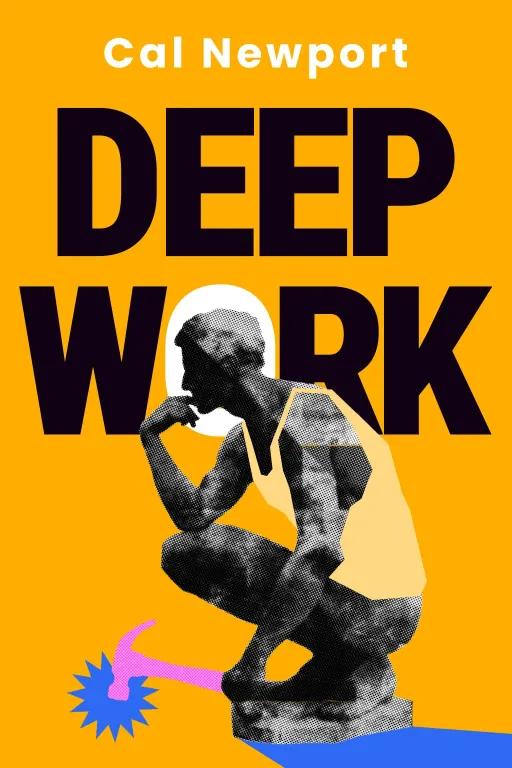
Nova: Exactly, Atlas. Today, we're dissecting that rare skill, that almost forgotten art, through the lenses of two pivotal books: "Deep Work: Rules for Focused Success in a Distracted World" by Cal Newport, and "The One Thing" by Gary Keller and Jay Papasan.
Atlas: Newport, he's a computer science professor, right? I'm familiar with his work. What's fascinating is that he famously wrote "Deep Work" from the perspective of someone who meticulously practices what he preaches. He's known for completely disconnecting for extended periods to achieve his intellectual breakthroughs. That's a pretty radical stance in our culture, where everyone feels like they need to be constantly available.
Nova: It is radical, and that’s precisely why his insights are so potent. He's not just theorizing; he’s living proof of the power of what he calls 'deep work.' And that naturally leads us into our first big idea: the existential threat to focus.
The Existential Threat to Focus: Why Deep Work is a Superpower
SECTION
Nova: So, what exactly is deep work? Newport defines it as "the ability to focus without distraction on a cognitively demanding task." It's the kind of work that pushes your individual capabilities to their limit, leading to new value, improved skill, or deeper understanding. Think of it as the antithesis to what he calls "shallow work"—the emails, meetings, social media, and administrative tasks that fill our days.
Atlas: Okay, but for our listeners who are Architects and Cultivators, they're often building robust systems or vibrant communities. What's the actual, tangible cost of all this digital fragmentation? It feels like more than just lost time; it feels like an erosion of the very foundation they're trying to lay.
Nova: You’ve hit on something crucial there. The real cost isn't just lost minutes; it's lost. Imagine an architect designing a complex new urban plan. If they're constantly interrupted by emails, phone calls, or notifications, they can't hold the entire intricate blueprint in their mind. They can't see the synergistic relationships between different zones, the flow of traffic, the social dynamics of the spaces. Each interruption forces a mental reboot, and the quality of the final design suffers. The system they’re building becomes fragile, prone to errors, and lacks the elegant coherence that only comes from sustained, uninterrupted thought.
Atlas: Wow, that’s a powerful analogy. So, it's not just about getting tasks done, but about the of the output, the lasting value. For Cultivators trying to build vibrant communities, you need that sustained attention to truly understand and connect with people, to identify those subtle social cues and needs, right? Without it, your efforts might feel scattered and superficial.
Nova: Absolutely. Newport argues that deep work is becoming the "superpower" of the 21st-century economy precisely because it's so rare. In a world awash with distractions, the ability to produce something truly original, to solve complex problems, or to master difficult concepts requires intense, focused attention. Without it, you're just shuffling information, not creating new knowledge or building something of enduring value. Our brains are literally being rewired for distraction, making this focused effort feel increasingly unnatural.
Atlas: That makes me wonder, how much truly groundbreaking work is being stifled because we're not giving our minds the space they need? It sounds like we're not just losing productivity; we're losing the potential for innovation and deep connection.
Architecting Your Focus: Practical Strategies for Cultivating Deep Work
SECTION
Nova: And that naturally leads us from the 'why' of deep work to the 'how.' If deep work is our superpower, how do we actually cultivate it in a world that constantly tries to steal our attention? It feels like a constant battle against the current.
Atlas: Exactly. For our listeners who are Architects and Cultivators, they need concrete solutions. How do you actually 60 minutes when your calendar is a battlefield, your inbox is a siren song, and your team needs answers? That sounds incredibly difficult to implement in a dynamic, high-pressure environment.
Nova: It absolutely is a challenge, but it's not impossible. Newport offers several principles. One is to. You don't just hope deep work happens; you carve out specific, protected time in your calendar for it. Treat these blocks like non-negotiable appointments. During these times, you turn off all notifications. No email, no social media, no instant messages.
Atlas: Hold on, for someone managing multiple projects or a growing team, 'draining the shallows'—all those emails and quick questions—might feel like neglecting their responsibilities. How do you balance the need for deep focus with the demands of collaboration and communication that are essential for sustainable growth?
Nova: That’s a critical point. It's not about isolation; it's about. You schedule your shallow work too. You might have specific times dedicated to answering emails or quick team check-ins. The key is to communicate these boundaries. Tell your team, "I'll be doing focused work from 9 to 11 AM; I'll check messages after that." This fosters a culture of respect for focused time. And when you do deep work, the quality of your output actually future shallow work – fewer clarification emails, fewer re-dos, clearer strategies.
Nova: This is where "The One Thing" by Gary Keller and Jay Papasan brilliantly complements Newport’s ideas. They argue for ruthless prioritization: identifying the that, by doing it, will make everything else easier or unnecessary.
Atlas: So you're saying, before you even block out time, you need to be crystal clear on what that deep work? Not just "work on the project," but "figure out the core architectural challenge for phase two of Project X"?
Nova: Precisely. If you're an Architect, that might mean identifying the foundational design flaw that's bottlenecking your entire system. If you're a Cultivator, it could be designing the most impactful workshop for your community. It’s about asking: "What's the ONE thing I can do, such that by doing it, everything else will be easier or unnecessary?" Then, you schedule your deep work block around one thing.
Nova: Consider a software lead, a classic "Architect" role. Their days are often a whirlwind of bugs, meetings, and code reviews. Applying these principles, they might block off their first two hours daily, 8 AM to 10 AM, specifically for coding on their most critical, complex feature—the one that will unlock the next phase of the product. They put their phone on airplane mode, close email tabs, and use noise-canceling headphones. They resist the urge to check Slack until that block is complete. This isn't just about finishing a coding task; it's about building a system of focus that ensures the most important, high-leverage work gets done consistently, leading to a much more robust and innovative product.
Atlas: That’s a perfect example. It sounds like a mindset shift as much as a tactical one. It’s about recognizing that sustained focus is a resource you have to protect and intentionally allocate, not just something that happens if you're lucky. And for the 'Resilient' aspect of our listeners, this is about building mental fortitude, almost like a muscle.
Synthesis & Takeaways
SECTION
Nova: So, what we're really talking about is not just a personal productivity hack, but a fundamental shift in how we approach value creation. It's about designing our lives and our work environments to allow for sustained, high-quality attention, which is the bedrock of building anything truly significant and lasting. It’s the difference between merely reacting to the world and actively shaping it.
Atlas: And for those 'Architects' and 'Cultivators' out there, this isn't just about individual output. It's about modeling a culture of intentional focus that can lead to more robust systems and more vibrant, connected communities, where everyone has the space to create impact. It’s about moving beyond busyness to true contribution.
Nova: Exactly. So, for our tiny step today, we challenge you: block out 60 minutes in your calendar tomorrow. Just one hour. Pick a single, cognitively demanding task – that one thing that truly moves the needle. Turn off notifications – phone, email, everything. And work on nothing else but that one thing during that time. Experience the difference.
Atlas: It's about proving to yourself that that focused attention isn't just possible, it's powerful. It’s the first brick in building your fortress of focus and reclaiming your most valuable asset: your attention.
Nova: This is Aibrary. Congratulations on your growth!