The Strategic Mind: Mastering Efficiency in High-Stakes Fields.
Golden Hook & Introduction
SECTION
Nova: What if I told you that in today's world, working harder isn't the answer to achieving more? In fact, it might be the very thing holding you back from true mastery.
Atlas: Whoa, hold on a second, Nova. That's a pretty bold claim. I feel like my entire professional life, especially for those of us in high-stakes fields, has been predicated on the idea that the more hours you put in, the more you achieve. Are you telling me my hustle is… counterproductive?
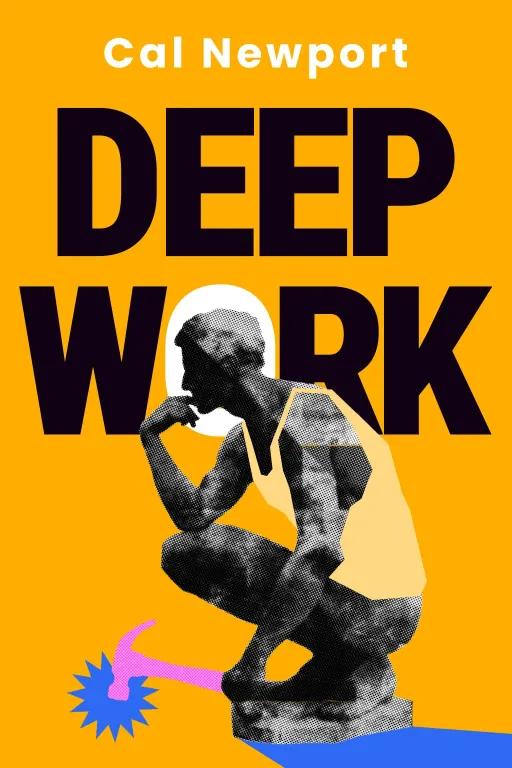
Nova: Not entirely, Atlas, but it's a critical distinction. We're talking about effort versus just effort. Today, we're diving into two absolute game-changers for anyone looking to truly master their craft: "Deep Work" by Cal Newport and "Atomic Habits" by James Clear.
Atlas: Ah, two titans of productivity. I've seen these titles everywhere.
Nova: Absolutely. And what's particularly fascinating about Cal Newport, the author of "Deep Work," is that he's a computer science professor at Georgetown who writes about cultivating focus and avoiding distraction… all while famously using social media himself. That gives his arguments about living a distraction-free, deeply focused life a certain undeniable, almost defiant credibility, wouldn't you say? He truly practices what he preaches.
Atlas: That's actually really inspiring. I imagine a lot of our listeners, especially those in demanding academic or professional tracks, feel like they're constantly battling a barrage of notifications, emails, and just general noise. It’s not just about wanting to focus; it’s about feeling like the world is actively conspiring against it.
Nova: Exactly! And that's where these books become less about simple productivity tips and more about a strategic overhaul of how we approach learning, performance, and ultimately, impact. They offer a blueprint for not just surviving, but truly excelling in an information-saturated world.
Deep Dive into Core Topic 1: The Superpower of Deep Work
SECTION
Nova: So, let's start with Newport's core concept: "Deep Work." He defines it as the ability to focus without distraction on a cognitively demanding task. It's the kind of intense, uninterrupted concentration that pushes your cognitive capabilities to their limit, creating new value and improving your skill. He contrasts this sharply with "shallow work," which is non-cognitively demanding, often logistical tasks performed while distracted.
Atlas: Okay, so it’s not just about sitting down at your desk. You’re talking about a kind of mental immersion. But for those of us in, say, a medical residency, where you’re constantly on call, juggling patient charts, responding to emergencies – how does one even to find that kind of uninterrupted, deep focus? It sounds like a luxury, not a reality.
Nova: That's a fantastic point, Atlas, and it highlights the challenge. Newport isn't suggesting you can eliminate all shallow work or interruptions. Instead, he argues that deep work is a skill, a muscle you need to train. One of his key rules is to "Schedule Deep Work." He says you need to intentionally block out significant chunks of time, often 90 minutes to four hours, and treat them with the same reverence as a critical meeting.
Atlas: Ninety minutes? Four hours? I’m trying to imagine telling my supervisor, "Sorry, I can't take this urgent call, I'm in my deep work block." That sounds a bit out there for the real world.
Nova: You're right, the context is everything. But think of it this way: a neurosurgeon isn't just performing surgery. They're spending hours studying complex anatomical maps, reviewing patient histories, and mastering new techniques. This isn't shallow work. If you could carve out even 60-90 minutes a few times a week, completely unplugged, to truly grapple with a complex case study or master a challenging physiological concept, imagine the compound effect. It’s about the of that mental engagement, not just the quantity of hours logged.
Atlas: I can see how that would be powerful. The idea of truly with something, instead of just skimming it while half-listening to a podcast or checking emails. What's even more interesting is how much of our "learning" today is actually just passive consumption, not deep engagement.
Nova: Exactly! Newport provides a compelling case study of a software engineer who, by consistently applying deep work principles, was able to produce complex code in a fraction of the time it took his peers. He wasn't working more hours; he was working hours. He created rituals: a specific time, a specific place, even a specific type of tea, to signal to his brain that it was time to enter that focused state.
Atlas: So, it's about creating a personal, almost sacred, environment for focus. But wait, how do you these blocks? Because the moment you sit down to do something important, suddenly every notification, every "quick question," every shiny new idea seems to scream for your attention.
Nova: That's the battle, isn't it? Newport suggests strategies like "batching shallow work," dedicating specific times for emails and administrative tasks, and even "productive meditation" – where you focus intensely on a single problem while going for a walk, allowing your subconscious to work on it. It’s about creating barriers, both physical and mental, to protect that precious cognitive space. It’s a skill, and like any skill, it gets stronger with practice.
Atlas: I guess that makes sense. It's not about magically having uninterrupted time appear, but aggressively and it. For our listeners who are aiming for mastery in their fields, this isn't just about getting more done; it's about getting the things done, with an intensity that leads to true understanding.
Deep Dive into Core Topic 2: Atomic Habits for Sustained Excellence
SECTION
Nova: And that naturally leads us to the second key idea we need to talk about, which often acts as the silent supporting architecture for deep work: James Clear's "Atomic Habits." If deep work is about the of your focus, atomic habits are about the of the small actions that make that intensity possible, day after day, year after year.
Atlas: Yeah, I can definitely relate to the frustration of trying to build a "big" habit, like "I'm going to study for three hours every single day," only to fall off the wagon after a week. What makes "atomic" different from just, well, regular habits?
Nova: Clear argues that "atomic" refers to two things: first, they're tiny, often seemingly insignificant changes, and second, they're a source of immense power, like an atom. He emphasizes that significant results come not from monumental changes, but from the cumulative effect of hundreds or thousands of small decisions. He offers a proven framework for improving every day, emphasizing the power of small, consistent changes.
Atlas: So you're saying that instead of trying to overhaul my entire study routine, I should aim for something ridiculously small? Like, read one page of a textbook?
Nova: Precisely! Clear breaks it down into four simple laws for building good habits: Make it Obvious, Make it Attractive, Make it Easy, and Make it Satisfying. And conversely, reversing them for bad habits. For someone like our "Aspiring Healer," instead of "I need to study for three hours," it becomes "After I pour my morning coffee, I will review one flashcard for five minutes." Make it obvious by having the flashcard right next to the coffee maker. Make it easy by only committing to one.
Atlas: Oh, I like that. It’s about reducing the friction. Because honestly, the biggest hurdle often isn't the task itself, but the mental energy it takes to the task. If it's too big, your brain just says "nope."
Nova: Exactly. Think about a medical student who needs to consistently practice a specific suturing technique. Instead of waiting for a dedicated practice session, they could "Make it Easy" by keeping a practice kit on their desk and committing to just one minute of practice after a specific trigger, like finishing a meal. Over weeks and months, those one-minute practices compound into significant skill acquisition.
Atlas: That’s a great way to put it. So, it's not about willpower as much as it is about environmental design. How can our listeners, especially those with chaotic schedules, actually make their desired habits?
Nova: That's where "Make it Obvious" and "Make it Easy" really shine. For example, if you want to read more academic journals, don't just to. Instead, "Make it Obvious" by leaving the relevant journal open on your desk. "Make it Easy" by only committing to reading the abstract and one key paragraph. Or, to avoid distractions during your deep work blocks, "Make it Impossible" to check social media by deleting the apps from your phone for that scheduled time, or using website blockers. It's about designing your environment so that the path of least resistance is the path to your desired habit.
Atlas: I imagine a lot of our listeners feel like their environments are constantly them towards distraction, not away from it. This sounds less like self-discipline and more like strategic self-engineering. And for someone driven by impact, like our user, building these reliable systems means they can consistently show up and do the work that truly matters.
Nova: Absolutely. It's the silent architecture of success. These tiny, consistent efforts, almost imperceptible day-to-day, are what build the foundation for sustained excellence and the capacity for truly transformative deep work.
Synthesis & Takeaways
SECTION
Nova: So, bringing these two powerful ideas together, we see that "Deep Work" provides the of focus needed to master complex subjects and produce high-quality output, while "Atomic Habits" provides the and to cultivate that focus day after day.
Atlas: That’s actually really inspiring. It’s not about working yourself to exhaustion, but about working smarter, more intentionally. For those aspiring to leadership in healthcare or navigating complex ethical decisions, this isn't just about productivity; it's about building a resilient, high-impact career that allows them to make a tangible difference without burning out.
Nova: Precisely. Mastering efficiency in high-stakes fields isn't about brute force; it's about strategic design. It's about recognizing that your attention is your most valuable resource and then systematically protecting and cultivating it. The smallest, most consistent effort, applied with deep focus, will always outperform frantic, distracted effort.
Atlas: That gives me chills. It reframes the entire struggle against distraction as an opportunity to build a superpower. So, for our listeners out there, especially those feeling overwhelmed by information overload, here’s a tiny step you can take: identify just one recurring distraction during your study or work time. For the next hour, commit to completely eliminating it. Turn off that notification, close that tab, put your phone in another room. And then, observe the difference in your focus.
Nova: Even that small act of intentionality can create significant momentum. It's the first atomic habit towards deeper work.
Atlas: We'd love to hear how that goes for you. Share your experiences and insights with us. This is Aibrary. Congratulations on your growth!