The Overwhelm Trap: Why More Isn't Always Better for Deep Work.
Golden Hook & Introduction
SECTION
Nova: If this episode found you, you probably open about twelve tabs in your browser before 9 AM, check your phone every five minutes, and feel like you're constantly busy but never quite getting to what truly matters.
Atlas: Oh, I know that feeling. It's like I'm running on a hamster wheel, but the wheel is made of notifications and urgent emails. Tell me, Nova, are you telling me I’m being productive by juggling twenty things at once? Because my inbox certainly thinks I am.
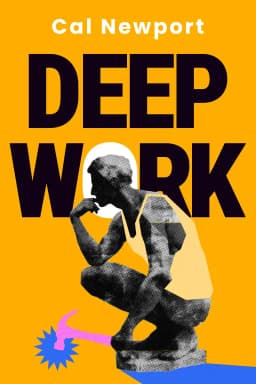
Nova: Exactly, Atlas! And that's the core of what we're dissecting today in "The Overwhelm Trap: Why More Isn't Always Better for Deep Work." We're pulling insights from two incredibly impactful books: "Deep Work" by Cal Newport and "The One Thing" by Gary Keller with Jay Papasan.
Atlas: Ah, Cal Newport. The computer science professor who basically told the entire knowledge work industry to calm down and focus. I remember his work getting a lot of buzz for cutting through the noise.
Nova: Absolutely. Newport, a professor at Georgetown, really challenged the modern workplace's obsession with constant connectivity and 'busyness.' His academic rigor lends so much weight to his arguments. And then Gary Keller, co-founder of the massive real estate company Keller Williams, brings the practical, actionable business perspective to the table with "The One Thing." Both books have received widespread acclaim for offering a powerful antidote to modern distraction.
Atlas: That’s a powerful duo right there. So, we're talking about escaping the notification hamster wheel and actually getting stuff done, the stuff.
Nova: Precisely. Because the cold, hard truth is, your brain craves novelty. That constant ping, that new email, that fresh headline—it's like a hit of dopamine. And that constant craving, Atlas, is precisely what shatters your focus and keeps you trapped in what Newport calls "shallow work."
Atlas: Shallow work? I can already feel the judgment.
Deep Dive into Core Topic 1: The Siren Song of Novelty: Why Your Brain Sabotages Deep Work
SECTION
Nova: Well, it's not judgment, it's a diagnosis. Newport defines "deep work" as professional activities performed in a state of distraction-free concentration that push your cognitive capabilities to their limit. These efforts create new value, improve your skill, and are hard to replicate. "Shallow work," on the other hand, is non-cognitively demanding, logistical-style tasks, often performed while distracted. Think email, social media, routine meetings.
Atlas: Okay, so deep work is the heavy lifting, the innovative stuff, and shallow work is… everything else that fills my day? That sounds rough. But wait, for someone in, say, a fast-paced engineering environment, staying updated, responding to urgent requests, it often like all of that communication is crucial. How do you build a "fortress" around your most important tasks when the world demands constant connection?
Nova: That's the million-dollar question, isn't it? And it comes down to understanding something called "attention residue." Imagine you're working on a complex problem, really in the zone. Then, a notification pops up, or you quickly check an email. Even if you don't fully engage with the new task, your attention doesn't instantly snap back to the original problem. A "residue" of your attention remains on the previous task, making it harder to regain full focus.
Atlas: So, even a quick glance at my phone to see if that critical system alert came through, it's not just a momentary distraction? It actually leaves a trace that impairs my next task? Like a mental ghost hanging around?
Nova: Exactly! It's like trying to bake a soufflé while constantly opening the oven door "just to check." You might think you're being efficient by multitasking or quickly checking things, but you're actually destroying the delicate cognitive environment needed for deep concentration. A software engineer constantly flipping between debugging complex code, responding to a Slack message from a colleague, and checking project management updates might busy, but they're rarely achieving the sustained focus needed to solve a truly challenging bug or architect an elegant solution. They're just context-switching themselves into a state of perpetual cognitive exhaustion.
Atlas: That makes me wonder, then, if it’s not about our willpower, but about creating an environment that respects how our brains actually work. Because honestly, sometimes it feels like I'm fighting my own brain's desire for the next shiny thing.
Nova: You are! Your brain is wired for novelty, for seeking out new information. It's an evolutionary survival mechanism. But in our modern information-saturated world, that mechanism becomes a liability, constantly pulling you away from the sustained focus needed for truly impactful work. It's why Newport argues you have to schedule deep work and protect it fiercely. You can't just hope it happens.
Deep Dive into Core Topic 2: The Domino Effect: Radical Prioritization and The Power of 'The One Thing'
SECTION
Nova: So, if understanding the "siren song of novelty" is the problem, what's the most powerful antidote? This is where "The One Thing" steps in with a radical prescription: simplify.
Atlas: Simplify? In this economy? Everything feels urgent, everything feels important. As someone who values efficiency and optimization, the idea of picking thing when there are fifty things screaming for my attention feels… counter-intuitive, almost irresponsible. How do you choose one thing, and how does that not lead to ignoring everything else that's also critical?
Nova: That’s the beauty of it, Atlas. Keller and Papasan introduce what they call "The Focusing Question": "What's the ONE Thing I can do such that by doing it, everything else will be easier or unnecessary?" It’s about identifying the single most important task for a – be it an hour, a day, a week, or a year. The premise is that success is built sequentially, not simultaneously.
Atlas: Okay, so you’re saying instead of trying to push all fifty dominos at once, I find the domino that will knock over the most others? Can you give an example of this "domino effect" in action that isn't just about sales targets? For a strategic learner or an engineer, the impact might not always be so immediately visible.
Nova: Think about it this way: a junior engineer might feel overwhelmed by the sheer number of programming languages, frameworks, and tools out there. They could spend years dabbling in all of them, becoming a jack-of-all-trades, master of none. Or, they could ask: "What's the ONE programming skill I can master that will unlock the most opportunities and make learning everything else easier?" Perhaps it's becoming truly proficient in Python for data science, which then opens doors to machine learning, automation, and powerful analytical insights. By focusing on that, they create a domino effect of skill acquisition and career advancement that far outstrips someone constantly context-switching between languages.
Atlas: I can see how that would be... powerful. It's not about ignoring the other dominos forever, it's about hitting the one first. That makes a lot of sense for someone aiming for self-mastery. It’s about building a solid foundation, rather than a shaky skyscraper.
Nova: Exactly. It simplifies your daily choices. When you have a clear "one thing," every decision about how to spend your time and energy becomes clearer. Does this task contribute to my one thing? Yes? Do it. No? Defer, delegate, or delete. It’s about intentional scheduling and ruthless prioritization, which exponentially increases your impact. It’s how you go from being busy to being truly productive.
Synthesis & Takeaways
SECTION
Nova: So, bringing these two powerful ideas together, we have Cal Newport showing us why our brains are so easily derailed by novelty and shallow work, and Gary Keller and Jay Papasan giving us the laser-focused strategy to combat it: find your one thing. It's not about working harder, Atlas, it's about working smarter and deeper, by protecting your focus and applying it to what truly matters.
Atlas: That's actually really inspiring. For someone who's ready to escape this overwhelm trap right now, what's the absolute smallest, most impactful action they can take tomorrow to start building that fortress around their deep work?
Nova: Here's your tiny step, Atlas, and for all our listeners: tomorrow, block out 90 minutes. Turn off notifications—from your phone, your computer, your smart devices. And during that 90 minutes, focus on one single, identified task. Just one.
Atlas: Just 90 minutes. One task. No pings. That’s a practical, actionable step that anyone can implement, even in a chaotic environment. It’s about reclaiming that mental space. It really speaks to that journey of continuous refinement, doesn't it?
Nova: It does. Because true impact, profound impact, often comes from subtraction, not addition. Less noise, more signal. Less distraction, more depth.
Atlas: Thank you, Nova. That's a powerful reminder that our most valuable resource isn't time, it's focus.
Nova: Well said, Atlas. This is Aibrary. Congratulations on your growth!