The Hidden Cost of Speed: Reclaiming Focus in a Distracted World.
Golden Hook & Introduction
SECTION
Nova: What if I told you that the very act of being 'busy' – that badge of honor we all wear in our fast-paced world – is actually making us less productive, not more? That the constant context-switching, the never-ending stream of notifications, and the feeling of being perpetually 'on' might be the biggest hidden cost to your impact?
Atlas: Whoa, that's a bold claim, Nova. I mean, for so many of us, especially those building something from the ground up, being busy feels like the only way forward. It feels like a necessary evil, doesn't it? The more plates you're spinning, the more you're getting done. Or so we tell ourselves.
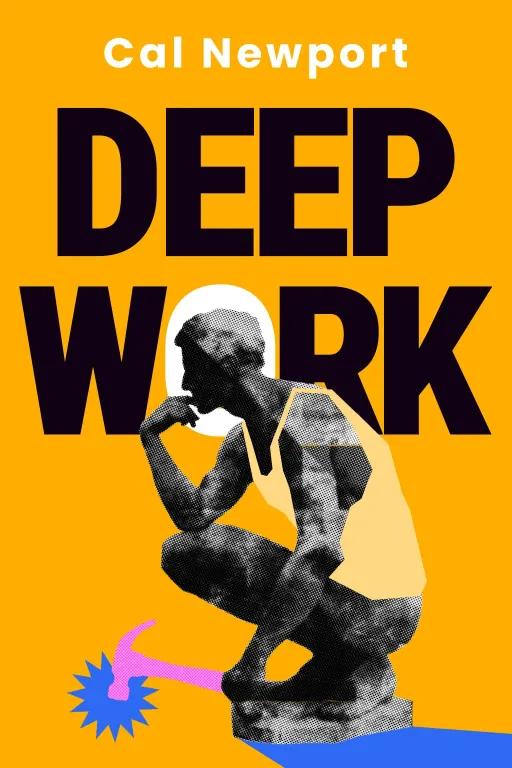
Nova: Exactly, Atlas! And that's the illusion we're going to dismantle today. We're diving into a profound concept from a book that has genuinely reshaped how many successful people approach their work: by Cal Newport. What's particularly fascinating about Newport is that he isn't just a self-help guru; he's a computer science professor at Georgetown. He built his entire academic career around this very concept, practicing what he preaches long before he even put pen to paper for this book. He's a living testament to the power of focused concentration.
Atlas: That's a great point. It adds a layer of credibility when the author isn't just theorizing, but actively living the principles. So, he's not just telling us to do it, he's showing us it's possible.
Nova: Precisely. And the core of our podcast today is really an exploration of how our modern obsession with speed and constant activity is actually hindering our ability to achieve meaningful results, and how we can reclaim focused attention as our most valuable asset. Today we'll dive deep into this from two perspectives. First, we'll explore the hidden costs of our 'always-on' culture and the illusion of productivity. Then, we'll discuss how to cultivate 'Deep Work' as a strategic advantage for anyone looking to make a significant impact.
The Busy Trap: Why Constant Activity Undermines True Productivity
SECTION
Nova: Let's start with what Newport calls 'shallow work.' This is the logistical, non-cognitively demanding stuff, often performed while distracted. Think answering emails, quick meetings, social media checks. And here's the insidious part: for many, especially founders, these activities become the default. They feel productive because they're things, but they're not actually moving the needle on complex problems.
Atlas: I totally know that feeling! You get to the end of the day, your inbox is empty, your Slack is cleared, and you feel like you've been running a marathon. But then you look at your big, strategic goals, and they haven't budged. It's like being on a treadmill – lots of motion, no forward progress.
Nova: That's a perfect analogy, Atlas. And it's not just about feeling busy. There's a real cognitive cost. Newport talks about 'attention residue.' When you switch from one task to another, your attention doesn't immediately follow. A 'residue' of your attention remains stuck on the previous task. So, if you're constantly jumping from a complex product strategy document to a quick email, then to a team sync, then back to the document, you're never giving your full attention to any single thing.
Atlas: Hold on, so you're saying that even a five-minute email check can derail my focus for much longer? That sounds rough, but how do you measure that 'cognitive residue'? It feels invisible.
Nova: It is invisible, but the impact is profound. Imagine your brain as a high-performance computer. Every time you switch tasks, it's like opening and closing multiple heavy applications. There's a loading time, a memory drain, and the previous program is still running in the background, slowing everything down. For a founder trying to solve a complex problem – say, designing a new growth loop or refining a pitch deck – that kind of fragmented attention makes deep, creative problem-solving nearly impossible. You’re constantly operating at a fraction of your cognitive capacity.
Atlas: I can definitely relate. It’s like trying to write code while simultaneously having a conversation and watching a movie. The quality of the code is going to suffer, and you’re going to feel exhausted. But for someone building a team, isn't constant communication and being available just part of the job? How do you escape that without missing something crucial or letting your team down?
Nova: That's the core tension, isn't it? The belief that being constantly available effective leadership. But what if your constant availability is actually preventing you from doing the high-level strategic thinking that your team from you? What if it's leading to reactive leadership instead of proactive vision? The cost isn't just personal exhaustion; it's a degradation of the quality of your output, which then impacts your product, your team, and ultimately, your company's growth. The assumption that more communication equals better communication often leads to a lot of shallow, low-value interactions.
Atlas: So basically you're saying that while we're patting ourselves on the back for clearing our inbox, we're slowly eroding our ability to do the work that truly matters. That's a bit unsettling, honestly.
Nova: It is, but it’s also incredibly empowering, because it means the solution is within our control. The problem isn't busyness itself; it's busyness.
Unlocking 'Deep Work': A Founder's Blueprint for Focused Impact
SECTION
Nova: And that naturally leads us to the antidote to this busy trap: the concept of 'deep work' itself. Newport defines it as "professional activities performed in a state of distraction-free concentration that push your cognitive capabilities to their limit." It's the kind of work that creates new value, improves your skills, and is difficult to replicate.
Atlas: That’s a great way to put it. "Distraction-free concentration." It almost sounds like a superpower in today's world. But what does that really look like in practice? Is it just about being alone in a room, away from everyone?
Nova: Not necessarily alone, but definitely from distractions. Think of it like this: your brain is an incredibly powerful engine, but it needs specific, high-octane fuel and the right conditions to run optimally. Shallow work is like constantly trying to start and stop that engine, using low-grade fuel, and expecting it to perform like a race car. Deep work is giving it the right fuel, clearing the track, and letting it build up to top speed. It’s about creating an environment—physical and mental—where your cognitive abilities can truly flourish.
Atlas: I get the analogy. So how does a founder, who has a million things pulling at them, actually this for 90 minutes? What are the first steps? What about urgent team issues or investor emails? The world doesn't stop just because I want to do some 'deep work.'
Nova: You're right, the world doesn't stop, but you can build a fortress around your focus. Newport emphasizes the importance of. It's not about spontaneously deciding to do deep work; it's about making it a deliberate, scheduled part of your day. For a founder, this might look like blocking out 90 minutes first thing in the morning, before the daily chaos begins. It could mean finding a quiet spot, putting your phone on airplane mode, closing all unnecessary tabs, and having a clear objective for that session.
Atlas: Okay, so scheduling it is key. But what if something genuinely urgent comes up during that 90 minutes? How do you balance the need for deep work with the unpredictable nature of leading a startup?
Nova: That's where the strategic "no" comes in. It's about being ruthless with your time and attention. Newport isn't advocating for ignoring your team or investors. He's advocating for. Can that "urgent" email wait 90 minutes? Can you delegate that quick decision? Often, what feels urgent is actually just a distraction. It's about setting boundaries, communicating those boundaries to your team, and trusting them to handle things for a short period. It also means preparing for your deep work session, perhaps by front-loading quick tasks or clearly outlining what you be doing.
Atlas: That makes me wonder, what are the common misconceptions about deep work? Is it just for creatives or academics? Is it just about being alone for hours on end?
Nova: Absolutely not. That's a huge misconception. Deep work is not just for authors or professors. It's for anyone who needs to solve complex problems, learn new skills quickly, or produce high-quality creative output. For a founder, that's everything from product strategy, to fundraising, to defining company culture. And it doesn't mean isolating yourself for days. Even 90 minutes of truly uninterrupted, focused work can yield more progress than an entire day of fragmented, shallow tasks. The key is the of the focus, not just the quantity of time. It's about pushing your cognitive limits, not just filling time.
Atlas: That’s actually really inspiring. It frames deep work not as a luxury, but as a strategic imperative for anyone who wants to make a real impact. It’s about working smarter, not just harder.
Synthesis & Takeaways
SECTION
Nova: Exactly, Atlas. What we’ve really explored today is that escaping the busy trap isn’t just about personal efficiency; it’s about enabling deep work, which in turn leads to superior output, quicker skill acquisition, and profound personal and professional satisfaction. This creates a virtuous cycle. The constant context-switching and shallow work we often default to are literally making us dumber and less effective at solving the truly complex problems that drive innovation and growth. Studies have shown that it can take over 20 minutes to fully regain focus after a significant distraction. That's a huge chunk of time lost every time you glance at a notification.
Atlas: So, for our listeners who are founders, feeling that constant pressure, spinning all those plates, what's one immediate, tangible step they can take this week to start reclaiming their focus and moving towards this deep work model?
Nova: My challenge to you, to anyone listening, is this: look at your schedule for the coming week. Identify one significant task you’ve been putting off that would truly benefit from focused, uninterrupted attention. And then, block out 90 minutes – just 90 minutes – for that task. Turn off all notifications, close all irrelevant tabs, tell your team you're unavailable unless the building is on fire, and dedicate that time entirely to that one problem. Experience the difference.
Atlas: That's a powerful challenge. It's not about an overhaul, but a single, intentional step. I love that. It makes it feel achievable.
Nova: It is achievable, and the results are transformative. It's about making a conscious choice to prioritize quality over perceived quantity.
Atlas: Fantastic insights today, Nova. This has definitely given me a new perspective on how I approach my own schedule.
Nova: Always a pleasure to dive deep with you, Atlas.
Nova: This is Aibrary. Congratulations on your growth!