The Hidden Cost of Digital: Reclaiming Focus in a Distracted World.
Golden Hook & Introduction
SECTION
Nova: Here's a thought experiment, Atlas: What if the very tools designed to connect us are actually making us profoundly disconnected from our own potential?
Atlas: Whoa, that's a bold claim, Nova. Most people would argue the opposite – that connectivity potential, that more access means more opportunity. But I'm listening. You've got my attention.
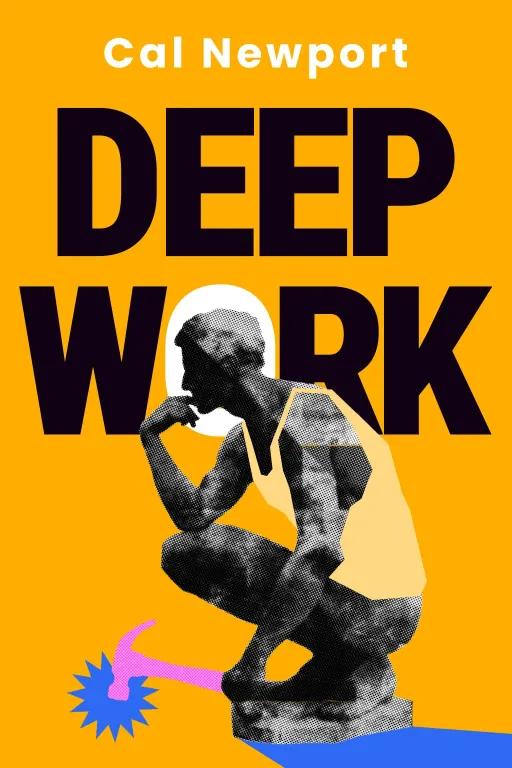
Nova: Exactly! Because today, we're dissecting a silent epidemic that's eroding our ability to perform what Cal Newport, in his seminal, highly acclaimed work, calls 'deep work.' Newport, fascinatingly, is a computer science professor who ironically champions deep, distraction-free work, almost as a rebellion against the very technology he understands so well. He's essentially saying: 'I built this, and now I'm telling you how to escape its clutches.'
Atlas: I love that origin story! It lends his argument so much weight. It’s like the architect of the digital world is giving us the escape plan. And we're not just stopping there, are we?
Nova: Absolutely not. We're pairing that diagnosis with James Clear's equally impactful, which is the practical playbook for fighting back. Clear, with his background in competitive weightlifting and a deep understanding of systems, offers the 'how-to' for Newport's 'why.'
Atlas: That pairing is brilliant! It’s like Newport gives us the crucial understanding of the problem and its stakes, and Clear hands us the step-by-step prescription for solving it. So, diving into that diagnosis first, what this 'deep work' and why is it so fundamentally threatened in our always-on world?
The Erosion of Deep Work: Why Distraction Costs Us Mastery
SECTION
Nova: Great question, Atlas. Cal Newport defines deep work as professional activities performed in a state of distraction-free concentration that push your cognitive capabilities to their limit. Think about a surgeon performing a delicate operation, a writer crafting a complex narrative, or a programmer debugging intricate code. These aren't tasks you can do while checking your phone every two minutes.
Atlas: Right, like trying to solve a complex puzzle while someone's constantly tapping you on the shoulder. It just fragments your thought process.
Nova: Precisely. And the insidious part isn't just the interruption itself, it's what researchers call 'attention residue.' When you switch from one task to another, your attention doesn't immediately follow. A residue of your attention remains stuck on the previous task. So, if you're working on a high-priority strategic plan, and then quickly jump to answer an email, your brain is still mentally juggling that email even as you try to return to the plan.
Atlas: Oh, I know that feeling! It's like trying to build a magnificent sandcastle while a toddler keeps kicking at the foundations, or trying to have a deep conversation with background noise constantly pulling at your ear. For our listeners who are constantly strategizing, building, and implementing, this sounds like a direct hit to their competitive edge. What's the real, tangible of this constant mental fragmentation?
Nova: The cost is enormous, Atlas, and it's far beyond just lost minutes. We're talking about reduced quality of output, slower learning curves, a stifled ability to innovate, and ultimately, a profound lack of skill mastery. Imagine 'Elara,' a brilliant software engineer. She was constantly interrupted by emails, Slack messages, and ad-hoc meetings. She busy, always responding, always 'on.' But her complex coding tasks, the ones that truly moved the needle for her company, suffered. She'd spend hours debugging simple errors that she would have caught in uninterrupted flow. The emotional toll was immense – the frustration of never quite getting into flow, the feeling of being a 'firefighter' instead of an 'architect' of her own work. Her potential was being silently sabotaged.
Atlas: That's a vivid picture. It’s not just about getting less done, then; it’s about getting things done, and doing them less well. It’s the difference between being reactive and being proactive, between treading water and actually sailing somewhere. So, we're trading true mastery for a constant state of being 'on call' and perpetually distracted. That's a profound thought. It's almost like we've collectively agreed to lower our cognitive ceiling.
Nova: Exactly! Newport argues that in an increasingly complex world, the ability to do deep work, to master hard things quickly, is becoming the defining skill of the 21st century. Those who can cultivate it will thrive; those who can't will be relegated to shallow, easily automatable tasks. It’s about securing your future relevance.
Building an Anti-Distraction Fortress: The Power of Intentional Habits
SECTION
Atlas: So, we've identified the enemy, this digital fragmentation, and its devastating cost. But how do we fight back? It feels like we're swimming against a very strong current. It can feel overwhelming.
Nova: That’s where James Clear's comes in, and it's a perfect complement to Newport. Clear emphasizes that willpower alone is a finite resource and often fails. The real power lies in designing your environment and building tiny, consistent habits – atomic habits – that make deep work inevitable and distraction difficult. It’s about architecting your life for focus, not just hoping for it.
Atlas: I'm curious. So you’re saying it's not about some grand declaration of 'I will never be distracted again,' which we all know fails by Tuesday. It's about designing your environment and your routine. For our listeners who are all about immediate application and building, this is gold. Give me an example of how someone would actually apply Clear's framework to this problem.
Nova: Let's take 'Liam,' a marketing strategist who, like Elara, was drowning in digital pings. Instead of trying to checking his phone, which is exhausting, he applied Clear's Four Laws of Behavior Change to create an 'anti-distraction fortress.' First, he focused on "Make it Invisible." He physically moved his phone out of his line of sight during specific work blocks, sometimes even putting it in a drawer in another room.
Atlas: Oh, I like that! Out of sight, out of mind. It’s so simple, but so effective. It cuts off the visual cue, which is often the first trigger.
Nova: Absolutely. Then, to 'Make it Easy,' he used a simple timer for 25-minute focus sprints, a technique called the Pomodoro Technique. No complex apps, just a kitchen timer. When the timer started, he focused on that one high-priority task. And to 'Make it Satisfying,' he celebrated completing a focused block with a short, intentional break – a walk around the block, a quick stretch, or a refreshing glass of water – instead of immediately diving into email.
Atlas: That's so practical! It's about breaking down an overwhelming goal into manageable, almost imperceptible steps. It’s about engineering success, not just wishing for it. But wait, Newport also talks about 'embracing boredom.' That sounds... uncomfortable. How does that fit into building these habits?
Nova: It’s a crucial piece, Atlas. Embracing boredom is about training your brain to resist the urge for instant digital gratification. When you have a moment of downtime – waiting in line, sitting at a traffic light – instead of immediately reaching for your phone, just with the boredom. Allow your mind to wander. This, surprisingly, is where true creativity, problem-solving, and deeper insights often happen. It's like strength training for your attention span.
Atlas: So, it's like we've addicted our brains to constant stimulation, and Newport and Clear are saying we need to rehab them. It's not just about blocking out time; it's about re-wiring our internal response to the world, creating a mental resilience against the constant pull of the digital. That's a much deeper game than just turning off notifications. It’s foundational for anyone who wants to truly master their craft.
Synthesis & Takeaways
SECTION
Nova: Exactly. When you combine Newport's profound understanding of deep work is essential for mastery and human flourishing with Clear's practical, systematic approach to to cultivate it through habit, you get an incredibly powerful toolkit. It’s not just about productivity; it's about reclaiming cognitive control and experiencing true, sustained engagement with your most meaningful work.
Atlas: It sounds like the ultimate competitive advantage in a world drowning in noise. For anyone aiming for mastery, for tangible results, for staying ahead of the curve, this isn't optional; it's foundational. It's about investing in your most valuable asset: your attention.
Nova: It truly is. And our tiny step for you today, our listener: Block out a 60-minute period tomorrow with zero digital distractions to focus on one high-priority task. Just one hour. See what happens.
Atlas: And don't just 'try' it. Design that hour. Turn off notifications. Put your phone in another room. Close unnecessary tabs. Make it an event. Because the future-focused among us know that our attention is our most valuable currency, and intentional focus is the key to unlocking true potential.
Nova: Absolutely. The insights from Newport and Clear aren't just about work; they're about reclaiming agency over your life, over your mind. It's about choosing intention over impulse, and depth over distraction. It’s about building a life of meaning and mastery.
Atlas: Powerful stuff, Nova. Truly powerful. This is Aibrary. Congratulations on your growth!