The Education Blind Spot: Why Traditional Learning Fails to Build True Mastery
Golden Hook & Introduction
SECTION
Nova: Forget the 10,000-hour rule. What if the secret to true mastery wasn't about specializing early, but about intentionally delaying it? Today, we're flipping the script on conventional wisdom.
Atlas: Whoa, that's a bold claim, Nova. Most of us are taught to pick a lane and stick to it, aiming for that laser-like focus from day one. Are you saying that's… wrong?
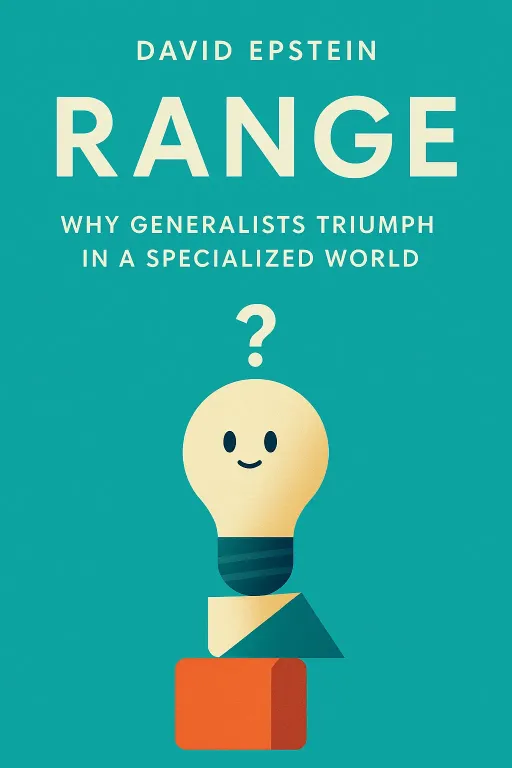
Nova: Not wrong, Atlas, but perhaps incomplete. Today, we're diving into a fascinating conversation inspired by two highly acclaimed books: by David Epstein, and by Cal Newport.
Atlas: Oh, I love those two! Epstein's famously challenged the widely accepted 10,000-hour rule, suggesting that breadth, not just hyper-specialization, is often the key to success. And Newport's has become a cornerstone for anyone trying to reclaim their focus in our increasingly fragmented world.
Nova: Exactly. And the tension between these two ideas—breadth versus depth—is what we're exploring. Our world often champions early specialization, pushing us towards narrow expertise. But this creates a blind spot, making us overlook the immense power of broad learning and deep focus for true, adaptable mastery.
Atlas: I can definitely relate to that. For our listeners, especially those who are architects of solutions, historians of patterns, or strategists of the future, the idea of balancing depth and breadth is critical. How do you build lasting impact if you're either too shallow or too rigid?
Nova: Precisely. And that naturally leads us to our first core idea: the unexpected power of being a generalist.
The Power of Range: Why Generalists Succeed in a Specialized World
SECTION
Nova: So, let's start with David Epstein's. He argues that in complex, unpredictable environments, generalists—people who develop a wide range of skills and experiences—often thrive. He uses a fantastic comparison between two sports legends: Roger Federer and Tiger Woods.
Atlas: Oh, I know this one! The ultimate specialist versus the ultimate generalist, at least in their early careers.
Nova: Exactly. Tiger Woods was groomed for golf almost from birth. His father famously said, "He was chosen." Every aspect of his childhood, his training, his family life, revolved around golf. He was the epitome of early, intense specialization. And he was incredibly successful, no doubt.
Atlas: Unmatched focus, undeniable results. That's the narrative we're often told to emulate.
Nova: But then you have Roger Federer, another GOAT. Unlike Woods, Federer played a multitude of sports as a child: badminton, basketball, soccer, wrestling, skiing, skateboarding. He didn't focus on tennis until much later than most elite players. His mother described him as an "all-around athlete."
Atlas: So you're saying Federer's broad athletic background contributed to his adaptability and longevity in tennis? That's counter-intuitive. For someone building complex solutions, isn't deep expertise non-negotiable? How does a 'generalist' avoid being a jack-of-all-trades, master of none?
Nova: That’s a crucial question. Range isn't about being superficial. It's about developing a that allows for novel connections, pattern recognition across domains, and superior problem-solving in new situations. Federer’s diverse athletic experiences gave him a wider movement vocabulary, better court vision, and a more adaptive approach to his game. He could draw on skills from soccer or basketball to anticipate and react in tennis in ways a pure specialist might not.
Atlas: That makes me wonder… so it's like a strategic leader who's worked in finance, then marketing, then operations. They might not be the absolute expert in any one silo, but they can see the interconnections and anticipate systemic challenges better than someone who's only ever known one department.
Nova: Precisely! Think of someone like Charles Darwin. He wasn't just a biologist; he had a deep passion for geology, botany, even theology. His broad intellectual curiosity, his "sampling period" across various scientific fields, allowed him to synthesize observations into the groundbreaking theory of evolution. He saw patterns others missed because his mental toolkit was so much larger.
Atlas: That’s a great example. So the takeaway for our listeners who are constantly strategizing and building is that rather than rushing to specialize, cultivating a diverse skill set, even if it feels tangential, can actually be a strategic advantage for innovation and adaptability. It creates transferable skills and a more robust conceptual understanding.
The Discipline of Deep Work: Mastering Focused Effort in a Distracted Age
SECTION
Nova: So while range gives us the map, we still need the engine to get there. And that's where Cal Newport's 'Deep Work' comes in. He explains that true productivity and skill mastery come from intense, focused work on a single task, free from distraction.
Atlas: Okay, but in today's always-on, always-connected world, deep work sounds almost utopian. How do you even to cultivate that level of focus when every notification is screaming for attention? For our architect listeners who need to build complex systems, but are constantly interrupted by team messages or client demands, this sounds incredibly challenging.
Nova: It absolutely is challenging, but that's why it's becoming rarer and more valuable. Newport provides compelling examples. Take a software developer who needs to design a complex algorithm. If they're constantly checking email, jumping between tasks, their brain never fully engages with the problem. The quality of their code, and their ability to innovate, suffers.
Atlas: So it’s not just about getting more done, but about the of what gets done.
Nova: Exactly. Newport highlights Bill Gates's famous "Think Weeks," where he would retreat to a cabin for a week or two, completely isolated from distractions, to read and think deeply about Microsoft's strategy. This wasn't a luxury; it was a core part of his success. He was applying the "monastic" philosophy of deep work, removing himself entirely from distractions.
Atlas: That's incredible. But for those of us who don't have a cabin in the woods or the luxury of a "Think Week," what's one immediate, practical step a strategist or builder could take to carve out 'deep work' time, even amidst a demanding schedule?
Nova: A great starting point is scheduling deep work blocks, even if they're just 60 or 90 minutes. Treat them like non-negotiable meetings with yourself. Put your phone on airplane mode, close unnecessary tabs, tell your team you're "unavailable" for that window. Newport also talks about creating a "deep work ritual"—a consistent routine that signals to your brain it's time to focus. It could be brewing a specific tea, listening to a certain type of music, or going to a particular location.
Atlas: That sounds incredibly powerful. It’s about being intentional, not just hoping focus will magically appear. The idea of a ritual is actually quite strategic – it builds a habit loop for productivity.
Integrating Broad Exploration and Deep Focus for Adaptable Mastery
SECTION
Nova: So we have the expansive view from and the focused execution from. The real magic, and the answer to our deep question, is in how we integrate them. It’s not an either/or proposition, but a cyclical process: broad exploration to identify promising avenues, then deep work to master chosen skills, followed by more exploration.
Atlas: That makes sense. It's not about choosing a lane, but mastering the art of switching lanes strategically. For our listeners who are 'The Strategist,' always looking for the next growth area or unique voice, how does this integration lead to truly adaptable mastery and lasting impact?
Nova: Take, for instance, a historical figure like Leonardo da Vinci. He was the ultimate generalist—a painter, sculptor, architect, musician, scientist, inventor. He explored an incredible range of fields. But when he was working on, say, the, he engaged in incredibly deep work, dissecting cadavers to understand human anatomy, meticulously studying light and shadow. His broad range informed his deep focus, and his deep focus allowed him to execute his broad visions with unmatched mastery.
Atlas: Wow. So his range gave him the insights and the ideas, and his deep work allowed him to bring those insights into being with profound skill. It’s about leveraging diverse knowledge to identify the most impactful areas for concentrated effort.
Nova: Exactly. This blend creates resilience and innovation. You have the breadth to understand complex problems and identify novel solutions, and the depth to actually execute those solutions to a high standard. It allows you to adapt when your specialized field changes, because you have a wider foundation to draw upon.
Atlas: So, it's about being able to see the big picture, pick the right battles, and then execute those battles with unmatched focus. It sounds like the ultimate competitive advantage for anyone looking to build a lasting legacy.
Synthesis & Takeaways
SECTION
Nova: What an incredible journey through these two powerful concepts. Ultimately, true mastery in today's complex world isn't about choosing between being a generalist or a specialist. It's about intelligently cultivating both.
Atlas: This isn't just about personal growth; it's about building more robust solutions, understanding the historical currents that shape our present, and crafting truly impactful strategies that stand the test of time. It’s about overcoming that education blind spot.
Nova: It’s a dynamic process of expansion and concentration, always seeking to learn widely and then apply that learning intensely.
Atlas: So, for our listeners, how might you consciously design your own learning journey, deliberately seeking both wide-ranging experiences and intense periods of focus, to cultivate your unique adaptable mastery?
Nova: Think about it. Where can you expand your range, and where can you commit to deeper work? The answers might surprise you.
Atlas: This is Aibrary. Congratulations on your growth!