The Deep Work Secret: How to Create Without Constant Distraction
Golden Hook & Introduction
SECTION
Nova: What if I told you that being busy, constantly checking emails, and juggling a million tasks is actually making you productive, and actively killing your creative potential? Sounds counterintuitive, right?
Atlas: Whoa, that's a bold claim, Nova. Because honestly, for most of us, "busy" feels like the default setting. It's almost a badge of honor to be constantly swamped, to have a buzzing phone and an overflowing inbox. We productive when we're reacting to everything.
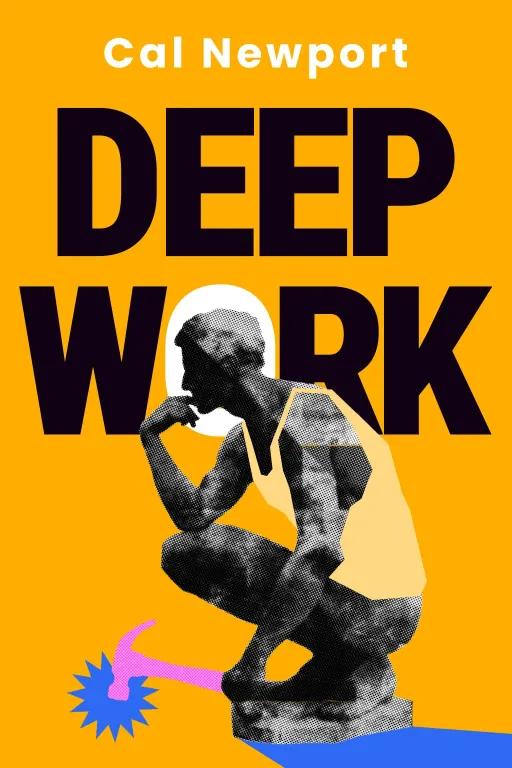
Nova: Exactly! And that feeling is a powerful illusion. Today, Atlas, we're diving into a concept that feels almost rebellious in our always-on world: "Deep Work," largely popularized by Cal Newport, and complemented beautifully by ideas from Jocelyn K. Glei's "Manage Your Day-to-Day."
Atlas: Ah, the prophets of focus in a sea of pings. Newport, if I recall, isn't just an author; he's a computer science professor who practices what he preaches, writing complex academic papers bestsellers without even having social media. That's a level of digital monasticism I both admire and fear.
Nova: It is! And it gives him immense credibility when he talks about carving out profound focus. The cold, hard fact is this: distraction is the enemy of creation, especially when you're balancing many roles. To truly excel, whether it's in creative writing, complex problem-solving, or mastering a new skill, you need uninterrupted, focused time. It's not just about doing things faster; it's about producing your absolute best work.
The Non-Negotiable Necessity of Deep Work for Creation
SECTION
Atlas: Okay, so "deep work." I hear that term thrown around a lot. Can you break down what Newport means by it? Because for many, "focused time" might just mean "doing my homework without YouTube open."
Nova: That's a great distinction. Newport defines deep work as "professional activities performed in a state of distraction-free concentration that push your cognitive capabilities to their limit." It's the kind of effort that creates new value, improves your skills, and is incredibly difficult to replicate. Think of it like this: imagine a master sculptor. They have a block of raw marble. To create something truly magnificent, something that transcends the ordinary, they need sustained, uninterrupted hours. They can't be chipping away for five minutes, then checking their phone, then responding to a text, then going back to the chisel.
Atlas: Right. The constant stopping and starting would shatter the flow, probably literally shatter the marble if they're not careful.
Nova: Precisely. That constant interruption forces them to restart their mental process, to re-engage with the material, to find that deep connection again. And that takes immense energy. Shallow work, on the other hand, is the logistical stuff: emails, meetings, administrative tasks. Important, yes, but rarely pushing your cognitive limits or creating lasting value.
Atlas: I get the sculptor analogy. But for someone juggling studies, a job, and trying to build a creative portfolio—like many of our listeners who are "Emerging Architects" in their own fields—"uninterrupted time" sounds like a mythical creature. How do you even that time, let alone justify it, when there's always a deadline looming or an email to answer from a professor or a client?
Nova: That's the core challenge, isn't it? It's not about time; it's about it, strategically. Newport argues that deep work is becoming increasingly rare in our hyper-connected economy. Because it's rare, it's incredibly valuable. Those who can consistently engage in deep work are the ones who will innovate, create, and excel. It's a strategic advantage. It's about prioritizing creation over reaction.
Atlas: So, it's less about having an empty calendar and more about declaring, "This block of time for deep work, and everything else can wait"?
Nova: Exactly. It’s a deliberate, almost defiant act in a world that constantly demands your fragmented attention. Instead of letting your schedule be a reactive mess of incoming requests, you proactively carve out sacred time for what truly matters: the creation and learning that will define your future.
Architecting Your Day for Uninterrupted Focus
SECTION
Atlas: Okay, I’m sold on the "why." It's a necessity, not a luxury. But that's the big hurdle: the "how." How do you go from wishing for more focused time to actually building it into a life that's already packed with responsibilities?
Nova: And that's precisely where the "how" comes in, Atlas. It's not just about believing in deep work, but actively building it into your life. This is where both Newport and Glei offer some serious blueprints. Newport, for instance, talks about scheduling your deep work. He suggests various approaches: you could have a "fixed-schedule productivity" where you block out specific deep work hours and treat them as non-negotiable appointments. Or a "journalistic approach," where you seize any unexpected free time for deep work.
Atlas: A journalistic approach, I like that. Like a reporter always ready to chase a story. So, you're saying it's about being intentional, rather than just hoping for a quiet moment to magically appear.
Nova: Absolutely. And Glei, in "Manage Your Day-to-Day," really emphasizes the importance of routines and rituals. It's not just about you work deeply, but you prepare for it. These small, consistent actions build momentum and protect against the fragmentation of modern life. Think of it like a musician who has a specific warm-up routine before a performance. It signals to their brain, "Okay, we're shifting gears. It's time to focus."
Atlas: That makes sense. A ritual creates a boundary. But what about the? The constant pull of messages, social media, even legitimate work or study requests? How do you actually that block when the world demands your immediate attention? That sounds like trying to meditate in a mosh pit.
Nova: That's the real battle, isn't it? The first step is the most obvious, yet often the hardest: turn off all notifications. Seriously, all of them. Put your phone in another room, or on airplane mode. Close unnecessary tabs. It’s about creating a physical and digital environment that signals deep work. Newport even talks about communicating your deep work blocks to others, so they know not to disturb you.
Atlas: So, it's not just about personal discipline; it's about setting expectations with the outside world. That’s a good point for someone balancing team projects at work and group studies. You have to actively build the walls around your focus.
Nova: Precisely. It’s an act of self-respect for your creative output. Nova's take on this is that structuring your time for deep focus is not a luxury; it's a necessity for meaningful creative output and skill development. It’s about saying, "My ability to create and learn at a high level is important enough to protect."
Synthesis & Takeaways
SECTION
Atlas: This is really powerful. So, for our listeners who are natural integrators, balancing studies and work, driven by self-improvement, this isn't just about getting more done. It's about building that solid foundation for future creative output, expressing their inner worlds through creative writing, and truly mastering their craft, right? It's about intentional growth.
Nova: Absolutely, Atlas. It's about cultivating a mindset where focused creation is non-negotiable. It’s the difference between merely completing tasks and truly something of lasting value. It's the engine of genuine skill development.
Atlas: I love that. It reframes the whole idea of productivity. It's not about how many hours you clock, but how many hours you invest.
Nova: Exactly. And the beautiful part is, it doesn't require a complete overhaul of your life. It starts small. Our "tiny step" for today, directly from the wisdom we've discussed, is incredibly simple, yet profoundly impactful.
Atlas: I'm ready. Lay it on me.
Nova: Block out 90 minutes tomorrow purely for creative writing, or any demanding cognitive task. And here’s the crucial part: turn off notifications. No pings, no alerts, just you and your work. Treat it like the most important meeting of your day.
Atlas: Just 90 minutes. I think anyone can find 90 minutes if they're serious about building something meaningful. That's a challenge I can get behind. It's practical, actionable, and directly addresses the core problem of distraction.
Nova: Give it a try. See what magic you can create when the noise is silenced. This is Aibrary. Congratulations on your growth!