The 'Busy' Trap: Why Doing Less Leads to More Impact
Golden Hook & Introduction
SECTION
Nova: Atlas, I'm going to give you a challenge. Five words. Describe the feeling of being 'busy' but not productive. Go.
Atlas: Oh, man. Endless. Empty. Pointless. Exhausting. Why? Just…?
Nova: Exactly! That 'why' is the million-dollar question, isn't it? Because in our always-on world, that feeling you just described? It's become the default. We're told busyness equals importance, constant motion equals progress. But what if that's a massive blind spot, keeping us from making real impact?
Atlas: Yeah, I mean, it feels almost counter-cultural to even suggest that. We're conditioned to believe the person working the most hours, sending the most emails, is the most dedicated, the most successful. My inbox alone feels like a badge of honor, or maybe a scarlet letter, depending on the day.
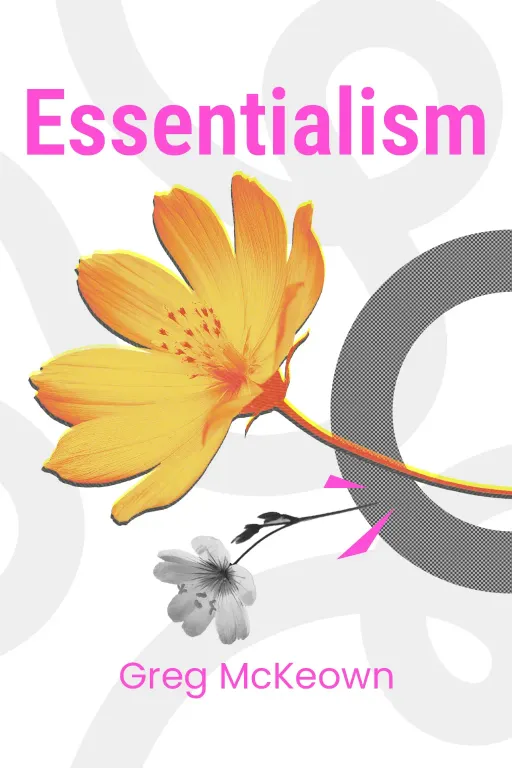
Nova: Well, today, we're ripping off that badge and digging into two transformative books that challenge this very notion: "Essentialism" by Greg McKeown and "Deep Work" by Cal Newport. McKeown, with his background consulting for Fortune 100 companies, brings a strategic, almost ruthless clarity to identifying what truly matters. And Newport, a computer science professor, grounds his arguments in a rigorous, almost scientific approach to focus. They both argue that true impact isn't about doing more, but about doing less, better.
Atlas: Okay, so you're telling me all those overflowing calendars and back-to-back meetings might actually be… holding us back? That's going to hit home for a lot of our listeners who are constantly striving to build, to lead, to make a difference. It feels like a risky proposition to slow down.
The 'Busy' Trap: Activity vs. Impact
SECTION
Nova: It absolutely is, Atlas. And that's precisely the 'blind spot' they're talking about. We confuse activity with productivity. Think about the archetypal "always-on" executive. Let's call her Sarah. Sarah is a whirlwind. Her calendar is packed from 7 AM to 9 PM. She's on every committee, replies to emails at midnight, takes client calls on vacation. She incredibly busy. She incredibly important.
Atlas: I know a few Sarahs. I might a Sarah on some days, if I'm being honest. It's almost a point of pride, right? Like, "Look how much I'm juggling!"
Nova: Exactly. But here's the crucial part: despite all that frenetic activity, Sarah's team struggles to launch critical new initiatives. Key projects stall. Her strategic vision, which is her core strength, gets diluted across a dozen minor responsibilities. The cause is often a fear of missing out, a desire to please everyone, or a societal pressure to appear indispensable. The process is scattered attention, context-switching, and a constant state of reactivity. And the outcome? Burnout, stalled impact, and a deep, underlying sense of unfulfillment, even though she's constantly in motion. She feels important, but deep down, she knows she's not moving the needle on what truly matters.
Atlas: Wow. That's a powerful and slightly uncomfortable image. So, are you saying that being visible, showing up, being responsive — that's not actually a good thing for someone trying to lead a team or build something meaningful? Because for many, especially in early-stage teams, visibility crucial. You need to be seen, you need to be connected. How do you square that circle?
Nova: That's a brilliant question, and it gets to the heart of the distinction. It's not that visibility or responsiveness are inherently bad. It's about you're visible and you're being responsive to. If your busyness is driven by a fear of saying no, or a lack of clarity on your priorities, then it becomes a liability. The problem isn't the activity itself; it's the behind it. It's the difference between doing things to busy and doing things that genuinely impactful. McKeown argues that if you don't prioritize your life, someone else will. And their priorities might not align with your core mission, your strategic vision.
Atlas: That's a stark way to put it. So, the 'blind spot' isn't just about being busy, it's about being busy on. I imagine a lot of our listeners, who are strategic seekers and engaged builders, are constantly navigating those external pressures. They're trying to align and motivate their teams, and that often means being present and responsive.
Shifting Focus: Essentialism and Deep Work
SECTION
Nova: Precisely. So if busyness is a trap, how do we climb out? That's where McKeown and Newport offer a lifeline. McKeown's "Essentialism" is all about the disciplined pursuit of 'less but better.' It's about figuring out what is truly essential and then ruthlessly eliminating everything else. Imagine a startup founder, let's call him David. David had three promising products in development, but none were really taking off. He was stretched thin, his team was exhausted. McKeown's approach would encourage David to ask: which of these products, if successful, would have the most profound, lasting impact?
Atlas: Okay, so he picks one. But what about the other two? Those might be good ideas too, right? That's the challenge for many of our listeners: good ideas are everywhere, opportunities knock constantly. How do you say no to the to make room for the?
Nova: That's the paradox. David, after much agonizing, chose to focus all his resources, all his energy, on just one product. He didn't just scale back; he the others. The cause was the realization that diluted effort leads to diluted results. The process was a deep dive into what truly aligned with his company's core mission and vision, and then a courageous 'no' to everything else. The outcome? That single product, with undivided attention, scaled massively, becoming a market leader. He amplified his impact without increasing his hours. It's a fundamental shift from "how can I fit everything in?" to "what do I need to let go of to make my highest contribution?"
Atlas: That sounds incredibly liberating, but also terrifying. I mean, for an early-stage team, saying 'no' to potential revenue streams or partnerships feels like a huge risk. But I can see how that focused effort, that singular vision, could be a game-changer. So, once you've stripped away the non-essential, how do you make sure that essential work actually gets done effectively?
Nova: That's where Cal Newport's "Deep Work" comes in. If McKeown helps you identify the essential, Newport shows you how to execute it with maximum effectiveness. He makes a compelling case for focused, uninterrupted work that produces high-value results. He contrasts it with "shallow work" – the emails, the meetings, the administrative tasks that are often necessary but don't require deep cognitive effort.
Atlas: Right, the kind of stuff that fills up Sarah's 80-hour week. So, what's an example of deep work in action? How does someone cultivate that ability? Because in our notification-saturated world, uninterrupted focus feels like a superpower.
Nova: It truly is. Newport gives the example of a software engineer, let's call him Alex. Alex realized he was spending his days in a constant state of reactivity, bouncing between Slack messages, quick fixes, and short meetings. He was busy, but the complex coding challenges that required sustained concentration were being pushed to evenings or weekends. His solution? He started blocking off specific, long stretches of time – four hours, sometimes more – and physically removing himself from distractions. No internet, no phone, just the problem at hand.
Atlas: Wait, no internet? In a tech job? That sounds almost impossible for many. How did that even work?
Nova: He treated it like a sacred ritual. The cause was the recognition that complex problem-solving requires unbroken concentration. The process involved creating an environment utterly free of distraction and explicitly communicating these "deep work blocks" to his team. The outcome? His coding quality and speed dramatically improved. He could solve problems in those four hours that used to take him days of fragmented effort. It's about cultivating the ability to concentrate without distraction on a cognitively demanding task, a skill that's increasingly rare, yet increasingly valuable. It's like comparing a craftsman meticulously carving a single masterpiece to a factory line worker assembling a thousand identical widgets. Both are work, but the depth of engagement and the value of the output are vastly different.
Atlas: That's a great analogy. So, it's not just about saying 'no' to non-essential things, but also creating the conditions to say 'yes' fully, deeply, to the essential ones. I can see how a strategic seeker would want to apply this to their foresight planning, or an inspirational leader to the development of their team's vision. It’s about creating space for truly high-impact thinking.
Synthesis & Takeaways
SECTION
Nova: Absolutely. What McKeown and Newport ultimately teach us is that true impact isn't about doing more, or even just doing things faster. It's about strategically choosing what matters most, ruthlessly eliminating the non-essential, and then dedicating focused, uninterrupted energy to that chosen few. It's about reclaiming agency over our time and our focus, defining what success truly means for ourselves, rather than letting the world define it for us. It’s about moving from a reactive existence to an intentional one.
Atlas: That's actually really inspiring. It frames the challenge not as a limitation, but as an opportunity for clarity and greater purpose. It's about choosing freedom over obligation, and impact over mere activity.
Nova: Precisely. So, to bring it back to our listeners, especially those who are constantly building and inspiring: What is one activity you can confidently say 'no' to next week that currently consumes your valuable time but doesn't align with your core impact? Even one small 'no' can create a ripple effect.
Atlas: That's a powerful question to end on. It's about giving ourselves permission to redefine productivity.
Nova: Exactly. This is Aibrary. Congratulations on your growth!