The 'Always-On' Trap: Why Constant Reactivity Kills Your Deep Work
Golden Hook & Introduction
SECTION
Nova: What if the biggest obstacle to your success isn't lack of effort, but rather, effort spread too thin across shallow tasks?
Atlas: Oh man, Nova, that feels like a personal attack! Too much effort? I thought the whole point was to hustle harder, chase every notification, and always be "on." Are you saying I’ve been doing it wrong this whole time?
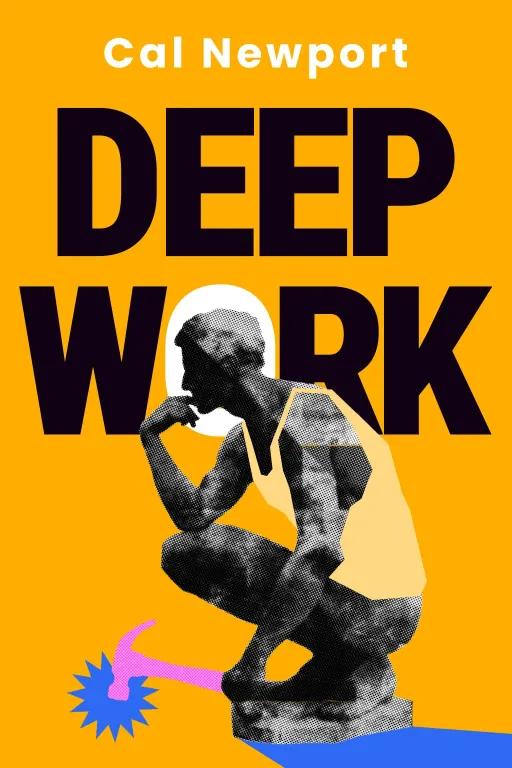
Nova: Well, Atlas, what I’m saying is that today, we're dissecting a concept that challenges that very notion, pulled from the highly acclaimed book, by Cal Newport. What's fascinating about Newport is that he's a computer science professor at Georgetown who famously doesn't use social media, which gives him a rather unique, and some might say, controversial perspective on focus in the digital age.
Atlas: Huh, a computer science professor who shuns social media… that's like a chef who doesn't eat. I’m already intrigued. For anyone out there trying to master a complex skill or build something significant, the idea of reclaiming focus sounds like a pipe dream.
Nova: Exactly. And that’s precisely where we need to start.
The Superpower of Deep Work: Building a Fortress of Focus
SECTION
Nova: Newport defines Deep Work as "the ability to concentrate without distraction on a cognitively demanding task." He argues that this skill is becoming increasingly rare in our hyper-connected world, but also incredibly valuable. Think of it as building a mental fortress around your concentration.
Atlas: Okay, but in a world of constant pings, urgent emails, and unexpected meetings, isn't "undistracted concentration" just a fantasy for most of us? Especially for those juggling high-stakes projects, where every minute feels like it needs to be accounted for in real-time.
Nova: That’s a fair point, and it’s the core tension Newport addresses. He’s not saying it’s easy, but he's arguing it's. Deep Work isn't just about ignoring distractions; it's about training your brain to sustain intense focus. It’s how you actually produce high-quality output and learn complex information quickly. It’s like being a mental athlete. You wouldn’t expect to run a marathon without training your body, so why do we expect our brains to perform at peak capacity without training them to focus?
Atlas: I guess that makes sense. We expect instant gratification from our technology, so we expect instant results from our brains. But that doesn’t change the reality of daily demands. For someone trying to master architecture, or make shrewd investment decisions, they need to process vast amounts of information and make critical judgments. How does this ‘deep work’ translate into tangible results for them?
Nova: It translates into breakthroughs. Consider a software engineer trying to debug a complex, multi-threaded application. If they’re constantly interrupted, their mental model of the system gets fragmented. Each interruption forces them to rebuild that model from scratch. But with deep work, they can hold that entire complex system in their mind, allowing them to see patterns, identify root causes, and find elegant solutions that shallow work would never reveal. It’s not just about spending more time; it’s about spending time. It’s what Gary Keller and Jay Papasan talk about in "The One Thing"—identifying your single most important priority and giving it your primary energy, creating a domino effect for everything else.
Atlas: That’s a great analogy, the mental athlete. I can definitely see how that would apply to someone trying to design a complex building, where a small error could have massive consequences, or an investor analyzing market trends, where a nuanced understanding is everything. It sounds like a competitive advantage, almost a secret weapon in a noisy world.
Nova: Precisely. It allows you to produce at an elite level, and it’s also key to rapidly learning difficult things. In a rapidly changing world, the ability to quickly master new skills is paramount.
Building the Fortress – Strategies & Overcoming the 'Always-On' Trap
SECTION
Atlas: So you’ve convinced me it’s a superpower. But if it's so powerful, how do we actually it? How do we build this ‘fortress’ when the digital world is constantly bombarding us, demanding our attention every second? It feels like trying to meditate in a mosh pit.
Nova: It starts with intentionality, Atlas. Newport isn't advocating for isolation; he's advocating for strategic, scheduled isolation. He outlines methods for scheduling and protecting focused work blocks, which he calls "ritualizing deep work." This means identifying and you’ll do deep work, and what rules you’ll follow. It could be dedicating the first 90 minutes of your day, or even a specific afternoon, to your most challenging task, with absolutely no notifications.
Atlas: But what about client demands, market fluctuations, or team emergencies? For someone in a dynamic environment, completely unplugging for 90 minutes feels like professional suicide. I imagine a lot of our listeners are thinking, "My boss would never allow that," or "My clients expect instant responses."
Nova: That’s a common misconception. Deep work doesn’t mean you’re unreachable 24/7. It means you’re strategically unreachable for. It’s about setting boundaries and communicating them. You might tell your team, "I'll be offline for a deep work session from 9 to 10:30 AM; for true emergencies, call this number, otherwise I'll respond after." It shifts the expectation from constant reactivity to. Many busy professionals successfully implement this by scheduling deep work at non-peak times, like early mornings before the office gets busy, or after hours. The key is to treat that deep work block with the same reverence you would an important meeting.
Atlas: That’s actually really inspiring. So it’s not about becoming a hermit, but about being a tactical hermit for a few hours a day. It’s like saying, "I'm going to put on my mental armor now, please hold all non-urgent fire." Does this tactical unplugging also impact mental well-being beyond just productivity? Does it foster more creativity or calm?
Nova: Absolutely. Newport argues that deep work doesn't just make you more productive; it makes you happier. There’s a profound sense of satisfaction that comes from mastering a difficult skill or producing something truly excellent. It combats the feeling of being fragmented and overwhelmed by shallow tasks. It allows for sustained concentration, which is a key component of flow states—those moments where you’re so immersed in a task that time seems to disappear. That’s where true creativity and innovative solutions often emerge. It’s a skill that builds mental resilience, allowing you to approach challenges with greater clarity and less stress.
Synthesis & Takeaways
SECTION
Nova: So, to synthesize this, Deep Work isn't just about getting more done; it's about doing work, finding greater satisfaction, and ultimately achieving mastery in your chosen field. It's a skill that builds mental resilience and allows for profound insights, combating the constant reactivity that erodes our capacity for true focus.
Atlas: Wow, that gives me chills. The idea that by intentionally carving out these deep work periods, we transform scattered effort into high-impact progress—it's incredibly powerful. It’s not just a productivity hack; it’s a path to a more fulfilling and impactful life. For anyone out there who feels like they’re constantly drowning in notifications and shallow tasks, it’s a lifeline.
Nova: It really is. And the tiny step to start is incredibly simple, yet profound. Tomorrow, block out 90 minutes with no notifications for your most challenging task. Just 90 minutes. See what happens.
Atlas: Just 90 minutes. That feels achievable. It's about respecting your own time and intellectual capacity enough to protect it, to build that fortress. It’s an investment in your future self.
Nova: Exactly. The true cost of constant reactivity isn’t just lost productivity; it’s lost potential, lost mastery, and ultimately, a less fulfilling life. Reclaiming deep work is reclaiming yourself.
Atlas: A powerful call to action. This is Aibrary. Congratulations on your growth!