The 'Always-On' Trap: How to Master Deep Work and Avoid Burnout
Golden Hook & Introduction
SECTION
Nova: If your brain feels less like a finely tuned engine and more like a browser with 50 tabs open, this episode found you. We're talking about the silent tax on your brilliance: constant distraction.
Atlas: Oh man, that hit a little too close to home! I think my brain has 50 tabs open, and half of them are YouTube videos I meant to watch three days ago. It’s a constant battle, isn’t it?
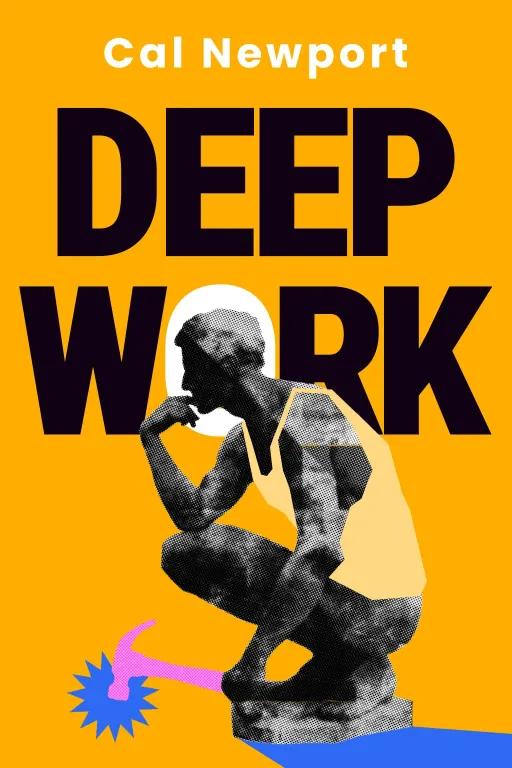
Nova: It absolutely is, Atlas. And it’s a battle many of us are losing, often without even realizing the true cost. Today, we're diving into a concept that promises to reclaim our most valuable asset – our focus – through the lens of a groundbreaking book: "Deep Work" by Cal Newport.
Atlas: Deep Work. I've heard the term, but I'm curious, who is Cal Newport? Is he some productivity guru locked away in a mountain cabin?
Nova: Not at all! What's fascinating about Newport is he's a computer science professor at Georgetown University. So he's steeped in the very technology that often fragments our attention, yet he famously has no social media accounts himself. He lives his philosophy, which lends incredible weight to his arguments. He's not just theorizing; he's practicing.
Atlas: That’s a powerful personal example. So, he's basically saying, "I know what I'm talking about because I live it." But in a world that often feels like it demands us to be 'always-on,' 'always connected,' what does 'deep work' even mean? And is it even possible for those of us trying to build and optimize things constantly?
The Power of Deep Work: Reclaiming Focus in a Fragmented World
SECTION
Nova: That's the million-dollar question, Atlas. Newport defines deep work as "professional activities performed in a state of distraction-free concentration that push your cognitive capabilities to their limit. These efforts create new value, improve your skill, and are hard to replicate."
Atlas: So you’re saying it’s not just about sitting down at your desk; it’s about a specific kind of intense, focused effort?
Nova: Exactly. Think of it as the opposite of "shallow work"—the administrative tasks, the endless emails, the constant meetings. Shallow work is often necessary, but it rarely creates significant value. Deep work, on the other hand, is where true innovation, complex problem-solving, and mastery happen. Newport calls it the "superpower of the 21st century" because it's becoming increasingly rare and therefore, increasingly valuable.
Atlas: I can definitely relate to feeling like I'm constantly doing shallow work, just moving things around on a chessboard without actually changing the game. But how does a strategist, who's always optimizing and needs to be aware of all the moving parts, carve out this 'deep' time when there's always an urgent email, a team question, or a new market trend to analyze? What does deep work actually like in action?
Nova: That's a great question, and it's where the rubber meets the road. Think about someone like Bill Gates. Famously, he would take "Think Weeks" – literally retreating to a cabin for a week or two, completely isolated, to read and think about big ideas for Microsoft. That's an extreme example, of course. For a more relatable scenario, imagine a software engineer grappling with a complex, obscure bug. They can't solve it while simultaneously answering Slack messages, checking social media, and attending ad-hoc meetings. They need an uninterrupted block of time, perhaps 90 minutes, to dive into the code, trace the logic, and truly immerse themselves in the problem. That intense, focused period, where their mind is pushed to its limit, is deep work. And the result? A breakthrough solution that saves countless hours.
Atlas: That makes perfect sense. The bug isn't going to fix itself with fragmented attention. But it also sounds… exhausting. What's the real cost if we do deep work? Beyond just not fixing the bug, what are we actually losing?
Nova: That's the silent tax I mentioned in the hook. Without deep work, you're not just producing less valuable output; you're also experiencing a constant state of cognitive fragmentation. This leads to increased stress, a feeling of being perpetually busy but unproductive, and ultimately, burnout. For a strategist or a builder driven by impact, constantly operating in shallow mode means you're never truly leveraging your sharp mind to its fullest. You're reacting instead of creating. You're optimizing processes that might be fundamentally flawed because you haven't had the deep thought necessary to question their core. You're building, but perhaps not building the thing, or not building it with the optimal architecture.
Atlas: That resonates. It’s like being stuck in a perpetual state of triage, never actually getting to the root cause, just dealing with symptoms. So, it sounds essential, but the gap between understanding its importance and actually doing it feels immense.
Escaping the 'Always-On' Trap: Strategies for Implementation and Overcoming Resistance
SECTION
Nova: It is, and that's precisely where Newport offers practical solutions. He doesn't just diagnose the problem; he gives us a toolkit. The core idea is to schedule deep work, treat it with sacred reverence, and actively minimize distractions.
Atlas: Okay, so how do we implement this? For someone who's building and optimizing, efficiency is key, but so is responsiveness. How do we schedule deep work without alienating our teams or missing critical updates? I mean, my instinct is to always be available, always connected, because that's how you stay on top of things. It feels risky to just… unplug. It’s a bit like delegating a critical task, which I know I do, but it feels counter-intuitive.
Nova: That's a completely valid concern, and it goes to the heart of the "always-on" trap. Newport isn't advocating for you to become a hermit. He suggests that deep work is a you cultivate, and like any skill, it requires practice and intentionality. The "tiny step" we often recommend is to block out just 90 minutes tomorrow for a deep work session. Turn off notifications – phone, email, Slack – and focus on one critical task.
Atlas: Ninety minutes. That still feels like a luxury for some of our listeners. What about the expectation from colleagues or clients? How do you tell your team, "I'm unavailable for 90 minutes" without causing panic or making them feel like you're not a team player? Isn't there a risk of becoming less collaborative?
Nova: That's actually a leadership challenge, not just a personal one. The key is setting clear expectations and communicating the. You can batch your communication, setting specific times to check email or messages. You can inform your team that you're entering a "deep work block" to tackle a complex problem that will ultimately benefit everyone. Frame it as a strategic choice for higher-quality output, not a selfish retreat. Many leaders find that when they model deep work, their teams start to understand its value and even adopt similar practices, leading to a more focused and productive culture overall. It’s about creating boundaries, which can feel like letting go, but it ultimately empowers your team by giving them space to solve problems independently.
Atlas: That’s a really interesting reframe – it's not about being unavailable, it's about being strategically unavailable for a higher purpose. So, what if someone feels truly trapped, like they can't even carve out those 90 minutes? Is there a more radical approach, a "hack" for the utterly overwhelmed?
Nova: Absolutely. Newport also talks about "fixed-schedule productivity." This is a powerful concept for high-achievers. Instead of trying to fit deep work into your day, you decide. Let's say you commit to leaving the office by 5 PM. Then, you work backward, scheduling your deep work sessions into that finite window. This forces you to be ruthless about what really matters and to protect those deep work blocks, because if you don't do them, your whole schedule collapses. It's about setting hard boundaries and making deep work non-negotiable. It emphasizes efficiency, not just in tasks, but in your entire day.
Synthesis & Takeaways
SECTION
Nova: So, what we're really talking about here, Atlas, is that deep work isn't just a productivity hack; it's a fundamental shift in how we approach meaningful contribution. It's about recognizing that in a world clamoring for our attention, the ability to focus intensely is the ultimate competitive advantage, leading to both higher quality output and a shield against burnout. It's a skill, and it can be built, piece by piece.
Atlas: So, for our listeners who are strategists, builders, visionaries, driven by impact, it sounds like deep work is less about 'doing more' and more about 'doing better,' right? It's about leveraging their sharp minds for true leverage.
Nova: Precisely. It’s about quality over quantity, impact over activity. It's about creating a legacy, not just a to-do list.
Atlas: That's a powerful distinction. So, here’s your tiny step for this week, dear listeners: Identify one recurring shallow task you can delegate, even if it's small, to free up space for a 60-minute deep work block. Just 60 minutes. See what happens.
Nova: Even small shifts create enormous ripples. Trust your instincts, protect your focus, and watch the impact you can create.
Atlas: This is Aibrary. Congratulations on your growth!