Systems for Peak Cognitive Output
Golden Hook & Introduction
SECTION
Nova: The most expensive habit you possess right now isn't the daily coffee or that subscription service you forgot to cancel. It is the notification bell. Research suggests that once your focus is shattered by a ping, it takes over twenty minutes to regain your previous level of cognitive intensity. We are living in an era of constant, fragmented attention, and the cost is our best work.
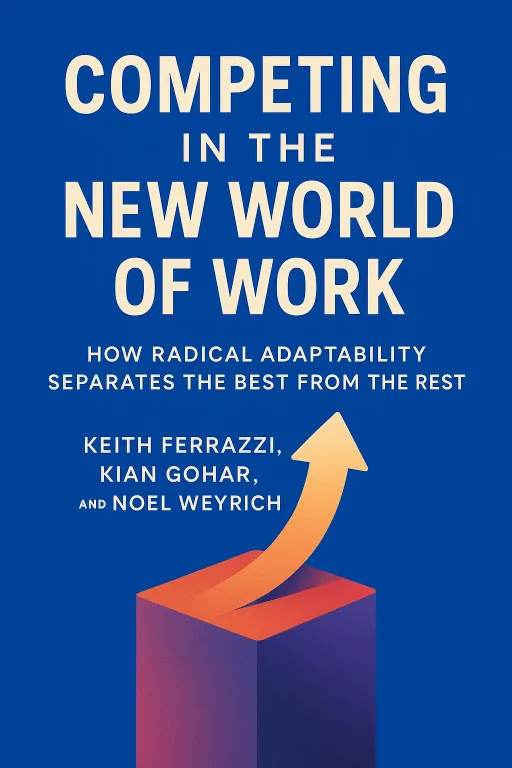
Atlas: That is a brutal reality to face, especially when the modern workplace demands that we be available for every ping and direct message. It feels like we are stuck in a tug-of-war. We have Keith Ferrazzi, Kian Gohar, and Noel Weyrich in their book, Competing in the New World of Work, telling us we need to be radically adaptable, constantly co-creating, and running micro-experiments. Then, we have Cal Newport in Deep Work, arguing that if you want to produce anything of value, you need to lock the door and disappear for hours.
Nova: You hit on the exact tension that defines the modern professional experience. The challenge is that these two ideas are often seen as enemies. People think they have to choose between being a responsive, collaborative team player or a monk-like deep thinker. The reality is that the highest performers are the ones who have mastered the art of doing both at different times of the day.
Atlas: That sounds like an ideal world, but how do we actually bridge that gap? Most of us are just trying to survive the inbox.
Nova: That is the pivotal question. Today, we are going to unpack how to design a daily blueprint that marries that relentless, collaborative adaptability with the kind of intense, deep execution that builds careers.
The Paradox of Modern Work
SECTION
Atlas: I have been thinking about this. If I try to be radically adaptable, I am checking my Slack, I am jumping on calls, I am iterating on projects in real-time. If I try to do deep work, I am offline. If I am offline, I am not adapting. How do we reconcile those two states?
Nova: You are framing it as a conflict of timing, but it is actually a conflict of intent. Ferrazzi and his co-authors point out that the future of work belongs to teams that run micro-experiments. This means you are constantly testing, learning, and pivoting. But here is the catch: you cannot run a good experiment if you cannot clearly analyze the data, synthesize the feedback, and think through the strategy. That is where Newport’s framework comes in.
Atlas: So, the deep work is the processing power required to make the adaptability actually work?
Nova: Exactly. Think of it as the difference between the pilot light and the engine. Radical adaptability is the engine—it keeps the car moving, turning, and adjusting to the road. Deep work is the pilot light that keeps the system alive and capable of high-level function. Without the deep work, your adaptability becomes just reactive flailing. You are changing direction, but you have no idea if those changes are actually moving you toward a goal.
Atlas: That makes perfect sense. I have seen this in teams. They are constantly pivoting, they are in meetings all day, they are doing the agile ceremonies, but they are not actually producing anything substantive because they never stop to think deeply about the problems they are solving.
Nova: Precisely. They are busy, but they are not effective. The authors of Competing in the New World of Work suggest that teams need to foster an environment of psychological safety where these micro-experiments can happen without fear. But if you, as an individual, do not have the cognitive capacity to interpret the results of those experiments, you are just running in circles.
Atlas: What I hear you saying is that the, quote-unquote, new world of work actually requires more deep, solitary thinking than the old world did, because the environment is so much more volatile and complex.
Nova: You nailed it. Complexity demands clarity. When the world is shifting under your feet, you need the ability to lock yourself in a room, disconnect from the noise, and figure out the signal. That is the only way to make the right decisions about where to pivot.
The Blueprint for Peak Output
SECTION
Atlas: Okay, I am sold on the necessity of this. But let's get tactical. If I am in a high-pressure environment, how do I actually protect that time? If I disappear for two hours, my team might think I am not a team player, or I might miss a critical update.
Nova: This is where we need to be surgical with our scheduling. The blueprint is simple, but it requires discipline. You dedicate a non-negotiable ninety-minute block every single morning before you even touch your team communications. No email, no Slack, no news, no social media.
Atlas: Ninety minutes. That sounds like an eternity in a world of instant messaging. What happens if an emergency pops up?
Nova: Most of what we call emergencies are actually just urgent distractions. If you start your day by engaging with the world’s priorities, you are immediately putting your own goals on the back burner. By the time you get to your own work, your brain is already drained of its best creative energy. You have spent your prime cognitive output on other people’s agendas.
Atlas: That resonates because I know that feeling of finishing a day and wondering what I actually accomplished. I spent eight hours responding to everyone else, but my own projects are exactly where I left them yesterday.
Nova: That is the trap. The ninety-minute morning block is the antidote. You are essentially paying yourself first. You are investing your highest-quality energy into your most important work. Once that ninety minutes is up, then you open the floodgates. Then you step into the role of the radically adaptable team member. You check the messages, you jump into the micro-experiments, you collaborate. But you do it from a position of strength, because you have already won the day.
Atlas: I am curious about the science behind that specific timeframe. Why ninety minutes? Is there something magic about that duration?
Nova: It aligns with our ultradian rhythms. Our brains operate in cycles of high-focus activity followed by rest. Ninety minutes is generally considered the peak window for sustained cognitive output before performance starts to degrade. If you push it to three hours, you are likely to experience diminishing returns. If you only do thirty minutes, you might not get deep enough into the problem to reach a breakthrough.
Atlas: That is fascinating. It’s like a sprint rather than a marathon. And I imagine the micro-experimentation comes in during the rest of the day?
Nova: Exactly. You use that morning block to set the strategy, write the core of the project, or solve the hardest problem. Then, for the rest of the day, you are in the arena. You are taking that work, sharing it with your team, getting feedback, and running those experiments that Ferrazzi talks about. You are using the morning to sharpen your sword, and the rest of the day to fight the battle.
Atlas: What if my work is entirely collaborative? What if I don't have a single project that I can work on alone for ninety minutes?
Nova: Even the most collaborative roles have deep tasks. Maybe it is not writing a report. Maybe it is mapping out a complex stakeholder plan. Maybe it is synthesizing the feedback from yesterday’s experiments so you can propose a better one today. Maybe it is just learning a new skill that will make your team more effective. Deep work is not about isolation; it is about the of your attention.
Atlas: I see. It is about applying that same focus to whatever the hardest, most valuable task is.
Nova: Right. If you are a manager, your deep work might be thinking through the culture of your team or preparing for a difficult conversation. If you are an engineer, it is the complex coding. The content changes, but the requirement for uninterrupted focus remains universal.
Synthesis & Takeaways
SECTION
Atlas: This feels like a shift in identity. We are moving away from being a "responder" to being an "architect."
Nova: That is a powerful way to put it. You are shifting from being a person who reacts to the environment to a person who shapes it. And that is really the core of what we are talking about today. It is about understanding that your time is your most precious asset. If you do not curate it, someone else will.
Atlas: I love the idea of the "first twenty minutes" as a starting point. For anyone listening who feels overwhelmed by the idea of a ninety-minute block, maybe start there. Just give yourself twenty minutes of uninterrupted time before the world gets a hold of you. It is a low barrier to entry that can build the momentum for the full ninety.
Nova: That is a great bridge to action. Start small if you have to, but be consistent. The goal is to build a system where you are not just surviving the modern workplace, but actively defining your role within it. You are not choosing between depth and agility; you are using the depth to power your agility.
Atlas: It reminds me that we are not just cogs in a machine. We are the ones designing the machine.
Nova: And the machine works best when it has a clear purpose. So, tomorrow morning, try it. Before you check the notifications, before you get pulled into the orbit of other people's problems, take that time. Protect it as if your career depends on it, because, honestly, in this economy, it probably does.
Atlas: That is a challenge worth taking. I am going to clear my calendar for tomorrow morning.
Nova: That is the spirit. It is the first step toward reclaiming your cognitive output and building a life of substance.
Atlas: This conversation has certainly shifted how I view my morning routine. It is not just about waking up early; it is about waking up with intent.
Nova: And that intent is what separates the people who are just busy from the people who are truly effective. Thank you for diving into this with me today.
Atlas: Always a pleasure to dissect these systems. To everyone listening, go build your blueprint.
Nova: This is Aibrary. Congratulations on your growth!