Stop Overthinking, Start Acting: The Guide to Deep Work Integration
Golden Hook & Introduction
SECTION
Nova: What if I told you that being is often the biggest enemy of being? We're not just talking about emails; we're talking about a subtle, insidious force that's robbing you of your intellectual superpower.
Atlas: Whoa, Nova, that’s a bold claim. I mean, for so many of us, 'busy' feels like the default state, the badge of honor even. Are you saying my overflowing inbox isn't a sign of my importance, but actually a symptom of a deeper problem?
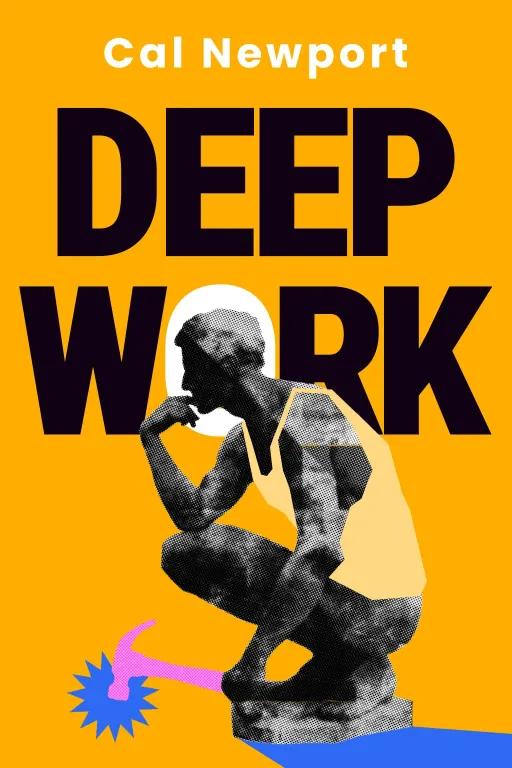
Nova: Precisely, Atlas. And it’s this deeper problem that our conversation today is designed to unravel, drawing heavily from the insights of Cal Newport’s seminal work, "Deep Work." What’s fascinating about Newport is that he famously built his entire academic career, publishing groundbreaking research and writing bestsellers, all while completely opting out of social media. He’s living proof that you can not only survive but thrive by deliberately disconnecting.
Atlas: That makes me wonder. In a world where connection is king, how does someone like Newport manage to not just survive, but? Because for a lot of our listeners who are constantly processing vast information and distilling complexity, the idea of just feels… well, it feels impossible.
Nova: It’s a powerful testament to his core argument: true deep work is a rare and incredibly valuable skill. Without it, your ability to produce high-quality output and master complex information will be severely limited. That's the cold, hard fact we need to confront.
The Existential Threat of Distraction: Why Deep Work isn't Optional Anymore
SECTION
Atlas: Okay, so this isn't just about getting more done, it's about the of what we’re doing. But help me define this, Nova. What exactly is 'deep work' in Newport’s eyes? Is it just… concentrating really hard?
Nova: It's far more nuanced than just concentrating, Atlas. Newport defines deep work as "professional activities performed in a state of distraction-free concentration that push your cognitive capabilities to their limit. These efforts create new value, improve your skill, and are hard to replicate." Think of it as a mental muscle. If you constantly do shallow, fragmented tasks – checking emails, hopping between apps, quick meetings – you're essentially doing mental cardio, but never lifting heavy weights. Your capacity for deep thought atrophies.
Atlas: That makes perfect sense. I can definitely relate to that feeling of my brain just being… after a day of jumping from one thing to the next, but not actually feeling like I’ve accomplished anything truly meaningful. So, when you say it pushes your cognitive capabilities to the limit, what kind of output are we talking about? Give me an example.
Nova: Imagine a software engineer trying to debug a complex system. They could spend eight hours, constantly interrupted by Slack messages, emails, and social media notifications, making incremental progress. Or, they could carve out a two-hour block, turn off everything, and dive into that code with singular focus. In that two hours, they might solve a problem that would have taken days of fragmented attention. The quality of their solution, the elegance of the code, the depth of their understanding – it all skyrockets. It’s like the difference between a sculptor meticulously crafting a masterpiece, and someone just chipping away blindly.
Atlas: So you're saying that consistent, focused effort creates a disproportionate amount of value compared to just putting in more hours? That’s a significant insight for anyone seeking optimized outcomes. But why is this more critical now than, say, twenty years ago? Was deep work always this rare?
Nova: That’s a brilliant question. The truth is, deep work has always been valuable, but it wasn't always so. Twenty years ago, the default state wasn't constant digital connectivity. Today, our environment is actively designed to pull our attention in a million different directions. Every app, every notification, every "Breaking News" alert is vying for that precious cognitive resource. So, the ability to focus without distraction has become a superpower, an intellectual edge that separates those who merely information from those who it and new value.
Atlas: That’s really profound. It’s not just a personal productivity issue; it’s almost an evolutionary challenge for our brains in the modern age. It feels like we’re fighting against the very design of our digital world.
Architecting Your Focus: Strategic Implementation of Deep Work Blocks
SECTION
Nova: And that naturally leads us to the crucial question: how do we fight back? How do we reclaim that intellectual edge? This is where strategic implementation comes in, drawing not only from Newport but also from Gary Keller’s "The One Thing." Keller emphasizes identifying your 'one thing' – that single most important task that, if done, makes everything else easier or unnecessary.
Atlas: Okay, 'one thing' sounds incredibly appealing, especially for someone who processes vast information. The clarity alone would be a game-changer. But how do you actually that one thing from the endless demands? For someone operating in a high-stakes environment where urgent requests are constant, 'turning off notifications' feels less like a productivity hack and more like career suicide. What's the practical approach?
Nova: That's the core challenge, and it requires strategy, not just willpower. The key is to schedule dedicated, uninterrupted 'deep work' blocks. Think of it like a surgeon scheduling an operation. They don't just hope they'll find time; they block it out, prepare the environment, and protect that time fiercely. For us, that means turning off notifications – phone, email, Slack, everything – and focusing on that one single task. It’s about creating an impenetrable mental fortress around your most valuable cognitive assets.
Atlas: That's a great analogy, a mental fortress. But for a focused practitioner, how do you even begin? What does a tiny step look like for someone who feels like they're constantly putting out fires?
Nova: The tiny step is deceptively simple but incredibly powerful: schedule your next two hours as an uninterrupted 'deep work' block. Just two hours. Decide on one single task – your 'one thing' for that block – and then ruthlessly protect it. Turn off everything else. It’s a muscle you have to train. And here’s where Nova’s take really solidifies it: protecting your deep work blocks is not just about productivity; it’s about safeguarding your intellectual edge and achieving mastery. It’s an investment in your future self.
Atlas: I can see how that tiny step could create a domino effect, as Keller puts it. If you consistently protect those blocks, you’re not just getting a task done; you’re building the capacity for mastery. It’s about cultivating that intellectual edge, not just for today, but for long-term growth and refined output. That resonates deeply with anyone driven by mastery.
Synthesis & Takeaways
SECTION
Nova: Exactly. So, what we've really explored today is a two-pronged approach to thriving in a distracted world. First, understanding the existential threat that constant distraction poses to our cognitive abilities and why deep work is our intellectual survival kit. And second, architecting our focus by strategically implementing and fiercely protecting those deep work blocks, transforming intent into impactful execution. It’s an act of intellectual self-preservation.
Atlas: That’s a powerful way to put it, Nova. It’s not just about doing tasks; it’s about becoming the kind of person who can do tasks, consistently. It really reinforces the mindset that this is a journey of integration, a refinement of how we engage with our work and our world, not just a revolutionary overnight fix. For listeners who are looking for that strategic advantage, that optimized outcome, what’s the one thing you want them to internalize from today’s conversation?
Nova: The most crucial takeaway is this: your attention is your most valuable asset. Treat it as such. Deliberately carve out and defend time for focused, cognitively demanding work. It's the singular path to not just productivity, but to true mastery and creating lasting value in a noisy world.
Atlas: And for all of you out there ready to embrace that challenge, remember to schedule those dedicated blocks for deep work integration. Protect that time like it’s gold, because it truly is.
Nova: This is Aibrary. Congratulations on your growth!