Stop Chasing Time, Start Designing It: Mastering the Art of Deep Work.
Golden Hook & Introduction
SECTION
Nova: Alright Atlas, rapid-fire. I say a word, you give me the first thing that pops into your head. Ready? "Productivity."
Atlas: Overwhelm.
Nova: Ooh, interesting! How about "Time management?"
Atlas: More emails.
Nova: And finally, "Focus."
Atlas: A unicorn. Definitely a unicorn.
Nova: A unicorn! That’s brilliant, and honestly, a perfect segue into what we’re dissecting today. Because for so many of us, true, undistracted focus feels exactly like that: mythical, elusive, and something we only dream about.
Atlas: Oh, I know that feeling. It’s like chasing a rainbow while simultaneously juggling flaming chainsaws. We all want it, but the reality of our daily grind makes it feel impossible.
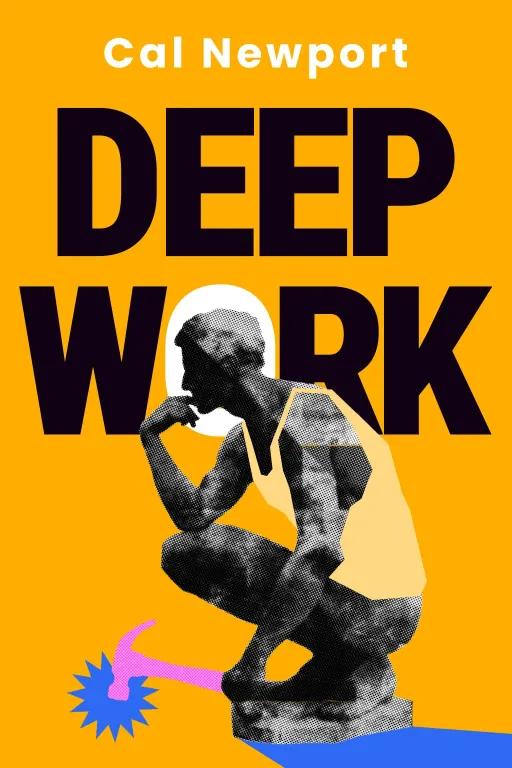
Nova: Exactly. And that’s why we’re diving deep into a concept that’s arguably more crucial now than ever before: "Deep Work," as articulated by the brilliant Cal Newport in his seminal book. What’s fascinating about Newport is that he’s not just another self-help guru; he’s a computer science professor at Georgetown University. This isn't just anecdotal advice; it’s grounded in rigorous research, bridging the gap between academic theory and practical application in our hyper-connected world.
Atlas: That’s a critical distinction. It’s not just someone telling you to "focus more" from a mountaintop. This is someone who understands the digital landscape we’re all navigating. So, what’s the core problem Newport is trying to solve with this idea of deep work, Nova? Why does focus feel like that unicorn for so many of us today?
The Illusion of Busyness & Fragmented Attention
SECTION
Nova: Well, Newport starts with what he calls "The Cold Fact." He argues that in our hyper-connected world, true productivity isn't about doing more, but about doing the right things, deeply. The problem is, constant distractions fragment our attention, preventing us from creating meaningful work. Think of it like trying to fill a bucket with a sieve. You’re constantly pouring in effort, but because of all the holes—the notifications, the emails, the quick chats, the 'just checking one more thing'—nothing truly stays, nothing accumulates.
Atlas: That’s a powerful analogy. I imagine a lot of our listeners feel like that sieve, constantly busy, constantly pouring, but at the end of the day, the bucket feels empty of real accomplishment. So, are you saying all those 'productivity hacks' and 'always-on' mentalities are actually making us less productive in the long run?
Nova: Absolutely. It’s the illusion of busyness. We equate being constantly responsive, constantly multitasking, with being productive. But those are often shallow tasks. Let me paint a picture for you. Imagine Sarah. She’s a marketing manager, bright, ambitious. She starts her day with a clear goal: draft a new strategic campaign proposal. She sits down, opens her laptop, and then…
Atlas: Let me guess. The first email dings. Then a Slack message. Then a notification about a trending news story.
Nova: Precisely! She tells herself, "Just five minutes to clear the inbox," which turns into twenty. Then a colleague pops over for a "quick chat" about something totally unrelated to the proposal. She jumps between drafting a paragraph, checking social media, responding to an 'urgent' client text that could have waited, and prepping for a meeting that’s still two hours away. By the end of the day, she feels utterly exhausted. She’s been "working" non-stop.
Atlas: But the strategic campaign proposal?
Nova: It’s still mostly blank. She’s been busy, incredibly busy. But she hasn’t actually anything meaningful for that high-value task. She’s perpetually busy but unproductive. The emotional toll is real – a sense of frustration, of never quite catching up, of feeling like her valuable skills are being chipped away by a thousand tiny demands.
Atlas: Wow, that’s kind of heartbreaking, and incredibly relatable. For our listeners who are managing high-pressure teams, or trying to innovate in fast-paced environments, this concept might feel impossible to implement. How do you escape this cycle when your job literally demands constant connectivity, or at least feels like it does? It’s not just a matter of willpower, is it?
Cultivating a Deep Work Ethic & Intentional Design
SECTION
Nova: It’s definitely not just willpower, Atlas. The nature of the work has shifted, and so must our approach. It sounds bleak, but Newport offers a powerful antidote to Sarah's dilemma, and it's not about working. It’s about cultivating what he calls a "deep work ethic." This is effort applied to high-value tasks without distraction. It’s about intentionally structuring your day to prioritize these deep tasks, and crucially, embracing boredom.
Atlas: Embracing boredom? That sounds almost counter-intuitive in our always-on culture. I mean, we're conditioned to reach for our phones the moment there's a lull. How does that actually help deep work?
Nova: It’s a mental muscle, really. If your brain is constantly stimulated, constantly jumping from one notification to the next, it loses its capacity for sustained, focused attention. Embracing boredom—allowing your mind to wander, to process thoughts without external input—is like resistance training for your focus. It strengthens your ability to then dive deep when you need to.
Atlas: That makes sense. It’s like if you constantly eat junk food, you lose your taste for nutritious meals. So, for someone who's a 'strategist' and always optimizing, what’s the first step they can take, beyond just blocking time, to start building this muscle?
Nova: The "tiny step" Newport suggests, and one I wholeheartedly endorse with "Nova's Take," is to block out 60-90 minutes for a single, focused task with zero distractions. Treat it as sacred time. Let me give you another picture. Mark, an analyst, hears about deep work. He’s skeptical but decides to try. He has a complex report due, usually something he’d chip away at for days. He commits to 90 minutes.
Atlas: And he actually turns off his email? No phone?
Nova: He does. The first 15 minutes are agony. His brain screams for stimulation. He feels the phantom vibration of his phone. But he pushes through. He focuses solely on that report. He dives into the data, makes connections he wouldn't have seen if interrupted. He actually gets into a flow state.
Atlas: And the outcome?
Nova: In those 90 minutes, he completes a significant chunk of the report – a section that would normally take him half a day with constant interruptions. He emerges not exhausted, but energized. He’s not just busy; he’s. The quality of his work is higher, and he feels a profound sense of clarity and satisfaction. It's a stark contrast to Sarah's experience. He designed his time, rather than just reacting to it.
Atlas: That gives me chills, honestly. It’s not just about productivity, it’s about reclaiming a sense of control and even joy in your work. So, the key is not just the time, but it and your mind for it.
Synthesis & Takeaways
SECTION
Nova: Exactly. It’s a profound shift in mindset. True productivity isn't just about managing your time; it's about designing your attention. It's about recognizing that in a world that constantly demands shallow engagement, the ability to do deep work is increasingly rare and therefore, incredibly valuable. By intentionally structuring your day to prioritize deep work, you can achieve more in less time, produce higher quality results, and ultimately, find a greater sense of accomplishment and clarity in your professional life. It’s about moving beyond the hamster wheel of busyness and finding true meaning in what you create.
Atlas: I love that – "designing your attention." It reframes the whole challenge. Instead of feeling like a victim of distraction, you become the architect of your focus. So, for our listeners who are feeling inspired right now, what’s the one tiny step they can take to start designing their attention this week?
Nova: Here it is: Block out just 60 to 90 minutes this week for a single, focused task with zero distractions. Turn off everything. Put your phone in another room. Treat that time as sacred. You might be surprised at what you can achieve when you truly commit to deep work.
Atlas: I think I’m going to try that. I'll let you know how my unicorn quest goes.
Nova: I have a feeling you'll find it.
Atlas: This is Aibrary. Congratulations on your growth!