Mastering Your Attention: Focus in a Distracted World
Golden Hook & Introduction
SECTION
Nova: Alright Atlas, quick game. Five words to describe 'Mastering Your Attention' and the journey to focused work. Go!
Atlas: Elusive, essential, hard, but possible.
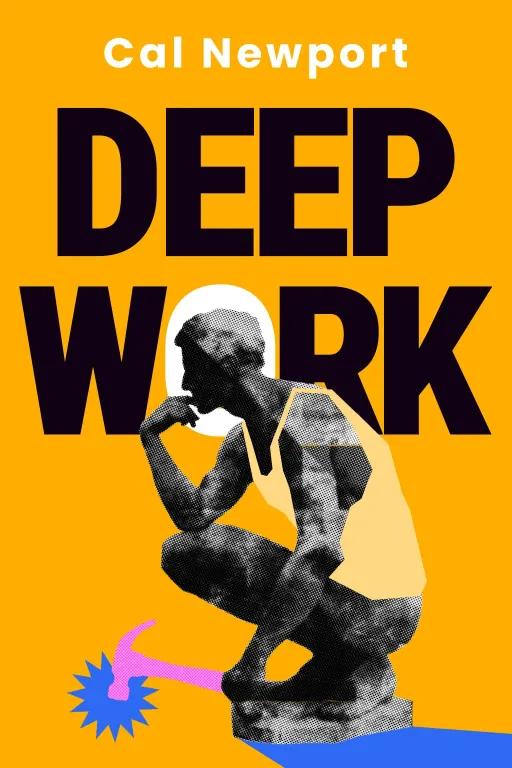
Nova: Oh, I love that. "Elusive, essential, hard, but possible." That perfectly encapsulates what we're diving into today. We're exploring the powerful world of focus, drawing insights from two titans in the field: Cal Newport's and Nir Eyal's. Newport, a computer science professor, argues that deep work is the superpower of the 21st century, a skill that's becoming increasingly rare but incredibly valuable. Eyal, an expert in behavioral design, spent years researching the psychology behind why we get distracted, offering a practical framework to fight back. Both authors, from different angles, reveal that mastering your attention isn't just about productivity; it's about reclaiming agency in your life.
Atlas: I can definitely relate to that. It feels like every day is a battle to keep my attention on what truly matters. I’m curious, how do these two perspectives, the deep work and the indistractible, converge? Are they talking about the same thing or complementary ideas?
The Imperative of Deep Work and Indistractibility
SECTION
Nova: That’s a great question, and they absolutely complement each other. Newport's "Deep Work" is about focused, distraction-free work that pushes your cognitive capabilities to their limit. It's the kind of work that creates new value, improves your skills, and is incredibly hard to replicate. Think of it as the ultimate mental workout for your brain.
Atlas: Okay, but how is that different from just concentrating really hard? For someone in a demanding field, like strategic planning or complex problem-solving, it feels like they’re already concentrating intensely. What makes 'deep work' distinct?
Nova: That’s a thoughtful distinction. It’s not just concentrating hard; it's about the nature of that concentration, and its. Imagine a software engineer debugging a complex piece of code for hours, completely immersed, solving a problem no one else can. That’s deep work. They’re not just reacting to incoming messages or jumping between tasks. They're crafting a solution. Now, Eyal's comes in to explain that uninterrupted focus is so challenging to achieve. He provides a practical framework for understanding the psychology of distraction itself, both internal and external triggers.
Atlas: Hold on. You’re talking about becoming "indistractable." For a lot of our listeners who are managing projects or teams, or just trying to navigate a modern, always-on world, eliminating distractions feels impossible. We to be connected, we to respond. Are you saying we should just disconnect entirely?
Nova: Absolutely not. That’s where many people misunderstand the concept. It's not about eliminating all distractions, which, let's be honest, is a fantasy in our interconnected lives. The key is understanding their roots and building systems to manage them, allowing for profound work and meaningful progress. It's about proactive management, not reactive avoidance.
Atlas: Okay, that’s a relief! So, it’s about understanding that notification feels so urgent, or my brain jumps to check social media when I’m facing a difficult task. Can you give an example of an "internal trigger" that isn't just boredom or procrastination? Something more subtle that even high-achievers might experience?
Nova: Oh, definitely. Internal triggers are often more insidious. It could be the subtle urge to check the news when you're feeling uncertain about a complex project and seeking a sense of control, even if it's external news. Or the anxiety about missing out on a social notification that makes you grab your phone, not out of boredom, but out of a fear of disconnection. The discomfort of cognitive strain, of truly pushing your brain, can trigger a search for easy, shallow distraction.
Atlas: That makes me wonder, so it's almost like our brain is actively distraction when faced with cognitive strain? It's trying to protect us from the hard work?
Nova: Exactly! It's a natural human response, a primitive urge to avoid discomfort and seek novelty. But it's an urge we can learn to observe and navigate, rather than automatically succumb to. It’s about building awareness around those impulses.
Building Your Personal Focus Fortress: Actionable Strategies
SECTION
Nova: And that brings us perfectly to the 'how' – building your personal 'focus fortress.' Our first tiny step, straight from the content, is to schedule a 90-minute 'deep work' block this week. Turn off all notifications and commit to a single, high-priority task.
Atlas: That sounds great in theory, but for someone with a demanding schedule, finding 90 uninterrupted minutes might feel like finding a unicorn. How do you even begin to carve that out, especially if your job requires constant communication or quick pivots?
Nova: You're right, for many, 90 minutes feels like a luxury. So, let's make it even tinier. Maybe it's not 90 minutes right away. It's about. Start with 25 minutes. Or even just 15. The exact time isn’t as important as the to that block. You schedule it, you prepare for it, and you protect it fiercely. It’s about building the muscle, consistently.
Atlas: Building the muscle, I like that. And what about those "Deep Questions" you mentioned? The content suggests we ask ourselves: "What are your most common internal and external triggers for distraction, and how can you proactively address them?" That feels like a therapy session!
Nova: It a form of self-inquiry, but a profoundly powerful one. Knowing you get distracted is truly half the battle. Is it the constant ping of an email, or the nagging thought about an upcoming deadline that makes you open a new tab? Once you identify the specific trigger, you can proactively address it. For example, if it's the email ping, you can schedule specific times to check email, rather than being at its beck and call. If it's the deadline anxiety, you can break the task into smaller, less daunting steps, or even just write down the nagging thought and tell yourself you'll deal with it later.
Atlas: So, it's about becoming a detective of your own attention, rather than just a victim of it. You’re actively investigating the root cause.
Nova: Precisely! It's about taking back control. And this leads to what we call the "Healing Moment." Acknowledge that the struggle for focus is universal. You’re not alone in battling the endless pings and pulls for your attention. Your dedication to mastering it is a testament to your commitment to excellence, your desire to make a real difference.
Atlas: That’s actually really inspiring. Because sometimes you feel like you’re the only one drowning in a sea of tabs and notifications, feeling guilty about not being able to focus. It’s helpful to know it’s a universal human challenge.
Synthesis & Takeaways
SECTION
Nova: It absolutely is. And that's the core insight here: focus isn't about being perfect or having some innate superpower. It's a skill. It's about consistent, intentional practice, coupled with self-compassion when you inevitably slip. It's about building resilience in the face of constant demands.
Atlas: I guess that makes sense. So, if there's one single, most important takeaway for a listener to implement, what would it be? For someone who wants to start building their own focus fortress, what's the first brick they should lay?
Nova: The single most important takeaway is to start small, but start with intention. Pick one small block of time – 15, 25, or 30 minutes – turn off that could distract you, and commit to one, single, high-priority task. Just once this week. Experience what that feels like.
Atlas: That sounds manageable. And it really speaks to the idea of building a foundation, step by tiny step, rather than trying to overhaul your entire life overnight. It respects the fact that our attention is constantly under siege.
Nova: Absolutely. It's about recognizing that your attention is your most valuable asset, arguably the most valuable in the 21st century. It's worth protecting and cultivating because it's how we create value, improve ourselves, and ultimately, contribute meaningfully to the world around us. It's how we move from simply reacting to actively creating.
Atlas: A powerful message for anyone trying to navigate the noise and truly make their mark. I think that's a perfect point to end on.
Nova: This is Aibrary. Congratulations on your growth!