Mastering the Inner Game: Cultivating Focus and Mental Resilience
Golden Hook & Introduction
SECTION
Nova: What if the biggest obstacle to your success isn't a lack of talent or opportunity, but the tiny supercomputer constantly buzzing in your pocket?
Atlas: Oh, man. You really went for the jugular with that one, didn't you? It’s like you peered into the soul of every listener trying to get anything done these days. We're all tethered, aren't we?
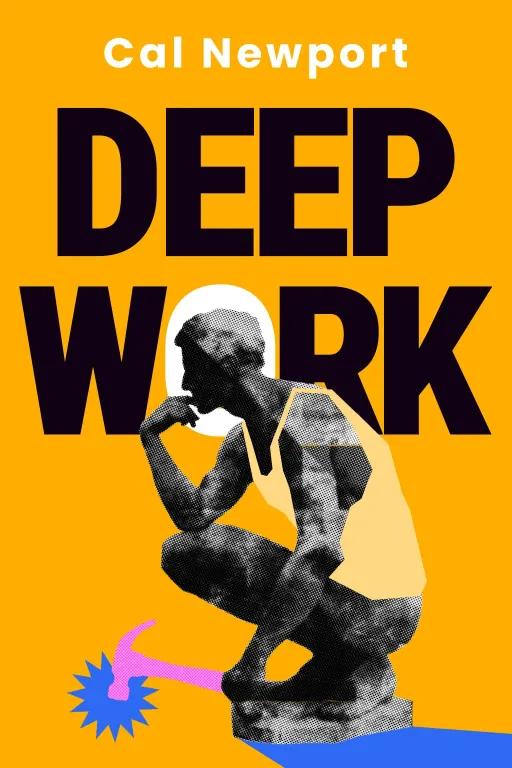
Nova: Absolutely, Atlas. And it’s not just the phone; it's the entire ecosystem of constant pings, notifications, and the seductive pull of the 'next new thing.' We're talking about a world designed to fragment our attention. Today, we're diving into how we can fight back and reclaim our focus. We're drawing insights from two incredible minds: Cal Newport, a computer science professor whose book "Deep Work" has become a modern manifesto, and Josh Waitzkin, a fascinating figure who achieved mastery in two wildly different fields—chess and martial arts—and chronicled his philosophy in "The Art of Learning."
Atlas: That’s quite the duo! A computer science professor telling us to step away from the screens, and a chess grandmaster turned martial artist talking about learning. I love that Newport, the tech guy, is advocating for less tech. What’s his story there?
Nova: It’s brilliant, isn't it? Newport, with his academic background, meticulously researched the impact of distraction on productivity and meaning. His work isn't just theory; he lives it. He's published multiple highly-regarded books while maintaining a demanding professorship, all by rigorously applying the principles of deep work. And Waitzkin, his journey is equally compelling. He was a child chess prodigy, then walked away from that to become a world champion martial artist. He truly embodies the idea of learning as a lifelong, adaptive process.
Atlas: Okay, so we have the academic rigor of Newport and the lived, embodied wisdom of Waitzkin. This is going to be good. So, let’s talk about that first big idea: the discipline of deep engagement.
The Discipline of Deep Engagement: Cultivating Uninterrupted Focus
SECTION
Nova: Exactly. Newport makes a compelling, almost urgent, case for what he calls "deep work." He describes it as professional activities performed in a state of distraction-free concentration that push your cognitive capabilities to their limit. These efforts create new value, improve your skill, and are hard to replicate. Conversely, he defines "shallow work" as non-cognitively demanding, logistical tasks, often performed while distracted, that don't create much new value.
Atlas: I imagine a lot of our listeners are nodding vigorously right now, thinking about their own days. But wait, is deep work just for people in highly intellectual professions, like, say, a computer science professor? What about someone in a fast-paced environment with constant demands?
Nova: That’s a crucial question, Atlas. Newport argues that deep work is essential for who wants to excel in the knowledge economy. He highlights examples across different fields. Take for instance, a journalist who needs to synthesize complex information for a groundbreaking article, or a marketing strategist designing an innovative campaign. Newport himself is a prime example. He schedules specific, often multi-hour, blocks in his calendar for deep work, sometimes even going entirely offline, away from email and the internet, to focus solely on writing or complex research. He treats these blocks with almost sacred reverence.
Atlas: That sounds incredibly disciplined. I mean, going offline for? In today's world, that feels almost radical. How does one even begin to implement something like that when your job, or your life, feels like a constant stream of interruptions?
Nova: It is radical, and that's precisely why it's so powerful. Newport isn't saying you have to become a hermit. He offers practical strategies. One is "fixed-schedule productivity," where you decide in advance when your workday will end, then work backward to fit your deep work into that finite time. Another is to "ritualize" your deep work: have a set location, a set time, a specific routine, so your brain knows, "Okay, we're doing serious thought now." He also talks about embracing boredom, resisting the urge to check your phone every time there's a lull, to strengthen your focus muscle.
Atlas: Oh, I've been there. That urge to just 'quickly check' email or social media. It feels harmless in the moment.
Nova: Exactly! And that's where the insidious nature of distraction really hits. Newport talks about "attention residue." When you switch from one task to another—even a quick check of an email—your attention doesn't immediately follow. A residue of your attention remains stuck thinking about the previous task. So, if you're constantly context-switching, you're never giving your full cognitive horsepower to any one thing. It's like trying to fill a bucket with a leaky hose. Every interruption is a leak.
Atlas: So, even those gentle acknowledgments of distraction, like returning to a breath in meditation, are part of this? Because it's about not letting the distraction pull you completely off course, right? It's about redirecting, not fighting.
Nova: Precisely. That "healing moment" of gently acknowledging a distraction and returning to your task is a micro-practice of deep work. It's training your brain to stay on target. The goal isn't to eliminate all distractions—that's impossible—but to build the mental fortitude to manage them and, crucially, to create protected spaces for deep, uninterrupted thought.
The Art of Learning: Embracing Mastery Through Soft Focus and Resilience
SECTION
Nova: And that naturally leads us to the second key idea we need to talk about, which often acts as a counterpoint to what we just discussed, but also deeply complements it. While Newport gives us the 'how' of deep focus, Josh Waitzkin in "The Art of Learning" gives us the 'why' and the 'how to persist'—the mental resilience required for true mastery.
Atlas: How does a chess champion and martial artist's approach to learning differ from just, you know, studying hard or practicing a lot? Is it just about being naturally gifted?
Nova: No, it's actually the opposite. Waitzkin's philosophy is about cultivating a specific mindset for growth and mastery. He emphasizes three core tenets: understanding fundamentals deeply, embracing loss as information, and cultivating what he calls "soft focus." It’s not about raw talent; it's about the of learning. Think of it like this: in chess, a beginner learns opening moves. A master understands the underlying principles of why those moves are good, and how they connect to the endgame.
Atlas: Right, like knowing the recipe versus understanding the chemistry of cooking. But what about "soft focus"? That sounds a bit mystical. Is it like meditation, or something else entirely?
Nova: It's similar to mindfulness, but applied directly to high-performance situations. Soft focus is a state where you're deeply engaged in the task at hand—you're focused—but you're also relaxed, aware, and open to subtle cues from your environment. It's not rigid, tunnel-vision concentration that can lead to burnout or blind spots. Imagine a martial artist in a sparring match. They are intensely focused on their opponent, but also aware of their own body, the space around them, and subtle shifts in their opponent's breathing or weight. They can adapt instantly, fluidly.
Atlas: So, it's being "in the zone" but with a wider aperture, not just a laser beam. I can see how that would be valuable in a high-stakes environment. And what about embracing loss? That sounds pretty counterintuitive for someone trying to win championships.
Nova: It absolutely is. Waitzkin's insight is that most people fear failure, but masters see it as invaluable data. Every loss, every mistake, is an opportunity to learn. He talks about "making smaller circles"—when he made a mistake, he didn't just move on; he would break down the problem to its smallest components, analyze what went wrong, and rebuild his understanding from the ground up. He used his losses in chess, and later in martial arts, to refine his fundamentals and adapt his strategies. He didn't just practice; he his practice, especially his failures.
Atlas: That’s actually really inspiring. It re-frames mistakes not as personal failings, but as essential steps in the learning process. And I can see how this "soft focus" connects back to our "healing moment" from earlier—that gentle redirection when distracted. It's a form of soft focus, isn't it? Not rigid self-criticism, but a flexible return to the task.
Nova: Exactly! It's the same underlying principle of mental resilience. Instead of getting angry at yourself for being distracted, you gently bring your attention back. You acknowledge the "loss"—the moment of distraction—and you use it as information to return to your deep work, strengthening your focus muscle. Waitzkin's journey from a rigid, hyper-focused chess prodigy to a fluid, adaptive martial artist truly illustrates this evolution from brute-force concentration to elegant, resilient engagement.
Synthesis & Takeaways
SECTION
Nova: So, when we bring these two ideas together, we see a powerful synergy. Cal Newport gives us the blueprint for creating the conditions for deep, focused work, while Josh Waitzkin offers the mindset—the mental resilience and adaptive learning—to sustain that focus, embrace challenges, and ultimately achieve true mastery.
Atlas: It’s not just about productivity, is it? It’s about cultivating a more profound and fulfilling way of engaging with the world, and with ourselves. That ability to concentrate deeply and cultivate mental fortitude really is a superpower in an age of constant noise.
Nova: It truly is. It underpins all true learning and achievement. It's the difference between merely consuming information and truly internalizing it, between just doing tasks and creating something meaningful.
Atlas: So, for our listeners who are feeling overwhelmed by distraction, or who want to deepen their learning, what’s one small step they can take today to start cultivating this superpower?
Nova: I’d say start small but consistently. Carve out just 30 minutes each day, or even a few times a week, where you completely disconnect from distractions and focus on one cognitively demanding task. Treat it like an appointment you can't miss. And when your mind inevitably wanders, practice that gentle redirection. Don't beat yourself up; just bring your attention back, like returning to a breath in meditation.
Atlas: I love that. Small, consistent steps can lead to profound change. This has been incredibly insightful, Nova. Thank you for illuminating these powerful ideas.
Nova: My pleasure, Atlas. And thank you to all our listeners for joining us on this journey into the inner game of focus and resilience. We encourage you to share your own experiences with deep work or learning strategies on our social channels—we'd love to hear how you're cultivating your superpowers.
Nova: This is Aibrary. Congratulations on your growth!