How to Navigate Innovation Without Burning Out: The Guide to Sustainable Progress
Golden Hook & Introduction
SECTION
Nova: Atlas, give me a five-word review of how modern society, especially in the innovation space, approaches productivity.
Atlas: Oh, that's a good one. Hmm. "Always on, always tired, rarely deep."
Nova: Ouch, but brilliantly accurate, and honestly, a little too relatable for many of us. That perfectly sets the stage for what we're dissecting today. We're diving into how to achieve groundbreaking innovation and sustained progress not by pushing harder, but by working smarter, more deliberately, and with greater focus on well-being. And we're doing it with insights from two incredible minds.
Atlas: I'm intrigued. Who are we hanging out with today? Because "rarely deep" really hits home for anyone trying to learn new things or innovate in a world screaming for constant attention.
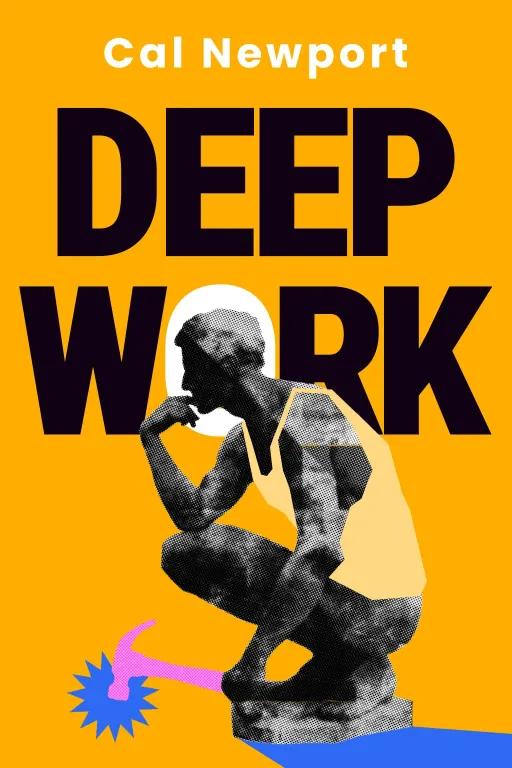
Nova: Exactly. First up, we're drawing from Cal Newport, a computer science professor whose book, Deep Work, essentially threw a wrench into the whole "hustle culture" machine and redefined what true productivity looks like. He's not some Silicon Valley guru; he's an academic who practices what he preaches. And then, we're bringing in Josh Waitzkin, the extraordinary chess prodigy who then became a martial arts world champion. His book, The Art of Learning, isn't about specific skills but the universal principles of mastery. These aren't your typical self-help authors; their insights are backed by rigorous thought and real-world, high-performance mastery.
Atlas: So we're talking about how to innovate without, well, burning out or dying inside? Because that five-word review I gave earlier hits a little too close to home for many of our listeners who are constantly pushing boundaries in their own fields, whether they're learning a new coding language or trying to master a complex new skill.
Nova: Precisely. We're challenging the cold fact that the drive for innovation often pushes us to work harder, not smarter, leading straight to burnout and stifling the very creativity we're trying to cultivate. We're going to explore how to flip that script and make sustainable progress a reality.
The Pitfalls of Unchecked Innovation Drive
SECTION
Nova: So, let's start with the problem. Cal Newport argues that true value in knowledge work comes from "deep work." He defines it as intense, distraction-free concentration on a single task that pushes your cognitive capabilities to their limit. The opposite? What he calls "shallow work." This is the non-cognitively demanding, logistical stuff that's often performed while distracted. Think emails, quick meetings, social media checks.
Atlas: Okay, so "deep work" sounds aspirational, almost mythical, in our current environment. But what exactly is the cost of all this "shallow work" when we're trying to innovate or learn something complex? It feels like we're just managing the flow, right?
Nova: That's the illusion, isn't it? Let me paint a picture. Imagine a brilliant software architect, let's call her Sarah. She's tasked with designing a revolutionary new system. She sits down, ready to dive into the complex logic. But then, a notification pings: an urgent email from a client. She switches to that. Ten minutes later, a colleague pops over for a "quick chat" about a project. Then, a Slack message about an upcoming meeting. Each interruption seems small, but here's the kicker: every time Sarah switches tasks, her brain doesn't immediately snap back to the complex architecture. There's a "cost of context switching," where residual attention from the previous task lingers.
Atlas: Ah, I know that feeling. It's like trying to restart a cold engine every five minutes. You burn more fuel and get nowhere fast. So for Sarah, that means her innovative design isn't just taking longer; the quality is probably suffering too, because she never truly gets into that flow state.
Nova: Exactly. She's constantly operating in a state of fragmented attention. She busy, she's responding to everything, but she's not producing high-quality, cognitively demanding output. The system she designs might be functional, but it lacks the elegance, the breakthrough insights that only emerge from sustained, deep concentration. She's working harder, yes, but not smarter, and the innovative potential is stifled. This constant state of reactivity is a fast track to burnout because you're expending mental energy without the satisfaction of meaningful progress.
Atlas: Wow. So it's not just about getting less done, it's about the of what gets done. And for curious learners, this is huge. If you're trying to learn a new programming language or a complex philosophical concept, you can't do it in five-minute bursts between emails. You need to immerse yourself. But isn't multitasking just a necessary evil in innovation now? How do you even begin to carve out that deep work time when everything feels urgent?
Nova: That's the challenge Newport addresses head-on. He argues that urgency is often a manufactured construct. True innovation and learning require protecting your cognitive environment. You have to be deliberate, almost ruthless, in creating those blocks. It's about prioritizing creation over reaction.
Mastering Deep Work and High-Performance Learning for Sustainable Progress
SECTION
Nova: So if shallow work is the enemy of innovation, how do we cultivate the intense focus needed for true breakthroughs and high-performance learning? This is where someone like Josh Waitzkin, who mastered two incredibly complex fields – chess and martial arts – becomes our guide. He offers principles that perfectly complement Newport's call for deep work.
Atlas: I'm curious. Waitzkin's world of chess and martial arts seems a million miles away from, say, a software engineer trying to develop a new AI algorithm. How do his principles translate to someone like a curious learner exploring a new knowledge area?
Nova: That's the beauty of it, Atlas. Waitzkin's insights are universal. One of his core principles is "making smaller circles." It sounds simple, but it’s profound. It means taking a complex skill or concept and breaking it down into its absolute fundamental components, mastering those, and then gradually expanding. It’s not about grinding for hours; it's about intensely focused, deliberate practice on a tiny, critical piece.
Atlas: So, for our software engineer, instead of trying to learn an entire AI framework at once, they'd focus on mastering one specific algorithm, understanding its every nuance, before moving on? That feels counterintuitive because we're often told to see the "big picture" first.
Nova: Precisely. The "big picture" can be overwhelming. Let's use another example. Imagine someone trying to learn a new language. Instead of trying to memorize a thousand vocabulary words and all grammar rules simultaneously, they might spend a week intensely focused on just five core verbs and how they conjugate in the present tense. They practice speaking, listening, and writing those five verbs until they are second nature. Then, they add five more. This hyper-focused approach allows for deep integration and builds a rock-solid foundation.
Atlas: That makes sense. It's like building a strong core before trying to do acrobatics. But wait, so intense focus burn me out? Isn't "smaller circles" just another way of saying "grinding" or "obsessing"? That sounds like a recipe for the very burnout we're trying to avoid.
Nova: That's where Waitzkin's concept of "the soft zone" comes in. It's not about brute force. The soft zone is about maintaining a state of relaxed intensity. It's being deeply engaged and focused, but without tension or anxiety. He describes it as being "like water," able to adapt and flow, yet incredibly powerful and cutting. It’s about being fully present and absorbed, yet also knowing when to step away, to rest, to allow your subconscious to work. It’s about sustainable energy, not just burning bright and fading fast.
Atlas: Oh, I like that. "Relaxed intensity." So it's not about how many hours you put in, but the of those hours and how you manage your energy. It's the opposite of Sarah, our distracted software architect. She was tense, fragmented, and unproductive. This is about being fully present and effective, then strategically recovering.
Nova: Exactly. By cultivating periods of deep focus, as Newport advocates, and understanding the mechanics of high-performance learning, like Waitzkin's "smaller circles" and "soft zone," you can innovate more effectively without sacrificing your well-being. It’s about building a sustainable rhythm of intense engagement followed by genuine recovery, allowing for creativity to flourish rather than be depleted.
Synthesis & Takeaways
SECTION
Nova: So, bringing it all together, the profound insight here is that our greatest creative and innovative potential lies not in constant output or frantic busyness, but in strategic periods of intense, undistracted engagement. It's about recognizing that our brains thrive on focused depth, not fragmented breadth.
Atlas: That's a huge reframing. It challenges the very definition of "productive" that many of us have internalized. It's not about looking busy; it's about actually effective and making meaningful progress.
Nova: Absolutely. And the tiny step to begin this journey? Our challenge to you, based on Nova's Take, is to schedule a 90-minute block for 'deep work' tomorrow. Turn off all notifications. Seriously, of them. Put your phone in another room. Close all unnecessary tabs. And focus on one single, critical task. Give yourself the gift of undistracted concentration, even if it's just for that short period. You might be surprised at what you accomplish.
Atlas: I love that. It’s actionable, and it directly tackles the fragmentation we've been talking about. For anyone who's a curious learner, passionate about new knowledge, this is your invitation to truly with that knowledge, not just skim the surface.
Nova: This is Aibrary. Congratulations on your growth!