How to Achieve Clarity Without Constant Hustle: The Power of Intentional Breaks.
Golden Hook & Introduction
SECTION
Nova: Atlas, five words to describe your relationship with your to-do list. Go.
Atlas: Insatiable, overwhelming, never-ending, taunting, and… unbroken. It just sits there, judging me.
Nova: Unbroken. Oh, that’s a good one, and honestly, a feeling I think a lot of our listeners can relate to. That relentless pressure to constantly be "on," constantly producing, constantly achieving.
Atlas: Absolutely. It’s like we’ve been programmed to believe that progress is directly proportional to how many hours we’re glued to a screen or how many tasks we check off. More hustle, more success, right?
Nova: That’s the cold, hard myth we’re here to dismantle today. Because what if I told you that true clarity, sustained productivity, and even breakthrough insights often come not from constant work, but from intentional, strategic breaks?
Atlas: Now that's a bold claim, Nova. For anyone trying to stay competitive, especially those navigating complex problems or driving advancement, taking a break can feel like a luxury they can't afford.
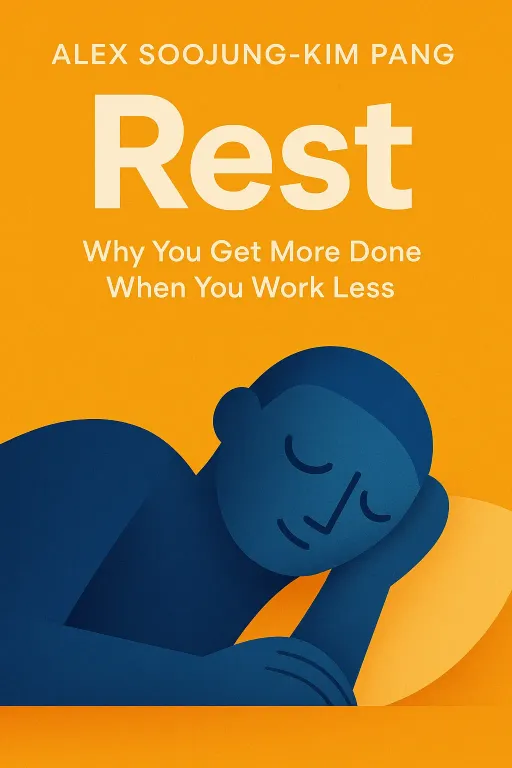
Nova: And that’s precisely why we need to talk about it. Today, we’re diving into the powerful concept of achieving clarity not through endless grind, but through the strategic use of intentional rest. Our insights today are heavily influenced by the groundbreaking work of Alex Soojung-Kim Pang's book,, and Cal Newport's influential.
Atlas: Cal Newport, the deep work guru? I know his work emphasizes focus. But Pang's? That sounds almost… counter-cultural in our always-on world.
Nova: It absolutely is. Pang, for instance, is a consulting futurist who spent years embedded in Silicon Valley, studying how the most brilliant and productive minds achieved their breakthroughs. He found their secret wasn't just endless hours; it was often highly intentional, almost counter-intuitive, periods of rest. And Newport, a computer science professor, brings that rigorous, research-backed approach to understanding how we actually get meaningful work done.
Atlas: So, you're telling me the path to peak performance isn't just about grinding harder, but about strategically stepping away? That makes me wonder how many of us are actually sabotaging our own productivity by resting.
The Myth of Constant Hustle & The Power of Deep Work
SECTION
Nova: Exactly. Let's start with that pervasive myth: the idea that constant hustle leads to constant progress. Our analytical minds thrive on space, on processing time, and on recharge. But we’ve convinced ourselves that every minute not spent actively "doing" is a minute wasted.
Atlas: I can see how that mindset takes hold. For our listeners who are natural problem-solvers, always facing challenges head-on, the instinct is to just power through. "If I just push a little harder, I'll break through this," right? But how does that actually play out in a high-stakes professional environment? Isn't taking a break just asking to be outmaneuvered?
Nova: That's the trap. Cal Newport, in, really shines a light on this. He argues that most of what we consider "work" today is actually shallow work—emails, meetings, administrative tasks. It feels productive because it keeps us busy, but it rarely moves the needle on our most cognitively demanding goals. True progress, he says, comes from deep work: the ability to focus without distraction on a cognitively demanding task.
Atlas: So you're saying my endless email refresh isn't actually my superpower? My entire workflow is a lie!
Nova: Not a superpower. More like a productivity black hole. Think about a software engineer, for example. This person is brilliant, but constantly interrupted. Slack messages, daily stand-ups, urgent emails, a steady stream of notifications. They busy, they're putting in the hours, but the really complex coding problems, the ones that require sustained, uninterrupted thought, sit untouched.
Atlas: That sounds painfully familiar. The context-switching alone is exhausting.
Nova: Exactly. So, this engineer, following Newport's principles, starts scheduling "deep work blocks" into his calendar. He sets aside two hours every morning, puts his phone away, closes his email, and focuses solely on that one complex architecture design. Initially, his colleagues are confused, even a bit annoyed. "Where's John? Why isn't he responding?"
Atlas: The fear of missing out, or, worse, the fear of being seen as not "available."
Nova: Right. But what happens? His output quality dramatically increases. He's solving problems faster, coming up with more elegant and innovative solutions. He's not working hours than his colleagues; he's working, producing superior results because he's protected his prime cognitive real estate. The cause was distraction and shallow work, the process was scheduling and protecting deep work, and the outcome was not just better code, but innovative breakthroughs.
Atlas: That's a powerful illustration. It’s not about slacking off; it’s about deliberately creating the conditions for high-value output. It makes me wonder how many truly innovative ideas are lost because we never give our brains the space to truly wrestle with them.
Intentional Rest as a Strategic Tool & The Wisdom of Deliberate Breaks
SECTION
Nova: And that deep work, as crucial as it is, needs a partner. And that partner isn't work. It's something far more radical and, ironically, just as intentional: deliberate rest. This is where Alex Soojung-Kim Pang's insights truly shine. He fundamentally shifts our perception of productivity, highlighting rest not as a luxury, but as a strategic tool.
Atlas: What exactly does "deliberate rest" look like? Is it just binging Netflix, or is there a method to this madness? Because for someone who's wired to be analytical and efficient, "just relaxing" feels… unstructured.
Nova: It’s absolutely structured, just not in the way we typically think of work. Pang reveals that for many historical figures who achieved extraordinary things, deliberate rest was not idleness but a crucial component of their creative and productive lives. Think about Charles Darwin. He was a powerhouse of intellect, but his daily routine was fascinating.
Atlas: Tell me. I'm picturing him hunched over a microscope for 18 hours straight.
Nova: Far from it. Darwin worked intensely for short, focused bursts – typically in the morning, and then again after lunch. But his afternoons? They were dedicated to long, solitary walks on his 'thinking path,' reading novels, even writing letters. He wasn't doing 'work' in the conventional sense. This was his deliberate strategy. He understood that his subconscious mind needed space and an uncluttered canvas to process the vast amounts of data he collected, to connect disparate ideas, and to formulate his revolutionary theories.
Atlas: So, it's about optimizing the processing power, not just the clock’s hours. Like a strategic defrag for your analytical mind. That perspective completely reframes what "rest" means. It's an active ingredient, not just an absence of activity.
Nova: Precisely. It allowed his mind to wander, to make novel connections, to consolidate learning, and to find the breakthroughs that direct, focused effort alone couldn't achieve. Churchill, another example Pang highlights, also famously incorporated structured naps and hobbies into his incredibly demanding schedule. He understood that to maintain peak strategic thinking, his mind needed these periods of deliberate disengagement.
Atlas: That's a powerful message for anyone who prides themselves on their focus and problem-solving abilities. It means embracing rest isn't a weakness; it's a higher-level strategy for sustained clarity and innovative thought. It’s about being effective over the long haul, not just burning out on a single sprint.
Synthesis & Takeaways
SECTION
Nova: And that’s the real breakthrough here, Atlas. It's realizing that rest isn't a break work, but an integral, fundamental part of work itself. It's the engine that powers clarity, sustains creativity, and allows for deep, meaningful insights. It’s about listening to the analytical needs of your own brain.
Atlas: This really shifts the narrative away from the grind culture. It’s not about working harder, it’s about working smarter by embracing the power of stepping away. For anyone facing complex problems, constantly seeking to optimize their impact, that space for processing is gold. It’s a strategic advantage, not a surrender.
Nova: Absolutely. Your analytical mind thrives when given space to process and recharge. So, for our listeners, here’s a tiny step you can take tomorrow: schedule just 15 minutes for a "thinking break." Put it in your calendar. Step away from your devices. Just think, or don't. Let your mind wander.
Atlas: And see what clarity emerges when you give your brain permission to breathe. It might just be the most productive 15 minutes of your day.
Nova: We’d love to hear how that tiny step impacts your clarity and productivity. Share your experiences with us on social media.
Atlas: Give yourself that permission. You might be surprised at the insights that bubble to the surface.
Nova: This is Aibrary. Congratulations on your growth!