The 'How-To' Twist: How to Make Decisions Without Drowning in Information.
Golden Hook & Introduction
SECTION
Nova: What if I told you that the very data you meticulously gather as a product leader might actually be betraying your decisions? That the information meant to clarify your path could, in fact, be leading you astray?
Atlas: Betraying? That sounds almost counter-intuitive, Nova. I mean, common wisdom screams that more data, more insights, more information always leads to better choices. For someone in product, that's practically gospel.
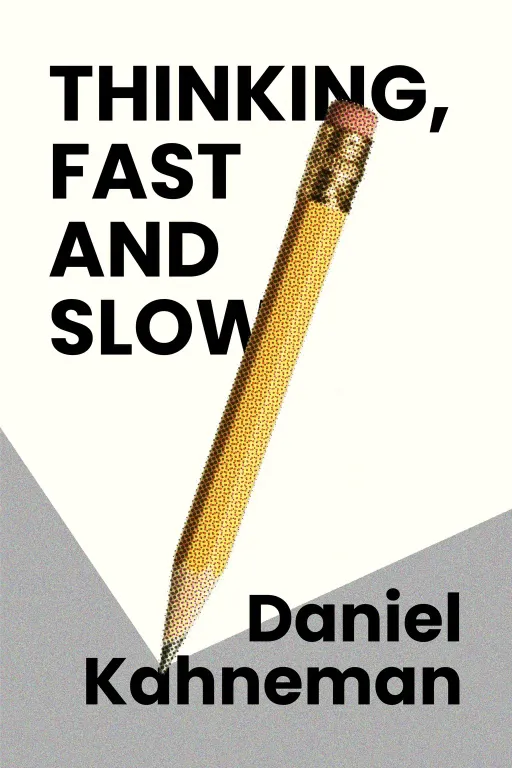
Nova: It's a powerful belief, Atlas, and often true to a point. But the real challenge isn't just gathering data; it's making truly robust decisions without getting paralyzed by the sheer volume of it. Relying solely on intuition, especially when that intuition is shaped by hidden biases, can lead to costly errors. And that’s exactly what we're dissecting today, pulling insights from two seminal works: Daniel Kahneman's "Thinking, Fast and Slow" and Chip Heath's "Decisive."
Atlas: Two heavy hitters! I know "Thinking, Fast and Slow" is legendary.
Nova: Absolutely. And what's particularly fascinating about Kahneman is that he's a psychologist who won the Nobel Memorial Prize in Economic Sciences for his work on prospect theory. He fundamentally changed how we understand human judgment and decision-making, proving that our brains operate on two distinct, often conflicting, systems. It’s an interdisciplinary bridge that few have managed to cross with such profound impact.
Atlas: A psychologist winning an economics Nobel—that’s a story in itself. It immediately makes me think about how much of our "rational" decision-making is actually driven by something far less logical.
Nova: Exactly. And that brings us perfectly to our first deep dive: unmasking those mental shortcuts.
Unmasking Your Mental Shortcuts: System 1 & System 2 Thinking
SECTION
Nova: Kahneman introduces us to System 1 and System 2 thinking. Think of System 1 as your brain's autopilot: fast, intuitive, emotional, and largely unconscious. It’s what helps you recognize a face, understand simple sentences, or react to a sudden noise. It’s brilliant for survival, but it's also prone to biases.
Atlas: So, like when I instantly decide a new product feature "feels right" without really digging into the user research? That's my System 1 kicking in?
Nova: Precisely. And then there's System 2: slow, deliberate, logical, and effortful. This is what you engage for complex calculations, learning a new skill, or, ideally, making critical product decisions. System 2 is what allows you to override System 1's initial impulses, to pause and analyze.
Atlas: But wait, in the fast-paced world of product, aren't we often forced into System 1 thinking? Deadlines are tight, markets move quickly. How do we even know when to trust our gut versus when to slow down? And what exactly are these "cognitive biases" you mentioned? That sounds like fancy academic jargon for "bad choices."
Nova: It’s not just bad choices, Atlas; it's systematically predictable errors in judgment. Cognitive biases are those consistent patterns of deviation from rational judgment. For example, confirmation bias. This is where your System 1 actively seeks out information that confirms your existing beliefs and dismisses anything that contradicts them. If you're a product leader convinced your new feature is revolutionary, you might unconsciously only hear the positive feedback and ignore the critical user tests.
Atlas: Oh man, I know that feeling. It's like when you’re scrolling through social media, and the algorithm just keeps showing you what you already agree with. You feel smart, but you're not actually growing. For our listeners who are managing high-pressure teams, this concept might feel impossible to implement. How do you really check yourself?
Nova: It’s a constant battle, but awareness is the first step. Think about the planning fallacy: our tendency to underestimate the time, costs, and risks of future actions, even when we know our past failures. Product roadmaps are notoriously optimistic because our System 1 wants to believe things will go smoothly. System 2 has to step in and say, "Hold on, remember last time? Let's add some buffer, and let's actively seek out reasons why this might."
Atlas: That’s a great way to put it. So, a product leader might have a brilliant idea, their System 1 screams "go for it!", but then System 2 needs to ask: "What if this wildly optimistic timeline is completely off? What data are we ignoring?" Can you give an example of a product decision where System 1 thinking could lead to a costly error, and how System 2 could have prevented it?
Nova: Absolutely. Imagine a product team launching a new feature based on a single, enthusiastic beta tester and an internal "gut feeling" that it's a game-changer. System 1 is shouting, "Success! Validation!" They rush to market. But System 2, if engaged, would have insisted on broader user testing, A/B testing with a larger segment, looking at market saturation, and perhaps even a pre-mortem exercise to identify potential failure points before launch. The cost of a failed launch – reputation, resources, lost time – far outweighs the perceived speed of System 1.
Atlas: That makes perfect sense. It’s not about stifling intuition entirely, but knowing when to apply the brakes and engage the more rigorous, analytical part of your brain.
Nova: Precisely. Understanding these mental traps is one thing, but how do we build a fortress against them, especially when our brains are wired for these shortcuts? That's where Chip Heath’s "Decisive" comes in, offering a tangible framework.
The WRAP Framework: A Practical Guide to Better Decisions
SECTION
Nova: The Heath brothers, in "Decisive," give us the WRAP framework: Widen your options, Reality-test your assumptions, Attain distance before deciding, and Prepare to be wrong. It’s a structured approach to counteract those very biases Kahneman identified.
Atlas: Okay, so this is the "how-to" part. I like that. Widen your options, that sounds pretty straightforward, but it’s probably harder than it sounds in practice.
Nova: It is. Often, when faced with a decision, we fall into a "spotlight" mentality, focusing on just one or two obvious choices. The Heath brothers call this "narrow framing." Instead of "Should we do A or B?", Widen Your Options pushes you to ask "What are our other options? What else could we try?" It means actively seeking out alternatives, even seemingly outlandish ones, to avoid being trapped by limited choices.
Atlas: Widening options makes sense, but how do you yourself to do that when deadlines are looming and you're already stretched thin? It feels like it adds more work to an already overloaded plate. For product managers, that's a huge pain point.
Nova: It’s about building the habit. They suggest using techniques like the "vanishing options test": if you couldn't choose any of your current options, what would you do instead? Or "multi-tracking," where you pursue multiple options simultaneously, at least in the early stages. It’s not about adding work, but work upfront. The next step is Reality-Test Your Assumptions. This means actively challenging your beliefs about the situation. Don't just gather data that confirms what you already think; seek out disconfirming evidence.
Atlas: Reality-testing often feels like it slows things down. How can product leaders integrate this without becoming paralyzed by analysis? It's easy to get stuck in "analysis paralysis" trying to test every single assumption.
Nova: It’s about strategic testing. Instead of a full-scale launch, can you run a small experiment? A pilot program? A "concierge MVP" where you manually deliver the service to a few users to learn? They tell a story of a company that built an expensive medical device based on assumptions about doctor's needs, only to find out it was too complex. A simple, cheaper prototype or even role-playing the doctor's day would have revealed this much earlier. You need to "zoom out, zoom in."
Atlas: That’s a perfect example. So, instead of just building, you're actually the core hypothesis. What’s the next part of WRAP?
Nova: Attain Distance Before Deciding. This addresses the emotional element. When we're bogged down in a decision, especially a high-stakes one, our emotions can cloud our judgment. Heath suggests stepping back. Ask yourself, "What would my successor do?" or "What advice would I give my best friend in this situation?" It helps you see the bigger picture, free from immediate emotional entanglement.
Atlas: That sounds like great advice, but how do you emotionally detach from a project you've poured your soul into? When you’re a product leader, your projects often feel like your babies. It’s hard to be objective.
Nova: It's incredibly difficult, but crucial. One technique is the "10/10/10 rule": How will you feel about this decision 10 minutes from now? 10 months from now? 10 years from now? It helps you prioritize long-term consequences over short-term emotions. And finally, Prepare to Be Wrong. Even with the best process, decisions can go awry. This step involves conducting "pre-mortems" – imagining it's a year from now and your decision has failed spectacularly, then asking. It helps you foresee potential pitfalls and build contingency plans.
Atlas: Preparing to be wrong... that sounds a bit defeatist. How does that foster a culture of innovation and confidence? Shouldn't we be optimistic?
Nova: It's not about being defeatist, Atlas; it's about building resilience and agility. A pre-mortem isn't about predicting failure; it's about anticipating risks so you can mitigate them. It allows you to move forward with greater confidence, knowing you've considered the downsides. It's about building a robust decision, not a perfect one. It’s about being smart, not just lucky.
Synthesis & Takeaways
SECTION
Nova: So, both Kahneman and Heath offer powerful lenses. Kahneman helps us understand the inherent flaws in our mental architecture – those cognitive biases that distort judgment. Heath then gives us a practical, systematic framework – WRAP – to actively counteract those biases and make more consistent, effective choices under pressure. It's about moving from passively being influenced by our brains to actively taking control of our decision-making process.
Atlas: That’s a profound insight. It means that being a great leader isn't just about having the best ideas, but about having the best process for evaluating those ideas and making choices, especially when you're swimming in information. It's about mastery over your own mind, not just mastery of the product. So, what’s one tiny step our product leaders listening today can take to start applying this immediately?
Nova: Before your next major product decision, list at least three alternative options you haven't considered yet. Don't just settle for the obvious two. Actively challenge your initial impulse. Force your System 2 to widen the options, even if System 1 is telling you it's a waste of time.
Atlas: That’s a fantastic, actionable step. It resonates deeply with the idea of continuous improvement and strategic foresight. It’s not just about building better products, it’s about building a better, more thoughtful decision-maker and, by extension, a more effective team. This isn't just about avoiding mistakes; it's about unlocking new pathways to influence and collective success. The mastery of decision-making really is a continuous journey, a muscle you have to keep exercising.
Nova: Absolutely. And we’d love to hear from our listeners: What's one decision you've made recently where you wish you'd challenged your initial impulse or widened your options? Share your experiences with us and the Aibrary community.
Atlas: Your insights help us all grow.
Nova: This is Aibrary. Congratulations on your growth!