The 'Decision Paralysis' Loop: How to Act Decisively Under Uncertainty.
Golden Hook & Introduction
SECTION
Nova: Okay, Atlas, give me your five-word review of decision-making under uncertainty.
Atlas: Oh man, overwhelming, risky, slow, regretful, avoidable.
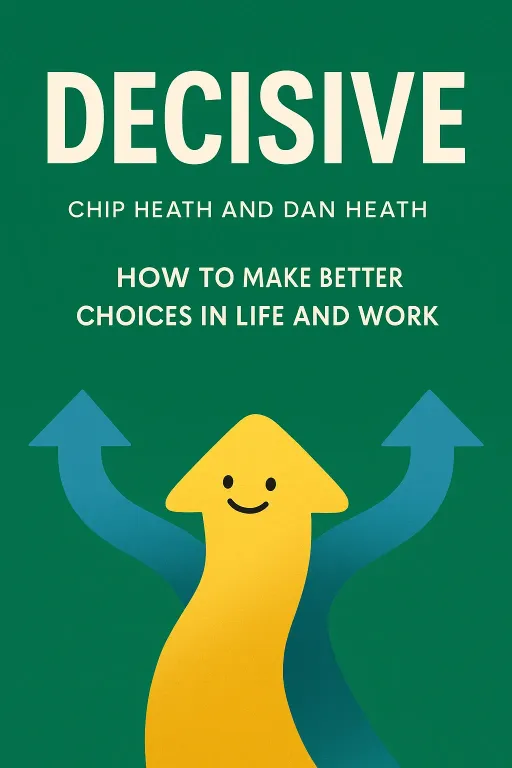
Nova: Avoidable, you say? That's quite the claim! And a perfect segue into our topic today. We're talking about 'The 'Decision Paralysis' Loop' and how to act decisively, leaning heavily on two titans: 'Decisive' by Chip and Dan Heath, and 'Thinking, Fast and Slow' by Daniel Kahneman. It's fascinating how Kahneman, a psychologist, won a Nobel Prize in Economics for showing us just how irrational our economic decisions often are.
Atlas: Wow, a psychologist winning in economics. That immediately tells me we're not just talking about spreadsheets, we're talking about people. And that 'avoidable' part really grabs me. For anyone trying to stay ahead, that slow, regretful part of decision-making feels like a real drag on progress. How do we make it avoidable?
The WRAP Framework: A Practical Compass for Decisive Action
SECTION
Nova: Exactly! That's where Chip and Dan Heath's 'Decisive' steps in with their brilliant WRAP framework. It's not just a theoretical model; it's a practical, four-step process to navigate those complex, uncertain environments that often leave us frozen. Think of it as your practical compass.
Atlas: A compass for chaos – I like that. So, what does WRAP stand for? Lay it on me.
Nova: Alright, let's break it down. First, 'W' is for. Most people, when faced with a big decision, think in binary: A or B. The Heaths argue that's a trap. They advocate for finding more choices, looking for 'this AND that' solutions, or even 'escape routes' if things go south.
Atlas: Widen your options sounds great, but honestly, when I'm head-down in a project, it's hard enough to see A and B, let alone C, D, and E. How do you actually do that when you're swamped and the clock is ticking for a strategic leader?
Nova: That's a fantastic question, and it’s precisely why the Heaths emphasize things like 'multitracking' – considering several options simultaneously. They also suggest looking for someone who's already solved your problem, or asking for advice from unexpected sources. It's about breaking free from the 'narrow frame' that limits our perspective.
Atlas: Right, like getting out of your own echo chamber. What’s next?
Nova: Next, 'R' is for. We all have biases, and we often make decisions based on what we is true. This step forces us to seek out disconfirming evidence, to 'zoom out' and challenge our own deeply held beliefs. It’s about asking, 'What if I'm wrong?'
Atlas: Reality-test assumptions – isn't that just common sense, or is there a trick? Because honestly, I see brilliant people make decisions based on shaky ground all the time.
Nova: It sounds like common sense, but it's incredibly hard to do. The trick is actively seeking out criticism, not just confirmation. The Heaths talk about conducting 'pre-mortems' – imagining that your decision has failed a year from now, and then asking. It flips the script and forces you to anticipate problems before they happen.
Atlas: That’s a powerful mental exercise. So, 'A' in WRAP?
Nova: 'A' is for. Our short-term emotions, our System 1 thinking as Kahneman would say, can hijack our long-term goals. This means stepping back, checking in with your core priorities, and asking yourself what advice you'd give a friend in the same situation.
Atlas: I can definitely relate to that emotional hijacking. Those high-stakes decisions can feel incredibly personal. What's the last letter?
Nova: Finally, 'P' is for. Even with the best process, uncertainty means outcomes aren't guaranteed. This step is about building 'tripwires' – signals that tell you when a decision needs to be revisited – and creating contingency plans. It’s about being resilient, not just right.
Atlas: Preparing to be wrong feels counterintuitive for a leader. Doesn't that undermine confidence? It almost sounds like admitting defeat before you even start.
Nova: It's actually the opposite. It builds confidence because you're acknowledging reality. Think of a hypothetical tech leader, Sarah, debating whether to launch a new product that's a radical departure from their core offering. Instead of just betting everything on one launch, the WRAP framework helps her. She widens her options by exploring partnerships or a phased rollout. She reality-tests her assumptions by running small-scale pilots and seeking out critics of the product idea. She attains distance by asking what her mentor would advise, free from her immediate emotional investment. And she prepares to be wrong by setting clear 'tripwires' – if user adoption is below X by month three, they pivot to Plan B. It's not defeat; it's strategic agility.
Unmasking the Mind's Traps: Cognitive Biases and Rational Choice
SECTION
Nova: That's a perfect example, Atlas. The WRAP framework is brilliant for we decide, but equally important is is deciding – and that's where Daniel Kahneman's 'Thinking, Fast and Slow' comes in. He helps us understand the internal machinery of our minds.
Atlas: Okay, so my brain is the 'who' in this equation. Tell me about this internal machinery.
Nova: Kahneman distinguishes between two systems of thinking. System 1 is fast, intuitive, emotional, and automatic. It's what lets you recognize a friend's face or react quickly to a sudden noise. System 2 is slow, deliberate, logical, and effortful. It's what you use to solve a complex math problem or plan a strategy.
Atlas: So, if System 1 is so tricky and prone to error, should we just try to use System 2 all the time? That sounds exhausting for a 'Future-Focused Leader' who needs to make quick calls and lead with conviction.
Nova: Absolutely exhausting, and impossible. System 1 is essential; it's what makes us efficient. The key isn't to eliminate System 1, but to understand its pitfalls and know when to engage System 2. For instance, System 1 loves shortcuts, which often lead to cognitive biases.
Atlas: Give me an example of one of these 'mind traps.' I'm curious how my brain might be tricking me right now.
Nova: One classic is. System 1 is wired to seek out information that confirms what we already believe and ignore evidence that contradicts it. Imagine a marketing team convinced their new ad campaign is a stroke of genius. Their System 1 will naturally filter out negative feedback, highlighting only the positive, even if sales are stagnant. They might even rationalize away poor performance by blaming external factors.
Atlas: Oh, I've been there! It's like your brain is actively trying to prove itself right, even when all signs point elsewhere. So, how does a busy leader actually 'slow down' their System 1 and outsmart these biases? How do we apply this?
Nova: It starts with awareness, Atlas. Just knowing these biases exist is a powerful defense. For confirmation bias, it means actively seeking out dissenting opinions, or appointing a 'devil's advocate' in meetings. For an anchoring effect – where our judgment is overly influenced by the first piece of information we hear – it means consciously considering multiple perspectives before forming an opinion. It’s about building processes that force System 2 to engage, even when System 1 is shouting its quick, confident answer.
Atlas: So, it's not just about having a framework like WRAP, but understanding the psychological terrain your own mind is navigating while you're that framework. That makes so much sense. It's the inner game of decision-making.
Synthesis & Takeaways
SECTION
Nova: Precisely. The WRAP framework gives you the map and the tools for to make better decisions, while Kahneman gives you the understanding of the terrain – the internal landscape of your mind and its potential pitfalls. Together, they transform uncertainty from a source of paralysis into an opportunity for strategic, confident action. It's about moving from 'overwhelming' to 'avoidable,' as you said.
Atlas: That’s actually really inspiring. So, it's about building a robust decision-making muscle, not just hoping for inspiration or gut feelings to guide you. It's about concrete skills for a strategic seeker.
Nova: Absolutely. It's about layering structure over our inherent human tendencies. It's about recognizing that decisiveness isn't about being perfectly right every time, but about having a process that allows you to move forward with confidence, even when stakes are high and the future is unclear.
Atlas: That’s a profound shift in perspective. For our listeners who are navigating complex, uncertain environments, I have a challenge. What decision are you currently delaying? Could applying just one part of the WRAP framework – widening your options, reality-testing an assumption, creating distance, or preparing to be wrong – or simply recognizing one cognitive bias, shift your perspective entirely?
Nova: That's a perfect 'tiny step' for anyone looking to make a direct impact. Embrace the uncertainty, but don't let it paralyze you.
Atlas: Excellent advice.
Nova: This is Aibrary. Congratulations on your growth!