Mastering Decision-Making: Beyond Fast and Slow
Golden Hook & Introduction
SECTION
Nova: Atlas, I want you to imagine something. You're at a crossroads, facing a decision that feels monumental. Your gut screams one thing, logic whispers another. What's your go-to move in that moment of high-stakes uncertainty?
Atlas: Oh, Nova, that's a classic setup! Honestly, my gut usually wins, especially when time is tight. But then later, I'm often left wondering if I just drove myself down a one-way street when there were perfectly good detours. It’s that feeling of knowing there's a better way to navigate, but not having the map.
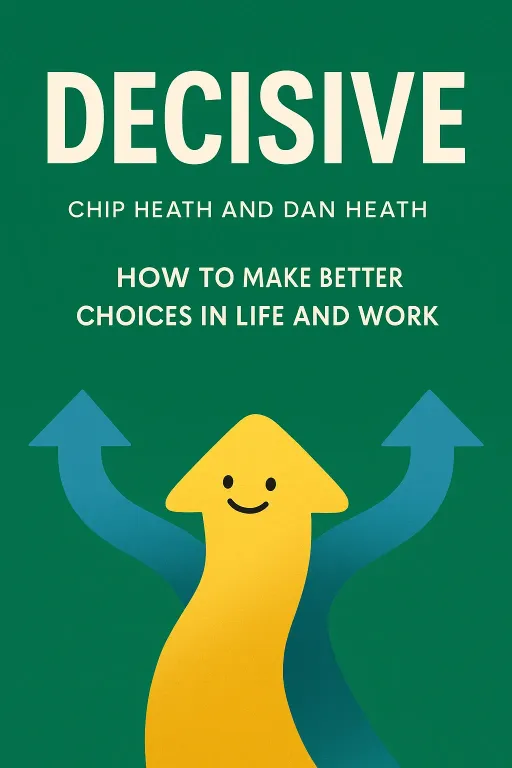
Nova: Exactly! That's the perfect entry point for today's discussion, because we're diving into the fascinating world of decision-making, drawing insights from two phenomenal books: Chip and Dan Heath's "Decisive," and Richard H. Thaler and Cass R. Sunstein's "Nudge." What's particularly interesting about the Heath brothers is their knack for making complex behavioral science incredibly accessible and actionable. They're known for distilling vast research into frameworks that anyone can apply, and 'Decisive' is a masterclass in that. It’s not just theory; it’s a toolkit.
Atlas: That’s a great way to put it. And when you pair that with 'Nudge,' which really pioneered the idea of understanding how subtle shifts in presentation can profoundly impact our choices, it feels like we’re getting the full spectrum. From consciously improving our own choices to understanding the invisible hands guiding us.
The WRAP Framework: A Strategic Shield Against Bad Decisions
SECTION
Nova: Absolutely. And let's kick off with 'Decisive,' and their brilliant framework: WRAP. It's an acronym for Widen your options, Reality-test your assumptions, Attain distance before deciding, and Prepare to be wrong. It’s designed to combat the four villains of decision-making: narrow framing, confirmation bias, short-term emotion, and overconfidence.
Atlas: Widen, Reality-test, Attain, Prepare. That sounds like a lot to remember in the heat of the moment. I imagine a lot of our listeners, especially those in high-stakes environments, might feel like they don't have time for this kind of structured thought. How do you even begin to 'widen your options' when you feel stuck between two bad choices?
Nova: That's where the beauty of it lies. The Heath brothers argue that often, our biggest problem isn't making the wrong choice, it's making choice from a too-narrow set of options. We fall into what they call 'narrow framing,' like a spotlight shining on just one or two paths. They tell a story about a CEO who was convinced he had two options: either fire his entire IT department and outsource, or invest heavily in upgrading their existing, underperforming team.
Atlas: Oh, the classic "either/or" trap. I've been there. It feels so definitive, so urgent. But it also feels incredibly limiting, like you're cornered.
Nova: Exactly! The CEO’s team felt the same. But by applying the 'Widen your options' principle, they started looking for completely different solutions. They explored things like bringing in a consultant to optimize the current team, or even doing a partial outsourcing while retaining key in-house talent. They eventually discovered a hybrid solution that nobody had considered, which saved jobs and improved efficiency significantly. The point is, don't ask "Should I do A or B?" Ask "Is there a C, D, or E that I haven't even thought of yet?"
Atlas: Wow. So, it's not just about brainstorming more of the same, but fundamentally shifting the lens through which you see the problem. It’s like being a detective and realizing the crime scene isn’t just the room you’re in, but the whole building.
Nova: Precisely. And this leads us to 'Reality-test your assumptions.' Once you have options, you need to challenge your beliefs about them. The Heath brothers talk about a company that was considering acquiring a smaller competitor. All the internal projections looked fantastic, everyone was excited. But a skeptical board member insisted they 'reality-test' by talking to customers of the target company.
Atlas: I can already guess where this is going. Internal enthusiasm can be a powerful, but also blinding, force. It's easy to get caught up in your own narrative.
Nova: Absolutely. What they found was that the target company's customers were deeply unhappy with a critical part of their service, a part that the acquiring company was planning to integrate directly. This wasn't reflected in any of the financial models. Had they not reality-tested, they would have inherited a massive customer satisfaction problem. It's about 'zooming out' from your internal echo chamber and looking for disconfirming evidence. What would have to be true for this NOT to work?
Atlas: That’s such a powerful question. It feels counter-intuitive to actively seek out reasons why your brilliant idea might fail, but it's essential. It reminds me of the scientific method – you try to disprove your hypothesis, not just confirm it.
Nova: What’s even more interesting is how they suggest 'Attain distance before deciding.' This is about emotional regulation. When we're making big decisions, especially under pressure, our emotions can hijack our rational thought. They suggest asking yourself, "What would I tell my best friend to do if they were in this exact situation?" Or even, "How would I feel about this decision 10 minutes from now, 10 months from now, or 10 years from now?"
Atlas: Oh, I love that '10/10/10 rule.' It’s a simple mental trick, but it forces you to step out of the immediate emotional whirlpool. It’s like hitting a mental refresh button, giving your prefrontal cortex a chance to catch up.
Nova: It's incredibly effective. And finally, 'Prepare to be wrong.' This isn't about being pessimistic, but about building in safeguards. They highlight the concept of a 'pre-mortem,' where you imagine it's a year later and your decision has failed spectacularly. Then, you work backward to figure out what went wrong. This helps you anticipate potential pitfalls and build contingency plans.
Atlas: That’s brilliant. It's not just about making a good decision, but making a resilient one. It's about accepting that uncertainty is inherent, and planning for it rather than pretending it doesn't exist. So, the WRAP framework is essentially a comprehensive system to systematically de-bias our decision-making, moving from instinct to informed action.
Choice Architecture: Nudging Towards Better Outcomes
SECTION
Nova: Precisely. And that naturally leads us to the second key idea we need to talk about, which often acts as a counterpoint to what we just discussed, or perhaps a complementary approach: 'Nudge' by Thaler and Sunstein. While 'Decisive' empowers individuals to make better choices, 'Nudge' explores how the environment itself can be designed to guide people towards better outcomes, often without them even realizing it. They call this 'choice architecture.'
Atlas: That sounds a bit… manipulative, doesn't it? The idea that someone is subtly 'nudging' me without my full awareness. I can imagine some listeners thinking, "Isn't that just taking away my freedom to choose?"
Nova: It’s a valid concern, and one Thaler and Sunstein address head-on. They argue that 'choice architecture' is unavoidable. Every decision we make happens within a framework, whether it's the layout of a cafeteria, the default settings on our phone, or the way retirement plans are presented. There's no such thing as a 'neutral' design. So, the question isn't we have choice architecture, but we design it.
Atlas: That’s a powerful reframing. So, if we’re always operating within some kind of architecture, why not design it intentionally for good? Can you give an example of a 'nudge' that truly makes a difference?
Nova: A classic example is organ donation. In some countries, you have to actively opt-in to be an organ donor. The default is 'no.' In others, the default is 'yes,' and you have to actively opt-out. The difference in donation rates is staggering. Countries with an opt-out system have significantly higher donation rates. This isn't about forcing anyone; it's about making a tiny change to the default option, which leverages our natural tendency to stick with the path of least resistance.
Atlas: Wow, that’s such a clear demonstration of the power of defaults. It’s like when you buy a new device, and it just works out of the box, you rarely go deep into the settings. We just accept the default. So, 'nudging' isn't about coercion; it's about making the desired behavior the easiest one.
Nova: Exactly. Another great example is retirement savings. Many companies now use 'automatic enrollment' in 401 plans. Employees are automatically signed up, with the option to opt-out. This simple change dramatically increases participation rates, helping countless people save for their future who might otherwise have procrastinated or simply never gotten around to it.
Atlas: That’s actually really inspiring. It takes the burden of active choice off individuals for things that are objectively good for them, like saving or donating. It helps people overcome inertia. So, it's about designing systems that make it easier for people to make choices that align with their long-term best interests, even if their short-term impulse might be different.
Nova: And it speaks directly to our 'Focused Achiever' listeners. If you want to make better decisions for yourself, you can apply these principles. Design your own 'choice architecture.' Want to eat healthier? Don't keep junk food in the house. Want to exercise more? Lay out your workout clothes the night before. These are personal nudges.
Atlas: So, it's not just for governments or large corporations. We can be our own architects of choice. That’s empowering. It’s like creating an environment that supports your goals, rather than constantly fighting against your own willpower.
Synthesis & Takeaways
SECTION
Nova: Absolutely. And when you bring these two ideas together – the proactive, structured WRAP framework from 'Decisive' and the subtle, environmental design of 'Nudge' – you get a really comprehensive toolkit for mastering decision-making. You're not just hoping for the best; you're actively shaping your choices and the world around them. The Heath brothers and Thaler and Sunstein collectively present a powerful argument that our decisions are rarely purely rational, but they don't have to be entirely random either. We can build resilience and clarity into our choice processes.
Atlas: That’s such a hopeful way to look at it. It moves beyond just lamenting our biases and gives us concrete strategies. For anyone who's ever felt overwhelmed by a big decision, or frustrated by consistently making the same mistakes, understanding these frameworks offers not just clarity, but a real path to growth. It’s about building momentum, one well-considered choice at a time.
Nova: Indeed. It's about recognizing that every choice is an opportunity to learn, to grow, and to refine your approach. It’s about being intentional, whether you're widening your options or simply setting up your environment for success.
Atlas: That's a profound takeaway. It shifts the focus from 'making the right choice' to 'designing a better choice process.'
Nova: This is Aibrary. Congratulations on your growth!