** The Charisma Code: Decoding Leadership for the Media Age
Golden Hook & Introduction
SECTION
Orion: Imagine you have a billion-dollar idea, but you walk away from the most important pitch of your life with nothing. In 2013, an inventor named Jamie Siminoff stood on the set of Shark Tank. He was pitching his video doorbell, a product he called Doorbot. The idea was revolutionary, the early sales were strong, but the Sharks... they all passed. Every single one.
Angel: And we all know what happened next. That company, Doorbot, became Ring, which Amazon bought for over a billion dollars. So what went wrong in that room?
Orion: Exactly. It wasn't the idea. It was his. He used a question inflection when stating his name, signaling low confidence. He missed the Sharks' negative cues, like their fake smiles and mouth shrugs of disbelief. His own body language screamed nervousness. A billion-dollar idea was undermined by a few seconds of bad signals.
Angel: That's a terrifying thought for any leader. That your message, no matter how brilliant, can be completely derailed by how you deliver it.
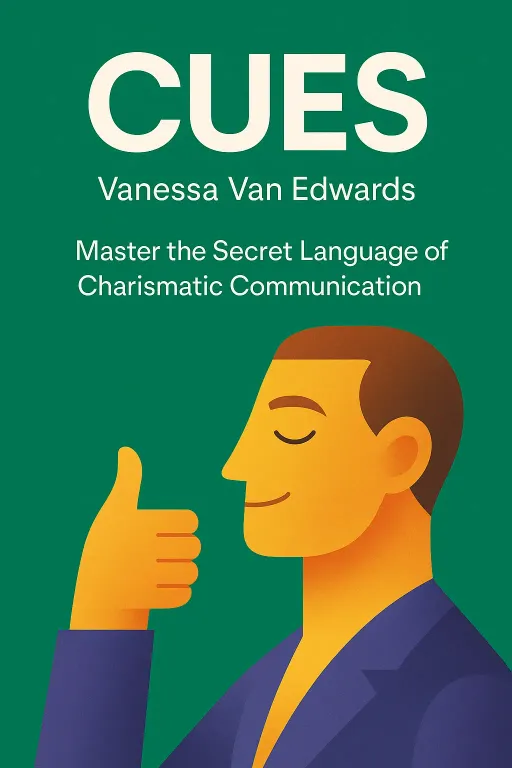
Orion: And that's the power of the secret language of communication explored in Vanessa Van Edwards' book, "Cues." It argues that we're all sending and receiving these signals constantly, and mastering them is the key to influence. Today, we're going to tackle this from two powerful angles. First, we'll unpack the fundamental equation for charisma: Warmth plus Competence. Then, we'll get tactical and decode the specific nonverbal cues that project power and build genuine connection.
Deep Dive into Core Topic 1: The Charisma Equation
SECTION
Orion: So Angel, as a leader in media, you've seen countless pitches, presentations, and on-air talents. How much of a 'yes' or 'no' really comes down to the person, not just the proposal?
Angel: Oh, it's immense. You can have the most well-researched, data-driven project, but if the person presenting it doesn't inspire confidence and trust, it's dead in the water. We're investing in people, in their vision and their ability to execute. The proposal is just the map; we need to believe in the captain.
Orion: That's the perfect entry into the book's central formula. Van Edwards argues that charisma isn't some magical, innate quality. It's an equation: Warmth plus Competence. When we first meet someone, our brain instantly asks two questions. First, for warmth: "Can I trust you?" And second, for competence: "Can I rely on you?"
Angel: Trust and reliability. That makes perfect sense. You need both. Competence without warmth is intimidating and suspicious. Warmth without competence is friendly, but you wouldn't trust them with a major project.
Orion: Precisely. The book calls this the "Charisma Scale." You can be high in both, low in both, or imbalanced. The most charismatic people can adjust their cues based on the situation. Take Jeff Bezos, someone on your list of interesting figures. In a casual interview with, he's all warmth—laughing, leaning in, gesturing freely. He's likable. But in a serious interview, he dials up competence—he sits expansively, his gaze is purposeful, his voice is lower. He's projecting authority.
Angel: That's fascinating. In media, we often see people pigeonholed. You have the 'warm' morning show host and the 'competent' hard-news anchor. The truly magnetic figures, the ones with real staying power like a Trevor Noah or a Susan Wojcicki, are the ones who can fluidly move between both. They can deliver a sharp, data-backed analysis and then share a personal, empathetic story moments later. It's about demonstrating that range.
Orion: And sometimes you have to consciously build the side you're not known for. The book tells a great story about Goldie Hawn. Everyone knows her as this bubbly, warm, funny actress. But in 2003, she wanted to launch a serious mindfulness program for children called MindUp.
Angel: And she'd be worried people wouldn't take her seriously. They'd see the warmth but question the competence.
Orion: Exactly. So what did she do? She didn't hide her warmth; she led with it. But she backed it up with undeniable competence. She partnered with neuroscientists and psychologists to conduct large-scale studies validating the program. The MindUp website is a perfect blend: you see smiling kids and Hawn's humor—that's the warmth. But right next to it, you see statistics, research data, and social proof. She balanced the equation.
Angel: That resonates deeply. As a woman in a leadership position, there can be an assumption that you lead with warmth, so you have to be very intentional about projecting competence. Hawn's strategy of leading with her natural strength but bolstering it with undeniable proof—that's a masterclass for any female leader. It's not about changing who you are; it's about making sure the full picture is seen.
Deep Dive into Core Topic 2: Decoding the Cues of Power and Connection
SECTION
Orion: So if balancing warmth and competence is the goal, let's get into the 'how.' The book gives us a tactical playbook of specific cues. Let's start with competence, the language of power. The book highlights dozens, but two are incredibly effective. The first is simply Powerful Posture. Taking up space. Shoulders relaxed and back, feet grounded. It signals confidence before you even say a word.
Angel: It's the physical manifestation of "I belong here."
Orion: Yes. And the second is a gesture called "Steepling." This is when you bring your fingertips together to form a kind of church steeple. It's a gesture of confident contemplation. You see it from leaders, from professors, from doctors. It signals, "I am thinking deeply and I am confident in my thoughts."
Angel: I've definitely seen that in boardrooms. It's a listening gesture, but a very active, authoritative one.
Orion: And the power of these visual cues is best illustrated by one of the most famous events in media history: the first televised presidential debate in 1960 between Richard Nixon and John F. Kennedy.
Angel: Ah, the ultimate case study.
Orion: It's perfect. Nixon had been ill and refused makeup. He was sweating under the hot studio lights. His posture was closed, he was gripping the podium so hard his knuckles were white. He looked anxious and uncomfortable. On the other side, you have Kennedy. He's tan, he looks relaxed, his posture is expansive, and he's looking directly at the camera, connecting with the audience at home.
Angel: And the result was a total split.
Orion: A complete split. The people who listened on the radio thought Nixon won. He was a seasoned debater, and his arguments were strong. But for the 70 million people watching on television, the visual cues were overwhelming. Kennedy presidential. Nixon looked like he was barely holding it together.
Angel: And that was the moment the visual medium truly took over politics and, really, all public communication. It proved that the message is inseparable from the messenger's image. What you frames what you. It's a lesson the media world has never, ever forgotten.
Orion: But as you said, power without connection is just intimidation. So let's pivot to a simple but powerful warmth cue: The Head Tilt. When you tilt your head, you expose your neck, which is a vulnerable area. It's a subconscious signal of trust and curiosity. It says, "I'm listening, I'm engaged, I'm open to what you're saying."
Angel: It's such a small thing, but it completely changes the energy of a conversation. It's the difference between being interrogated and being heard.
Orion: And this is where we can bring in another figure from your list, Walt Disney. The book talks about the "Wow Factor" at Disney Parks. Their goal is to treat every guest like a VIP. And they do it with a "plethora of little wows." These aren't grand gestures. They are small, consistent warmth cues. It's the cast member who kneels to speak to a child at their eye level. It's the enthusiastic "Mmmm, good choice!" you hear at a Starbucks. It's the head tilts, the eyebrow raises of interest, the genuine smiles.
Angel: It's about creating micro-moments of connection. In publishing, we talk about audience engagement. It's not just about selling a magazine or a book. It's about building a loyal community. Those "little wows" are what create brand loyalty. It makes the customer feel seen and valued, not just transacted with. That's the Disney magic, and it's 100% applicable to any industry.
Synthesis & Takeaways
SECTION
Orion: So when you put it all together, it's this constant dance. You're projecting competence with your powerful posture and your confident gestures, but you're building trust and connection with warmth cues like a simple head tilt or a genuine smile. It's the combination that creates true charisma.
Angel: You know, it's not about being fake or becoming an actor. I think it's about being intentional. It's about doing an internal audit and asking, "Do my external signals accurately reflect my internal confidence and my genuine desire to connect?" For any leader, that alignment is everything. When it's misaligned, that's when you get the Jamie Siminoff problem.
Orion: That's a perfect way to put it. So, let's end with a challenge. For our listeners, and Angel, maybe for you too—try this. In your next important meeting, your next pitch, your next one-on-one, pick just one competence cue and one warmth cue to focus on. Maybe it's steepling your fingers when you're listening intently, and then using a head tilt when someone else is speaking. Just one of each. And see how that small, intentional shift changes the dynamic of the room.
Angel: I accept the challenge. It's a powerful reminder that leadership isn't just in the grand strategies and the big decisions. It's built in the micro-moments of communication, one cue at a time.