The Collaborative Mindset: Building Shared Understanding in Teams
Golden Hook & Introduction
SECTION
Nova: Atlas, I've got a challenge for you. Imagine you're on a game show, and you have to guess the number of jelly beans in a giant jar. You get one guess. What do you do?
Atlas: Oh, man. Jelly beans? My gut says... a million. No, wait, that's just a random number. I'd probably squint, try to estimate the volume, maybe recall some vague high school geometry. But honestly? I'd probably be way off. What kind of challenge is this, Nova? Are we talking about my sweet tooth today?
Nova: Actually, it's about something far sweeter than jelly beans: collective intelligence. Because if I gave that same jar, and that same question, to a thousand people and then averaged their guesses, that average would almost certainly be closer to the true number than your single, brilliant guess.
Atlas: Whoa. Really? Even if some of those people were wildly off? That sounds a bit out there. It feels counter-intuitive. My instinct is always to find the smartest person in the room. But you're saying the of everyone, even the not-so-smart, is better?
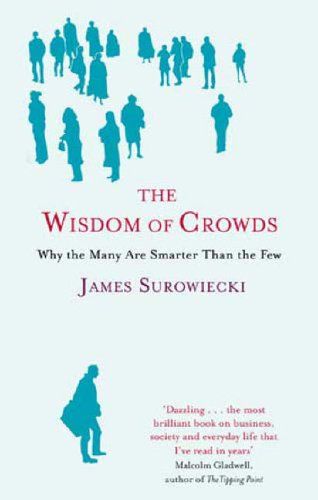
Nova: Exactly! And that fascinating phenomenon is at the heart of what James Surowiecki explores in his seminal work,. It's a book that fundamentally challenges our assumptions about decision-making, demonstrating how diverse groups, under the right conditions, can be smarter than any individual within them.
Atlas: That makes me wonder, how does he even quantify 'smartness' in a crowd? And what are these 'right conditions'? Because I've been in plenty of group decisions that felt... less than wise.
Nova: Well, Surowiecki, a journalist by trade, brings this concept to life with incredible clarity, drawing from fields like economics, psychology, and even animal behavior. His insights are particularly profound for anyone looking to optimize team performance and strategic thinking, which I know is a constant pursuit for many of our listeners. He's not just talking about random guesses; he's talking about a specific kind of collective intelligence.
The Wisdom of Crowds: Leveraging Diverse Perspectives
SECTION
Nova: Think about it this way: Surowiecki identifies four key conditions for a crowd to be 'wise.' The first is diversity of opinion. Everyone needs to have some private information, even if it's just an eccentric interpretation of known facts.
Atlas: So, not just parroting what the boss said, or what the loudest person in the room thinks. That makes sense. But how do you diversity of opinion, especially in teams where people might be afraid to speak up or just naturally conform? That sounds like a leadership challenge right there.
Nova: It absolutely is. The second condition is independence. People's opinions shouldn't be determined by the opinions of those around them. This is where things like groupthink or charismatic leaders can actually from the crowd's wisdom.
Atlas: Ah, so it's not a free-for-all, but it's also not a echo chamber. I can see how that would be a tightrope walk for any leader. You want collaboration, but you don't want everyone just nodding along. You want them to genuinely contribute their own unique perspective, not just what they think you want to hear.
Nova: Precisely. And the third condition is decentralization. People should be able to specialize and draw on local knowledge. This prevents everyone from trying to solve the same problem in the same way. It's about distributing the cognitive load.
Atlas: That's a great way to put it. So, if you have a problem, you don't just put everyone in a room and tell them to solve it together. You break it down, let different experts or different perspectives tackle their piece, and then bring it all back. Like a hive mind, but with distinct, independent bees.
Nova: Exactly! And finally, aggregation. There needs to be some mechanism for turning private judgments into a collective decision. This could be simple averaging, voting, or even a market system. The key is that it's a way to synthesize all those diverse, independent, decentralized opinions.
Atlas: Okay, so diversity, independence, decentralization, and aggregation. That's a powerful framework. But I’m curious, can you give an example of this in action? Something that really illustrates the power of these principles?
Nova: Absolutely. Surowiecki recounts a fascinating story about the search for the lost submarine, the USS Scorpion, in 1968. The submarine vanished without a trace in the Atlantic, and the Navy had very little data to go on. They convened a group of naval experts, but instead of asking them to agree on one location, they asked each expert to individually estimate the probability of the submarine being in various grid squares on a map.
Atlas: So they didn't just ask for a single best guess; they asked for a of probabilities from each person. That's clever.
Nova: It was. And then, rather than debating to a consensus, they used a mathematical formula—a version of Bayesian inference—to aggregate all these individual probability distributions. They essentially created a 'wisdom of crowds' prediction.
Atlas: And what was the outcome? Did it work?
Nova: Incredibly, the aggregated prediction pointed to a location just 220 yards from where the Scorpion was eventually found, over 10,000 feet below the surface. This was far more accurate than any single expert's estimate, even the most brilliant ones. It was a stunning validation of the power of collective intelligence when the right conditions are met.
Atlas: Wow, that’s actually really inspiring. To think that a systematic approach to gathering diverse, independent opinions, even when individual data points might be noisy, can lead to such a precise and critical outcome. It makes me think about how many times teams struggle because they're trying to force agreement instead of truly leveraging the spread of perspectives.
Nova: It's a profound lesson. It tells us that empowering teams goes beyond individual skills; it requires cultivating environments where collective intelligence can flourish through effective communication and the synthesis of diverse perspectives. But here's the rub, Atlas: applying these principles often means navigating disagreement, tough feedback, and high-stakes conversations. And that naturally leads us to the second key idea we need to talk about, which often acts as a critical enabler for true collective wisdom.
Crucial Conversations: Mastering High-Stakes Dialogue
SECTION
Nova: So, if the 'wisdom of crowds' tells us we need diverse input, by Kerry Patterson, Joseph Grenny, Ron McMillan, and Al Switzler tells us to actually get it, especially when the stakes are high, opinions differ, and emotions run strong.
Atlas: I know that feeling. Those are the conversations most people actively avoid, right? The ones where you have to tell someone their idea isn't going to work, or challenge a decision, or give difficult feedback. My stomach clenches just thinking about them.
Nova: Exactly. The authors define a crucial conversation as one where opinions vary, the stakes are high, and emotions run strong. And their core premise is that the ability to effectively navigate these conversations is a foundational skill for high-performing teams and organizations. They argue that when these conversations go poorly—or are avoided altogether—it leads to breakdowns in trust, poor decisions, and ultimately, a less effective collective.
Atlas: That makes perfect sense. I imagine a lot of our listeners, especially those in leadership roles, are constantly grappling with this. You want to foster an environment where people feel safe to challenge, but you also need to maintain respect and move forward. It’s a delicate balance. How do these authors suggest we approach these minefields?
Nova: Their central concept is to focus on creating a "Pool of Shared Meaning." In any crucial conversation, each person brings their own unique information, observations, and feelings. When these are openly and safely contributed to a common pool, everyone involved has access to a richer, more accurate understanding of the situation. This shared understanding is what leads to better decisions and stronger relationships.
Atlas: So it's not about winning an argument; it's about enriching the collective understanding. I like that. But how do you get people to actually to that pool, especially when emotions are running high and people are feeling defensive?
Nova: That's where their practical tools come in. One of the most powerful is "Start with Heart." Before you even open your mouth, get clear on what you want for yourself, for the other person, and for the relationship. If your motive is to win, or to punish, or to be right, the conversation is likely doomed. But if your motive is genuinely to find a solution that works for everyone, that intention will guide your approach.
Atlas: That's a great way to put it. It's about aligning your internal compass before you set sail into choppy waters. I can definitely relate to conversations going sideways because someone, or everyone, came in with the wrong intentions. But what about when things go sideways? When someone gets defensive or shuts down?
Nova: Then you need to "Make it Safe." When people feel unsafe, they either resort to silence or violence. The key is to notice these signs and then step out of the content of the conversation to restore safety. This might involve apologizing if you've made a mistake, contrasting to clarify your intent, or creating a mutual purpose if you suspect people don't believe you share their goals.
Atlas: So it's like a circuit breaker for emotional overload. You pause, address the underlying safety issue, and then you can return to the actual topic. That’s actually really practical. I can think of so many meetings where if someone had just hit that "safety" button, things wouldn't have devolved into unproductive arguments.
Nova: Absolutely. And the brilliant thing is how these two books complement each other. gives us the strategic imperative to seek out and integrate diverse perspectives. provides the tactical toolkit to actually that, especially when those diverse perspectives come with inherent tension or disagreement.
Atlas: It's like one gives you the 'why' and the other gives you the 'how.' You need both to build truly high-performing, innovative teams. Without the ability to navigate those tough conversations, the 'wisdom of crowds' just becomes a cacophony of conflicting opinions, or worse, silence.
Nova: Precisely. Nova's take is that empowering teams goes beyond individual skills; it requires cultivating environments where collective intelligence can flourish through effective communication and the synthesis of diverse perspectives. The collaborative mindset isn't just a nice-to-have; it's a strategic advantage, built on both the principle of leveraging diverse thought and the practice of mastering dialogue.
Synthesis & Takeaways
SECTION
Nova: So, Atlas, bringing it all together, what's the core insight you're taking away from thinking about these two powerful ideas?
Atlas: For me, it's about moving beyond the illusion of the "lone genius" or the "perfect leader." The real power, the real innovation, lies in the collective. But that collective power isn't automatic; it's cultivated. It requires a deliberate effort to not only invite diverse viewpoints – which so brilliantly advocates for – but also to create a safe space for those viewpoints to actually be heard, processed, and integrated, which is where becomes indispensable. It's about turning potential conflict into productive collaboration.
Nova: I love that. It’s about recognizing that the true strength of a team isn't just in the individual brilliance of its members, but in the quality of their interactions. It's in their ability to engage in productive disagreement, to learn from each other's unique insights, and to build a truly shared understanding that transcends any single person's perspective.
Atlas: Exactly. And the tiny step for our listeners: before your next team decision, explicitly encourage diverse viewpoints and critically evaluate how different perspectives are being integrated. Are you just hearing what you want to hear, or are you genuinely leveraging the 'wisdom of your crowd'? And are you creating the psychological safety for those crucial conversations to even happen?
Nova: That's a powerful call to action. Because it's not enough to simply diverse opinions; you have to actively cultivate the environment and the skills to them. Otherwise, you're leaving so much potential on the table.
Atlas: It’s about making sure that the silence in the room isn't just compliance, but genuine contribution.
Nova: Absolutely. This is Aibrary. Congratulations on your growth!