Mastering High-Stakes Communication
Golden Hook & Introduction
SECTION
Nova: You know, Atlas, I was thinking the other day about all the things we avoid in life. That overflowing email inbox, the gym membership we never use… but what if the most costly thing we avoid isn't a chore, but a conversation?
Atlas: Oh man, I know that feeling. The one where you see a specific name pop up on your calendar, and your stomach does a little flip? Like trying to explain to a toddler why they can't have ice cream for breakfast, but with higher stakes and less adorable whining.
Nova: Exactly! Because those are the moments that truly define our professional and personal trajectories. The conversations that feel too important, too charged, or too difficult to have. And often, by avoiding them, we inadvertently make things worse.
Atlas: That makes me wonder, how do you even you’re in one of those make-or-break moments? Is there a flashing neon sign that says, "Warning: Crucial Conversation Ahead!"?
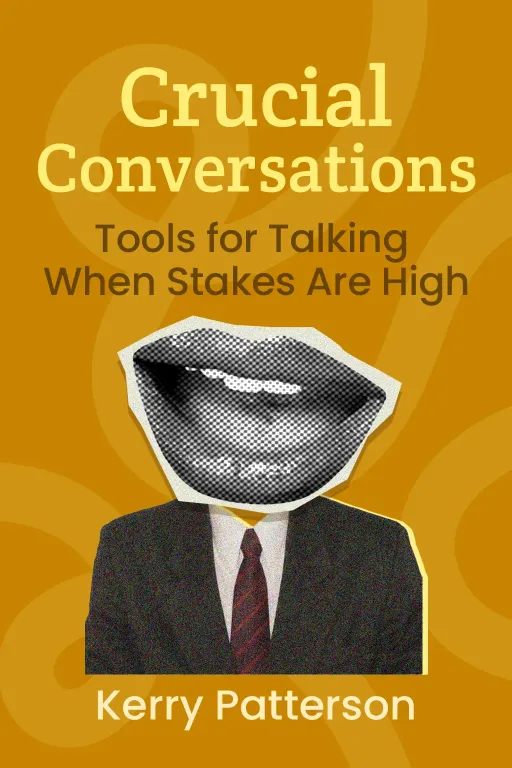
Nova: Well, not a neon sign, but there are definite indicators. And luckily, we have some incredible guides. Today, we're diving into the wisdom of two powerhouse books. First, "Crucial Conversations: Tools for Talking When Stakes Are High" by Kerry Patterson, Joseph Grenny, Ron McMillan, and Al Switzler. This book emerged from decades of research, observing thousands of real-life interactions to distill what actually works when communication breaks down. It's renowned for its practical, almost clinical approach to human interaction.
Atlas: And then, building on that foundation, we'll explore "Communicate to Influence: How to Inspire Action in Your Daily Leadership" by Ben and Kelly Decker. These communication experts, who've coached leaders in various industries, bring a modern, audience-centric lens to ensure that when you speak, your message doesn't just land, it actually moves people.
Nova: So, whether you're trying to give tough feedback, negotiate a critical deal, or simply ensure your brilliant ideas are heard and acted upon, these insights are gold.
Identifying and Entering the "Crucial Conversation Arena"
SECTION
Atlas: Okay, so let's start with those "crucial conversations." My gut tells me these are the ones where you're already sweating before you even open your mouth.
Nova: That’s a pretty good indicator! The authors of "Crucial Conversations" define them by three elements: high stakes, differing opinions, and strong emotions. Think about it: negotiating salary, giving a peer negative feedback, confronting a disrespectful colleague, or discussing a major project failure. If you try to avoid these, or handle them poorly, the consequences ripple out.
Atlas: Oh, I’ve been there. You know, for anyone who wants to connect, who wants clarity and impact, these are the moments that feel like a minefield. So, what happens when people step into that minefield unprepared?
Nova: Typically, we fall into one of two unhelpful patterns: silence or violence. Silence means we withhold information, we sugarcoat, we retreat, or we just don't say what needs to be said. We might rationalize it as "keeping the peace," but it's really just avoiding conflict, and problems fester.
Atlas: Right, like that time I kept quiet about a team member consistently missing deadlines, hoping it would just magically fix itself. Spoiler alert: it did not.
Nova: Exactly. And then there's violence, which isn't necessarily physical. It’s when we try to compel others to our point of view through yelling, accusing, interrupting, or even subtle forms of manipulation or sarcasm. We dominate the conversation, shut others down, or make them feel unsafe.
Atlas: That sounds rough, but I can see how, when emotions are high and you feel unheard, it's easy to just want to your point across. So, if we’re doing neither silence nor violence, what’s left? Just... polite disagreement?
Nova: It's much more profound than that. The core insight of "Crucial Conversations" is that the moment a conversation becomes crucial, you need to step back and ask: "What do I want for myself, for the other person, and for the relationship?" And critically, "How can I make it safe for us to talk about?"
Atlas: So you're saying, before I even think about I'm going to say, I need to check the emotional temperature of the room, and my own internal temperature?
Nova: Precisely. They introduce the concepts of "mutual purpose" and "mutual respect." Mutual purpose means we genuinely care about the other person's goals and find a shared objective. Mutual respect means acknowledging their inherent worth and dignity, even if you vehemently disagree with their ideas. Without these, dialogue breaks down.
Atlas: But wait, looking at this from a high-stakes professional perspective, isn't it hard to genuinely find "mutual purpose" when you're on opposite sides of a negotiation, or you have a completely different vision for a project? How do you even that?
Nova: It’s not about abandoning your own goals, but expanding the conversation to find a higher, overarching goal that benefits everyone. For instance, instead of "I want my budget approved" versus "I want to cut costs," the mutual purpose might be "We both want the company to succeed and be profitable." It’s about creating a safe space where all voices contribute to finding the best solution for that mutual purpose. You might say, "I really value our working relationship, and I want us to find a solution that works for both of us and moves this project forward." That immediately signals respect and a shared goal.
Atlas: That’s actually really inspiring. So, it's about shifting from a "me versus you" mentality to an "us versus the problem" mentality.
Strategic Communication for Impact: Beyond Just Talking
SECTION
Nova: Exactly. And that naturally leads us to the second key idea we need to talk about, which often acts as a critical next step: once you've established that safe space and mutual purpose, how do you actually the outcome? Because feeling safe isn't the same as getting people to agree or take action.
Atlas: Right? For our listeners who are driven by effectiveness and want to make their voice heard, the goal isn't just to be heard, it’s to make what you say. That’s where the "Communicate to Influence" aspect comes in, I’m guessing.
Nova: Absolutely. Ben and Kelly Decker argue that true influence isn't just delivering information; it's about shaping perceptions and driving action. It starts with understanding your listener's perspective and their desired outcome, not just your own.
Atlas: So you’re saying it’s not about having the best argument, but about knowing your audience inside and out? That sounds a bit out there. Isn’t that just manipulation? Or just saying what people want to hear?
Nova: That’s a great question, and it’s a common misconception. It’s not manipulation because your intent is still to achieve a positive, mutually beneficial outcome, which you've already established with mutual purpose. It's about, not deception. Think of a doctor explaining a diagnosis. They don't just rattle off medical jargon. They tailor their explanation to the patient's level of understanding, their concerns, and what they need to next. They might frame it differently for a medical student versus a worried parent.
Atlas: That’s a perfect example. So, it's about translating your message into their language, their priorities. But how do you actually that in a high-stakes setting? Give me a concrete scenario.
Nova: Alright, imagine a project manager trying to convince a skeptical executive team to invest in a new, unproven technology. If the project manager just talks about the tech's cool features and elegance, it's likely to fall flat. An executive team cares about ROI, risk mitigation, and strategic advantage.
Atlas: So, the project manager needs to frame the new technology not as "this cool thing," but as "this solution to biggest headache."
Nova: Precisely. They need to shift their message from "What I want to say" to "What does my audience need to hear to be persuaded?" The Deckers would say, before you even open your mouth, ask yourself: What are their biggest concerns? What are their priorities? What do they already know, and what do they they know? What's their desired outcome from this conversation, and how can my message align with that?
Atlas: I can definitely relate. I’ve been in meetings where someone just dumps a ton of information, and you just glaze over because it’s not hitting on what you care about. So, before I walk into that room, I need to do my homework on the in the room, not just the topic.
Nova: Exactly. It's about empathy and strategy working hand-in-hand. You combine the ability to keep the dialogue safe from "Crucial Conversations" with the intentionality of "Communicate to Influence" to craft a message that not only gets heard but actually inspires action and achieves your objective.
Synthesis & Takeaways
SECTION
Nova: So, bringing these two powerful ideas together, it sounds like "Crucial Conversations" gives you the framework to even the difficult discussions, ensuring everyone feels safe enough to contribute. It gets you to the starting line.
Atlas: And "Communicate to Influence" then helps you win the race. It ensures that once you're in that safe dialogue, your message is so finely tuned and strategically delivered that it actually resonates, persuades, and drives the action you need. For our listeners who crave clarity, precision, and impact, this is about transforming those stomach-churning moments into opportunities for genuine connection and effectiveness.
Nova: It truly is. The deep question we posed earlier was: How can you proactively identify these crucial conversations and prepare to navigate them with both empathy and strategic intent, ensuring all voices are heard and respected? The answer isn't a magic spell, but a set of learnable skills.
Atlas: And it sounds like the first step is self-awareness. Recognizing when you're entering one of these high-stakes moments, and then consciously choosing to engage rather than retreat or dominate.
Nova: Absolutely. So, for our listeners, here’s one concrete action you can take: Identify just one upcoming conversation—it could be with a colleague, a family member, or even a friend—that feels a bit "crucial." Before you go into it, spend just ten minutes thinking: What's the mutual purpose here? What do I want for everyone involved? And then, what's perspective? What do they care about, and how can I tailor my message to truly connect with them?
Atlas: It’s a journey, not a destination, but every word is a step. And your voice, when used strategically and empathetically, truly matters.
Nova: This is Aibrary. Congratulations on your growth!