Balancing Efficiency and Evolution
Golden Hook & Introduction
SECTION
Nova: What if the biggest mistake you can make in business isn't failing to grow, but growing too much? We're talking about the silent sabotage of scale.
Atlas: Whoa, Nova. That's a bold claim, especially for anyone driven by building and scaling. You're saying growth can actually be... counterproductive?
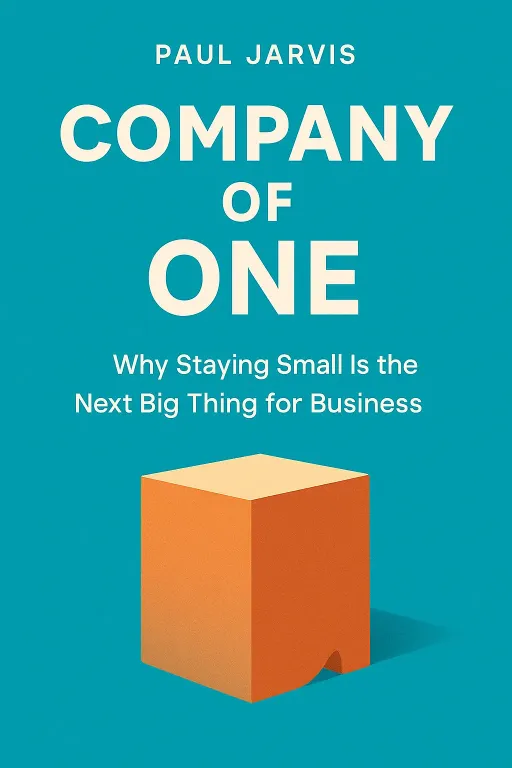
Nova: Exactly! Today we're cracking open two powerful ideas that challenge the conventional wisdom: Paul Jarvis's 'Company of One' and Sebastian Klein and Ben Hughes' 'The Loop Approach.' Jarvis, a designer turned author, built his career on intentional smallness, proving you don't need a massive empire to thrive. He’s all about doing more with less, but with purpose.
Atlas: And 'The Loop Approach' comes from deep within the world of organizational design, offering a blueprint for speed and adaptability in today's chaotic markets. It's about how to build resilient organizations that don't just survive change, but actually thrive on it.
Nova: Precisely. So, we're essentially looking at how to be lean, incredibly effective, and strategically flexible, even when the world's spinning faster than ever. It's about maximizing profitability and maintaining strategic flexibility, not just chasing arbitrary growth metrics.
Atlas: That makes me wonder, how do these two seemingly different concepts—one about staying small, the other about organizational agility—actually complement each other?
Nova: That's the magic. Let's start with Jarvis and this radical notion of the 'Company of One.'
Deep Dive into Core Topic 1: The Power of "Company of One"
SECTION
Nova: Paul Jarvis challenges the ingrained belief that growth is always good. He argues that many businesses are trapped in a cycle of scaling for scaling's sake, which often leads to decreased profitability, increased stress, and a loss of focus. He suggests that intentional smallness can actually be a massive strategic advantage.
Atlas: Hold on, so you're saying the "grow or die" mantra is actually a myth? For someone constantly analyzing business models and market entry, the default is always expansion.
Nova: It is, but Jarvis asks us to question we're growing. Is it for more money, more impact, or just because everyone else is doing it? He points out that many "companies of one" – which can be a single person or a small, focused team – achieve higher profit margins, more personal freedom, and greater operational efficiency because they avoid the overhead, bureaucracy, and diluted focus that often comes with rapid expansion.
Atlas: I can see that. I’ve definitely seen companies get bogged down in internal politics and processes as they scale, losing that initial spark and agility. But how does this actually maximize profitability? Most traditional models suggest economies of scale mean bigger is better for the bottom line.
Nova: Consider a bespoke software development firm. Let's call them "Code Weavers." They're a team of five highly skilled developers. They consciously decide to chase every large corporate contract. Instead, they focus on a niche: developing complex, secure data management systems for mid-sized financial institutions. They charge a premium because of their specialized expertise and the exceptional quality of their work.
Atlas: So, they're not trying to be a massive agency, but a highly effective, specialized unit.
Nova: Exactly. They maintain tight control over their client list, ensuring they only take on projects that align with their core strengths and values. This allows them to deliver exceptional results with fewer resources, avoid the costs of managing a large, diverse workforce, and maintain very high-profit margins per project. They're not chasing volume; they're chasing value and impact within their chosen domain.
Atlas: That sounds great for a specialized service, but what about a product company? Or a team of 10 or 20? At what point does 'small' become 'stagnant' or unable to compete?
Nova: That's the crucial distinction. Jarvis isn't advocating for stagnation. He's advocating for growth that serves a clear purpose, rather than growth as an end in itself. For a product company, it might mean focusing on a single, high-quality product that delights a specific customer segment, rather than trying to launch dozens of mediocre products. It’s about being a master of one trade, not a jack of all. This allows you to innovate deeply within your niche, rather than broadly and superficially.
Atlas: So it's about strategic focus, not just size. It’s about clarity in your mission and operations, which resonates with anyone trying to build efficient systems. You're saying the optimal size isn't necessarily the largest size.
Nova: Precisely. It’s about finding optimal size where you can maximize your impact, profitability, and personal satisfaction without the unnecessary baggage of unbridled growth.
Deep Dive into Core Topic 2: "The Loop Approach" – Self-Organization and Adaptability
SECTION
Nova: This idea of strategic smallness naturally leads us to the second key concept: how do these focused units, whether a company of one or a small, intentional team, actually in a rapidly changing world? That's where Sebastian Klein and Ben Hughes' "The Loop Approach" comes in.
Atlas: I’m curious. Self-organization sounds fantastic on paper, but how do you prevent it from devolving into chaos? Especially when you're trying to build resilient organizations.
Nova: The Loop Approach provides a framework for precisely that. It’s a method for self-organization designed to improve speed and adaptability. Imagine an organization that operates like a living organism, constantly sensing, responding, and adapting, rather than a rigid machine with a top-down command structure.
Atlas: Okay, so it’s not just a free-for-all. There’s a structure to this self-organization.
Nova: Absolutely. The "loop" refers to a continuous cycle of sensing, interpreting, deciding, and acting. Teams are empowered to make decisions and iterate quickly, learning from each cycle. This isn't about throwing out leadership; it's about distributing leadership and decision-making closer to the information, closer to the customer, and closer to the problem.
Atlas: What are the practical steps for a business to implement a 'loop approach'? Where does one even start if they're used to a more traditional, hierarchical structure?
Nova: Let’s look at a manufacturing startup, "SwiftFab." They make custom components using 3D printing. Instead of a traditional structure, they organize into small, cross-functional teams, each responsible for a specific product line or customer segment. Each team has the autonomy to design, produce, and even market their components.
Atlas: So, they're not waiting for approval from multiple layers of management?
Nova: Exactly. If a customer provides feedback on a component, the SwiftFab team responsible for that component senses the feedback, interprets its implications, decides on a design modification, and acts by implementing the change, often within days. They don't need to go up a chain of command to get approval for every minor iteration. They learn quickly from their customers and their own experiments.
Atlas: That makes me wonder, isn’t this just another flavor of 'agile,' or is there something fundamentally different here that helps with strategic flexibility?
Nova: While it shares principles with agile, The Loop Approach emphasizes a deeper, systemic shift in how an organization is fundamentally structured and led. It's less about a specific set of project management rituals and more about embedding adaptability and continuous learning into the organizational DNA. It's about creating a culture where every team member is an active participant in the "loop," not just executing tasks. This fosters a level of strategic flexibility that goes beyond just project delivery; it impacts the entire business model.
Atlas: So, it's about empowering teams to be mini-entrepreneurs within the larger organization, constantly innovating and responding. That would certainly help build resilient organizations.
Nova: It means you’re always evolving, always learning. It removes the bottlenecks of traditional hierarchies, making the entire organization inherently more responsive and capable of navigating unforeseen challenges.
Synthesis & Takeaways
SECTION
Nova: So, we've got the strategic choice to focused and intentional with "Company of One," and the operational framework to incredibly dynamic with "The Loop Approach." How do these two powerful ideas dance together to create something truly transformative?
Atlas: It’s almost like a martial art for business: you're small, but incredibly fast and precise, able to adapt to any opponent. Not just powerful, but also elegant.
Nova: That's a perfect analogy! The true power lies not in choosing between growth and efficiency, but in the mindset of intentional smallness—knowing your optimal scale and purpose—with the operational agility of self-organizing loops. It creates businesses that are not only profitable and resilient but also deeply satisfying for those who run them. It’s about designing a business that serves and your customers, not just an arbitrary growth chart.
Atlas: That gives me chills. It's about designing the future of commerce, not just reacting to it or blindly following old models. It allows for genuine business model innovation.
Nova: Exactly. For our listeners who are analyzing business models and building efficient systems, the challenge is clear: don't just optimize for endless growth. Optimize for and within your chosen scale. Schedule that 30 minutes this week for deep work, not just on scaling up, but on refining your core, making it more resilient, more responsive, and ultimately, more successful on your own terms.
Atlas: That's a powerful shift in perspective. It really emphasizes the importance of iterative learning and strategic clarity.
Nova: Absolutely. This is Aibrary. Congratulations on your growth!