The Macro-Drivers of Human Progress
Golden Hook & Introduction
SECTION
Nova: History is not a series of accidents, nor is it merely a collection of heroic deeds by larger-than-life figures. It is a series of algorithms. We often look at the trajectory of human progress as a random walk, but there is a distinct, measurable architecture beneath the chaos.
Atlas: That sounds like a bold claim, Nova. Most people I talk to think history is just one thing happening after another, driven by whoever happens to be in charge at the time. You’re suggesting there is an actual blueprint we can read?
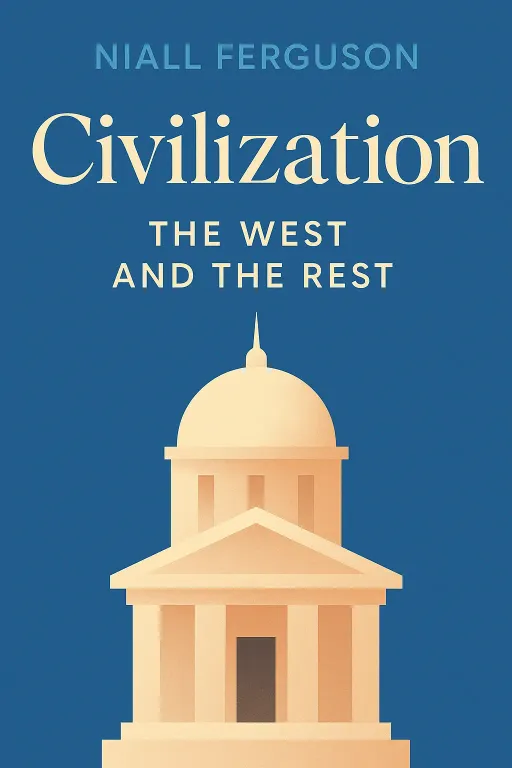
Nova: Exactly. And that is why we are looking at two of the most significant macro-histories written in recent decades. We are bridging the gap between Niall Ferguson’s work in Civilization and Ian Morris’s sweeping analysis in Foragers, Farmers, and Fossil Fuels. Ferguson gives us the software—the institutional innovations that allowed Western societies to surge ahead. Morris gives us the hardware—the physical energy capture methods that dictate what a society is even capable of valuing.
Atlas: Right, so one is the instruction manual for how to organize, and the other is the physical limit of what we can actually build. That is a fascinating dichotomy. I have always found that people focus too much on the "why" of history—the politics and the philosophy—and ignore the "how."
Nova: That is precisely the trap. When we look at Ferguson’s perspective, he argues that the rise of the West wasn't some inevitable destiny or a result of inherent superiority. It was driven by six distinct institutional innovations he calls killer apps. These are things like competition, science, property rights, modern medicine, consumerism, and the work ethic.
Atlas: I remember hearing about that framework. It’s almost like he’s describing a startup ecosystem for civilization. But before we get deep into the mechanics of those killer apps, let’s set the stage. Niall Ferguson is a Scottish historian who has spent his career examining the financial and political systems that underpin global power. He has a way of looking at the past that feels incredibly modern, almost like he is analyzing a corporate merger or a market shift rather than a centuries-old war.
Nova: That is the perfect way to describe his approach. He strips away the romanticism. And then, when you pair that with Ian Morris, who is an archaeologist and historian known for his work on social development, you get a complete picture. Morris looks at history through the lens of energy—how many calories a society can extract from its environment. He argues that our values are not fixed; they are a direct output of how we fuel our lives.
Atlas: This is starting to click. You have the institutional software, and then you have the energy-based hardware. Let’s start with that software. If Ferguson is right, and there is a set of killer apps that drove the ascent of the West, what does that actually look like in practice? How do those apps translate into real-world dominance?
The Software of Progress - Ferguson’s Institutional Innovations
SECTION
Nova: Think of it this way. Before these innovations, most of the world operated on a system of centralized, rigid control. Ferguson points out that the real breakthrough was the introduction of competition. In Europe, because of its unique geography and political fragmentation, you had dozens of competing states. They were constantly vying for power, which forced them to innovate. If one king didn't like a new technology or a new way of doing business, the innovator could just move to the next kingdom over.
Atlas: That makes sense. It’s the difference between a monopoly where you can just sit on your laurels and a competitive market where you have to constantly improve or die. But how do we apply that to the other killer apps? It’s not just competition. You mentioned property rights and science.
Nova: Science is the second major pillar. It wasn't just about discovery; it was about the institutionalization of the scientific method. It allowed for the systematic accumulation of knowledge. But the real game-changer, the one that often gets overlooked, is property rights. When you have a system where the state cannot arbitrarily seize your wealth, you create an incentive for long-term investment.
Atlas: I see how that works. If I know the government is going to take my shop tomorrow, I’m not going to invest in better equipment today. I’m going to extract whatever value I can and hide it. But if I have a secure property right, I have a reason to build, to scale, and to innovate. It’s the foundation of capital accumulation.
Nova: Exactly. And that flows directly into the work ethic. When you have property rights, you have the potential to accumulate wealth, which changes the cultural value placed on labor. Suddenly, working hard is not just a necessity for survival; it is a path to social mobility and security. This is where Ferguson’s argument gets interesting. He argues these apps were not just good ideas; they were a systemic advantage. They created a feedback loop. Competition led to science, which led to better technology, which was protected by property rights, which fueled more investment, and so on.
Atlas: That creates a very compelling picture of growth. But I have to play devil’s advocate here. We often hear critiques that this institutional model ignores the cost of that growth. Ferguson has faced pushback from readers and critics who argue that this "Western-centric" view glosses over the colonial exploitation that often accompanied these "killer apps." Is it possible to have the benefits of these institutions without the historical baggage?
Nova: That is a critical point, and one that is widely debated. The nuance is that these apps are not inherently "Western" in a racial or cultural sense; they are functional technologies of organization. They are tools. The controversy often stems from the fact that they were deployed in a world that was already uneven. But if you look at the successful development of nations in the East, like Japan or the Asian Tigers, they didn't reject these apps. They adopted them. They adopted the competition, the science, and the property rights, and they used them to leapfrog into modernity.
Atlas: That’s a great distinction. It’s not about the culture; it’s about the system. If you want the output, you have to run the software. But this brings me to a thought. You can run the best software in the world, but if your hardware is broken—if you don't have the energy to run it—you’re stuck. And that’s where Morris comes in, right?
The Hardware of Progress - Morris’s Energy Capture
SECTION
Nova: Precisely. This is the pivot to Ian Morris. While Ferguson focuses on the institutional software, Morris focuses on the physical reality of energy capture. He breaks history down into three distinct eras: foragers, farmers, and fossil-fuel users. He posits that the amount of energy a society can extract from its environment sets the absolute limit on its social development.
Atlas: That sounds almost deterministic. Are you saying our values are just a byproduct of how we get our energy? That feels a bit cold. Does that mean we don't have agency?
Nova: It is not about a lack of agency; it is about the constraints of the possible. Think about the values of a foraging society. They lived in small, mobile groups. Their energy capture was limited to what they could hunt and gather. Because they were mobile, they couldn't accumulate vast amounts of property. Their social structure was egalitarian because accumulation was physically impossible.
Atlas: So, you’re saying their egalitarianism wasn't necessarily a moral choice; it was a physical necessity.
Nova: Exactly. If you have to carry everything you own on your back, you don't value hoarding. Now, jump to the farming era. Farming allowed for the domestication of plants and animals, which is a massive jump in energy capture. But farming also requires land, which requires defense, which requires hierarchy. Suddenly, you have inequality, slavery, and entrenched power structures. These weren't necessarily choices people made because they were "bad" people; they were the structural requirements of an energy-dense society based on agriculture.
Atlas: That hits hard. It reframes the history of human suffering not just as a failure of morality, but as a consequence of the energy system. So, what happens when we move to the fossil-fuel era?
Nova: The fossil-fuel era is the ultimate game-changer. It unlocked an amount of energy that was orders of magnitude higher than anything humans had ever experienced. We went from relying on muscle power—human and animal—to the concentrated power of hydrocarbons. This massive surplus of energy allowed for the massive expansion of the middle class, the decline of extreme inequality, and the rise of democratic values.
Atlas: Wait, let me make sure I’m following this. You’re saying our modern democratic values—things like human rights and equality—are linked to our energy consumption? That’s a provocative idea.
Nova: It is. Morris argues that when energy is cheap and abundant, we can afford to be more liberal and egalitarian. We have the surplus to invest in education, healthcare, and social safety nets. But when energy is scarce or expensive, those values tend to retract. We see a shift back toward more authoritarian or hierarchical structures.
Atlas: This is a perfect bridge between the two authors. Ferguson says the "killer apps" of institutions created the modern world. Morris says the "fossil fuel" energy capture provided the capacity for those institutions to actually deliver on their promises. You need the institutions to organize the energy, but you need the energy to fuel the institutions.
Nova: That is the synthesis. If you try to implement high-level institutional software—like complex markets and scientific research—in a low-energy society, it will fail. It won't have the "processing power" to run. Conversely, if you have massive amounts of energy but no institutional software to organize it, you end up with chaotic, unsustainable systems.
Atlas: This feels incredibly relevant to the modern world. We are currently staring down a massive transition in our energy systems. We are trying to move away from fossil fuels toward renewables. If we follow Morris’s logic, this isn't just a technical challenge. This is a fundamental shift in the hardware of our civilization. If we don't get the institutional software right—the incentives, the property rights, the competition—during this transition, are we going to see a regression in our values?
Nova: That is the million-dollar question. If the transition to new energy sources leads to a period of energy scarcity or instability, we might see the values of the fossil-fuel era—which we take for granted—come under immense pressure. This is where the Strategic Architect mindset is so vital. You cannot just look at the market noise. You have to look at the deep structural evolution.
Synthesis & Takeaways
SECTION
Atlas: I love that. It turns the noise of the daily news cycle into something much more manageable. When you see a conflict or a market crash, you don't just react to the headline. You ask: "Is this an institutional failure, or is this a structural energy constraint?"
Nova: Exactly. And that is the takeaway for the listener. Whether you are leading a team, building a business, or just trying to understand the world, you have to operate on two levels. First, check your software. Are you fostering the killer apps of competition, scientific inquiry, and clear, protected property rights? Are you creating an environment where value can be created and accumulated?
Atlas: And second, check your hardware. Do you have the resources—the energy, the time, the focus—to actually execute? Are you trying to run a high-performance system on a low-energy budget? That is a recipe for burnout, both for an individual and for a society.
Nova: It is the ultimate resilience strategy. Recognize that your values and your outcomes are constrained by your physical reality, but they are liberated by your institutional choices. We are not just victims of history; we are architects of the systems that define our future.
Atlas: This has been a fascinating breakdown. I think our listeners are going to walk away with a much clearer view of why things are the way they are. It’s not just about what happens; it’s about the software and the hardware that make it possible.
Nova: It is a deep, structural lens, and once you put it on, you can’t take it off. You start seeing the "killer apps" and the "energy limits" everywhere.
Atlas: Thank you for walking us through that, Nova. It definitely sharpens the focus. And for everyone listening, remember: keep building your systems, keep refining your apps, and keep an eye on your energy.
Nova: This is Aibrary. Congratulations on your growth!