Deconstructing the Architecture of Human Progress
Golden Hook & Introduction
SECTION
Nova: We are told that competition makes us better, but what if the very thing that drives our success is the same thing that keeps us awake at three in the morning, chasing goals that were never actually ours?
Atlas: That is a unsettling thought. It hits on a paradox that I see all the time in high-performing teams. We talk about competition as the ultimate engine for growth, yet it often feels like we are just running in circles, fighting for the exact same status symbols.
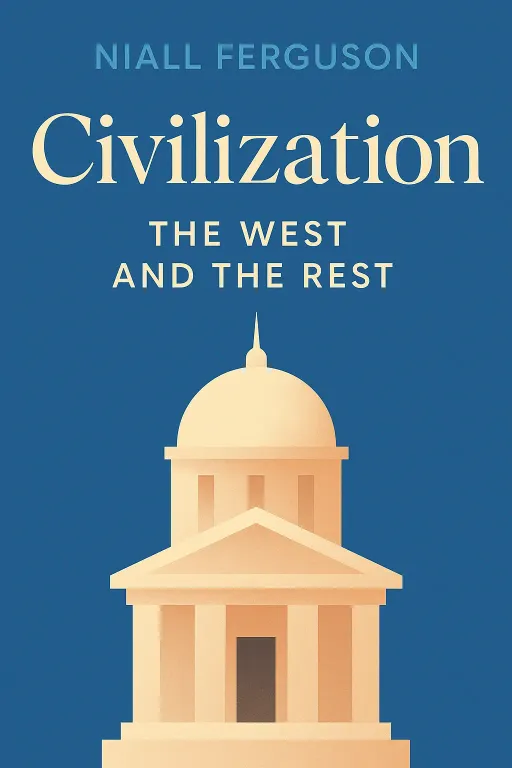
Nova: Exactly. And that tension is the heartbeat of two profound, yet very different, intellectual heavyweights. We are diving into Niall Ferguson’s, where he maps out the six killer apps that allowed the West to dominate the modern world. Then, we are going to pivot to René Girard’s. Girard takes a much darker, psychological look at why we actually desire things in the first place.
Atlas: I love that pairing. Ferguson gives us the structural, historical roadmap of how we built the world, and Girard gives us the hidden, often messy, human psychology behind why we build it that way. It is the difference between looking at the engine of a car and looking at the driver’s subconscious.
Nova: That is a perfect analogy. Ferguson argues that Western development wasn't an accident. It was the result of six specific, institutionalized killer apps: competition, science, property rights, medicine, consumerism, and work ethic. He wrote this to explain the rapid expansion of Western influence, and while it sparked massive debate about the nature of history and power, it remains a brilliant framework for understanding systemic growth.
Atlas: And then you have Girard. His work is almost the antithesis of that clean, institutional view. Girard was a French polymath who developed the mimetic theory of desire. He argued that we don't actually want things because they are inherently valuable; we want them because other people want them. It is a fundamental shift in how we view human motivation.
Nova: It really is. And for our listeners, specifically the builders and the strategists, this isn't just academic. This is the difference between building something truly innovative and just chasing the next shiny object because everyone else is doing it.
The Engines of Progress
SECTION
Atlas: Let’s start with Ferguson. The six killer apps. When you look at them—competition, science, property rights, medicine, consumerism, work ethic—they sound like the blueprint for a successful company. But is competition really the first one on the list for a reason?
Nova: It is. Ferguson highlights that the West wasn't a single, unified empire for much of its history. It was a fragmented, messy collection of competing states. Think of the contrast between the Ming Dynasty in China, which was a monolith, and the European states, which were constantly at each other's throats. That fragmentation forced innovation. If you didn't invent a better cannon, a better ship, or a more efficient tax system, your neighbor would conquer you.
Atlas: That makes sense. It is the ultimate survival of the fittest. But here is the challenge for a modern tech leader or a business owner. How do you foster that kind of healthy, productive competition without creating a toxic environment where the team is just trying to destroy each other?
Nova: That is the million-dollar question. Ferguson’s point is that competition works when it is institutionalized. It is about rules, not just raw aggression. When you have property rights, for example, competition shifts from looting your neighbor to out-innovating them. You have a legal framework that makes it safer to invest in the future.
Atlas: I see where you are going. It is about channeling the energy. But let’s look at the science and medicine aspects. Those feel like "killer apps" for objective progress. You can’t really argue with a vaccine or a faster computer processor. Those are measurable wins.
Nova: They are, but even those require a specific cultural mindset. Ferguson emphasizes the work ethic—the Protestant work ethic, specifically—as a driver. It wasn't just about having the tools; it was about the belief that hard work had inherent value and that life could be improved through rational effort. You needed the science, but you also needed the culture that valued the application of that science.
Atlas: That feels like the missing link in many organizations. You can give a team the best tools in the world, the best software, the best hardware, but if the work ethic—the belief that the effort matters—isn't there, the tools sit idle.
Nova: Exactly. And that brings us to the most debated app: consumerism. Ferguson argues that the ability to consume, to create a market, is what sustained the industrial revolution. It turned luxuries into necessities. It created a cycle where you needed to produce more to consume more.
Atlas: Which is where it starts to feel a bit relentless. I can see how that drives global expansion, but it also creates this constant, gnawing dissatisfaction. We are always looking for the next thing.
Nova: And that, my friend, is where we bump into René Girard.
The Mimetic Trap
SECTION
Atlas: Let’s bridge this. We have Ferguson saying that competition and consumerism are the engines of progress. Now, how does Girard’s mimetic theory complicate that?
Nova: Girard would look at Ferguson’s list and ask, "Why do we want those things?" Girard’s fundamental insight is that desire is not autonomous. You don't look at a car or a promotion or a status symbol and decide, in a vacuum, that you want it. You look at what other people want, and you want that, too.
Atlas: Oh, that hits hard. It’s the "keeping up with the Joneses" effect, but on a structural, societal level.
Nova: It is exactly that. Girard calls it mimetic desire. We mimic the desires of others. If a peer is chasing a specific role, suddenly that role becomes the most valuable thing in the world to you. It is not about the job itself; it is about the fact that someone else wants it.
Atlas: This changes the entire concept of competition. If Ferguson says competition drives innovation, Girard would say that competition often leads to rivalry and conflict, not because the goal is scarce, but because our desire for it is contagious.
Nova: Precisely. And this is where the scapegoat mechanism comes in. When two people or two groups want the same thing, and that desire becomes intense, it leads to rivalry. That rivalry can tear a group apart. To restore peace, the group instinctively identifies a scapegoat—someone to blame for the chaos—and casts them out. The group unites against the scapegoat, and that unity brings a temporary sense of order.
Atlas: That sounds like every office politics scenario I have ever witnessed. You have two talented people fighting for the same promotion. They start mimicking each other’s moves. The rivalry heats up. The team starts taking sides. And eventually, someone gets pushed out, or a new policy is implemented to "fix the problem," and everyone kind of settles down, but the underlying issue remains.
Nova: You hit the nail on the head. That is the mimetic cycle. In a business context, this is incredibly dangerous. If you are a leader, you need to recognize if your team is competing for the right reasons—to solve a problem, to build something new—or if they are trapped in a mimetic rivalry, fighting over status symbols because they saw someone else get excited about them.
Atlas: This makes me think about the "innovation" side of things. How much of what we call "innovation" is actually just mimetic? Like, everyone in tech decides that a certain trend is the future, so everyone piles into that space, not because it is the best use of their skills or the biggest opportunity, but because everyone else is doing it.
Nova: That is a brilliant observation. It is the "herd mentality" dressed up as strategic brilliance. When you see everyone in your industry rushing toward the same goal, you have to stop and ask: Is this a genuine opportunity, or are we all just caught in a mimetic loop?
Atlas: And the danger is that we end up with a crowded market, diminishing returns, and a lot of burnt-out people. It is the opposite of the "killer app" of competition, which is supposed to diversify our efforts and lead to unique, breakthrough solutions.
Nova: Ferguson’s competition is about creating new possibilities. Girard’s mimetic rivalry is about narrowing our focus to what everyone else is fighting over. They are two sides of the same coin of human ambition.
Synthesis & The Strategist’s Dilemma
SECTION
Atlas: This is giving me a new framework for decision-making. If I am a strategist or a builder, I need to wear two hats. I need the Ferguson mindset to build the systems, the property rights, the work ethic, and the culture of healthy competition. But I also need the Girardian awareness to spot when my own desires, or my team’s desires, are being hijacked by mimicry.
Nova: That is exactly the takeaway. You want to foster the killer apps, but you have to actively manage the mimetic traps.
Atlas: How do you do that? How do you practically apply this? If I am leading a team, how do I prevent that rivalry from taking over?
Nova: Start by looking at your reward structures. Are you rewarding the things that actually move the needle, or are you rewarding the things that create the most visible status? If you reward people for being the most "visible" or the most "aggressive," you are fueling mimetic rivalry. If you reward people for solving the hardest, most boring, or most overlooked problems, you are channeling competition into genuine innovation.
Atlas: I love that. Focus on the hard, overlooked problems. That is a great way to break the mimetic cycle because nobody else is fighting over those problems. They aren't "cool" yet.
Nova: Exactly. And transparency helps. When you make the goals clear and objective—like Ferguson’s institutional rules—you reduce the ambiguity that fuels mimetic desire. When everyone knows exactly what success looks like, they are less likely to look at their neighbor’s plate and wonder if they should be eating that instead.
Atlas: It is about creating a sandbox where the rules are clear, but the play is free. You have the structure, but you are not forcing everyone into the same game.
Nova: That is the ultimate balance. Ferguson gives us the structure to scale; Girard gives us the psychological wisdom to keep our sanity while we do it.
Atlas: This is such a powerful lens for anyone in a high-impact role. It forces you to be honest with yourself. Are you building, or are you just competing?
Nova: And that is the question we should all be asking ourselves at the end of every week. Is the progress we made this week real, or is it just a reflection of what we think we should be doing?
Atlas: I have a lot to think about for my own team meetings now. I think I am going to look at our "top priorities" list with a very different set of eyes. Are these priorities, or are they just the things everyone else is talking about?
Nova: That is the mark of a true strategist. You aren't just managing tasks; you are optimizing the human system. And understanding these two perspectives—the structural engine of Ferguson and the psychological driver of Girard—gives you a massive advantage.
Atlas: It really does. It turns the noise of the market into a clear signal. Thank you for this. It feels like we just zoomed out to see the whole board.
Nova: It was a pleasure to dive into this. Remember, the goal is not to stop competing, but to make sure you are competing for the things that truly matter. This is Aibrary. Congratulations on your growth!