Architecting the Future of Human Collaboration
Golden Hook & Introduction
SECTION
Nova: The most successful teams in the world today aren't actually managed. They are organisms. They function more like a living forest than a rigid factory floor, yet most of us are still clocking into systems designed for the nineteenth century.
Atlas: That is a bold way to start, but I have to push back immediately. If you tell a project manager at a Fortune 500 company that they should treat their team like a forest instead of a hierarchy, they are going to laugh you out of the room. We live in a world of deadlines, quarterly targets, and, let’s be honest, the need for control.
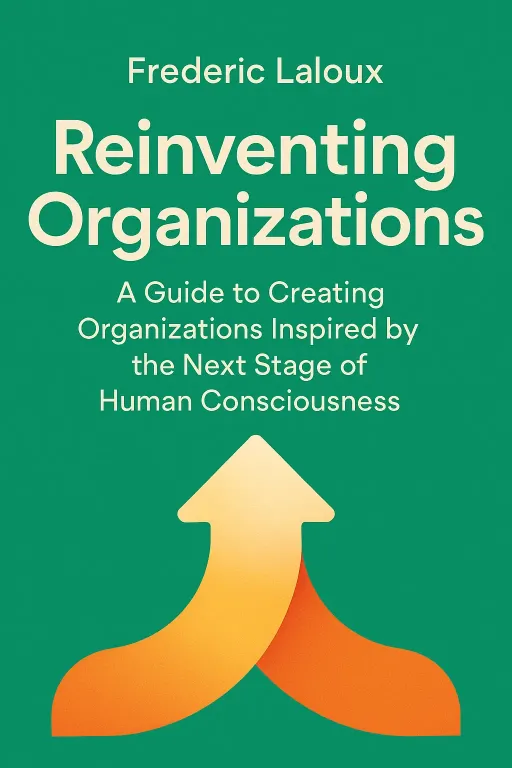
Nova: You are absolutely right. The resistance is real because our current systems have been incredibly successful. Today, we are looking at how to bridge that gap. We are diving into the structural shift in human collaboration by exploring two powerful frameworks. First, we have Frederic Laloux’s Reinventing Organizations, which maps out the next stage of human cooperation he calls Teal. And to understand why we are even in this current system, we are looking at Niall Ferguson’s Civilization, which breaks down the historical killer apps that built the modern world.
Atlas: I have always found Ferguson’s work fascinating because he is so blunt about the mechanics of power. He does not sugarcoat history. He looks at things like property rights, modern medicine, and competition as the specific software that allowed the West to dominate the last few centuries.
Nova: Exactly. Ferguson argues that these were the killer apps of their time. They were the upgrades that allowed society to scale. But Laloux’s work suggests that we have hit the ceiling of those old apps. He argues that we are ready for a new operating system, one that moves beyond the command-and-control structures that Ferguson chronicled.
The Historical Engine of Hierarchy
SECTION
Atlas: Okay, let’s unpack that. If Ferguson’s killer apps, like competition and property rights, were the reason we became so efficient and wealthy, why would we want to move away from them? Efficiency has been the golden rule for a long time.
Nova: Efficiency is a great goal, but it often comes at the cost of human potential. Think about the way Ferguson describes the rise of the West. It was fueled by institutions that prioritized specialization and hierarchy. You have the boss at the top, the workers at the bottom, and a very clear, linear chain of command. It worked brilliantly for building railroads and organizing assembly lines. It allowed us to coordinate thousands of people to do repetitive, complex tasks.
Atlas: Right. It was the only way to scale. You cannot build a transcontinental railway with a democratic, consensus-based committee. You need someone saying, do this, then do that.
Nova: Precisely. That is what Laloux calls the Orange paradigm. It is the era of the machine. The organization is viewed as a clockwork mechanism where everything is predictable. But here is the problem: the world is no longer predictable. When you apply a machine-like management style to a world that is chaotic, fast-moving, and driven by information, the machine breaks. You get silos, you get burnout, and you get leaders who are drowning in decisions because they are the only ones allowed to make them.
Atlas: That resonates deeply. I see this all the time. Leaders feel like they have to approve every single email, every single design, every single decision, because the system they are operating in assumes that only the person at the top has the context. But they don't have the context. The people on the ground have the context.
Nova: And that is exactly where the friction lives. Ferguson would point out that historically, when institutions fail to adapt to new realities, they collapse. They become brittle. Laloux is suggesting that Teal organizations—these self-managing, evolutionary entities—are the adaptation we need. They are not just a nice idea; they are a survival mechanism for the modern complexity we face.
Atlas: I am curious, though. When you say self-managing, it sounds like chaos to a lot of people. It sounds like a startup where no one knows who is in charge and everything takes three times longer to get done. How does it actually function without the traditional chain of command?
Nova: That is the most common misconception. People assume that without a boss, you have anarchy. But Teal organizations are actually more disciplined than traditional ones, not less. The discipline just comes from a different place. In an Orange organization, the discipline is external. It is the manager checking your work. In a Teal organization, the discipline is internal and peer-based. You are accountable to the team, not just to a supervisor.
Atlas: That is a massive mental shift. I imagine most people have never worked in an environment where they were truly accountable to their peers. We are trained from school to look for the teacher’s approval.
Nova: We are. And that is why this is so difficult. Ferguson’s historical perspective helps us understand that these hierarchies are deep-seated. They are not just corporate policy; they are cultural habits that have been reinforced for centuries. When you try to introduce self-management, you are fighting against the gravity of history.
The Anatomy of the Shift
SECTION
Atlas: So, if we are fighting against centuries of conditioning, how do we actually start? I want to get into the mechanics of this. If I am an architect of my own future, and I am sitting in a standard, hierarchical team, I cannot just flip a switch and turn us into a Teal organization tomorrow. That would be professional suicide.
Nova: You are absolutely right. You cannot force a revolution. You have to start with an audit. Laloux suggests we need to map our current operational style. Most of us are living in what he calls the Orange stage. It is all about profit, competition, and hierarchy. The first step is to look at your team and identify one specific bottleneck where that hierarchy is actually slowing you down.
Atlas: Let’s make this concrete. Give me an example of a bottleneck that is ripe for this kind of shift.
Nova: Think about the approval process for a project. Let’s say you have a team of five experts. They are all highly skilled. But every decision they make has to go through a senior manager who is three levels removed from the actual work.
Atlas: Oh, I know that person. They are always in meetings, they are always behind on emails, and they have no idea what the client actually needs.
Nova: Exactly. And because they are the bottleneck, the work stalls. The team has to wait for approval, they lose their momentum, and the quality of the work suffers because the person approving it doesn't have the granular detail. A Teal approach would involve replacing that centralized approval with peer-to-peer accountability.
Atlas: How do you do that without the project going off the rails? If you just remove the manager, don't you get five people doing five different things?
Nova: You don't remove the manager; you change the manager's role. Instead of being the decision-maker, they become the coach. And for the team, you implement a decision-making process that is rooted in advice, not approval.
Atlas: Explain that. Advice versus approval. That sounds like a semantic trick.
Nova: It is a fundamental shift in responsibility. In the advice process, anyone can make a decision. But before they do, they are required to seek advice from two groups: anyone who will be significantly affected by the decision, and anyone who has expertise in that area.
Atlas: So, I don't need your permission to launch this feature, but I am obligated to listen to your feedback because you are the one who has to maintain the code?
Nova: Precisely. And here is the kicker: you are not obligated to follow that advice. You are only obligated to seek it and consider it. If you choose to ignore the advice, the responsibility for the outcome rests entirely on your shoulders. You own the success, and you own the failure.
Atlas: That is terrifying for most people. Most people want to hide behind the manager's approval so they can say, well, they told me to do it.
Nova: That is the safety blanket of hierarchy. Ferguson would argue that this is exactly what held back progress for centuries—the fear of taking individual responsibility. But in the modern world, the people who thrive are the ones who can synthesize information, take ownership, and move quickly. By shifting from approval to advice, you are actually distributing intelligence throughout the team. You are turning the team into a processor, not just a set of hands.
Atlas: I like the way you framed that. It is about distribution of intelligence. It is not about being nice; it is about being smarter.
Nova: Exactly. And once you start with that one bottleneck—that one area where the hierarchy is creating a friction point—you start to see the ripple effects. The team starts to build trust. They start to understand that they are capable of making high-quality decisions without the safety net. That is the beginning of the shift.
The Purposeful Architect
SECTION
Atlas: I am thinking about the listener who is listening to this and feeling the weight of their current job. They feel like a cog in a machine. They are looking for that foundation you mentioned earlier. How does this shift to self-management help them with their long-term vision? It sounds like it helps the team, but how does it help the individual?
Nova: It helps because it forces you to clarify your own purpose. When you are just a cog in a hierarchy, your purpose is to do what you are told. When you are part of a self-managing team, you have to ask, what is the evolutionary purpose of this work? Why are we doing this?
Atlas: That sounds a bit philosophical, but I see the practical side. If I am not just waiting for orders, I have to be proactive. I have to think about the long-term impact of my work.
Nova: And that is where the mastery comes in. When you are responsible for the outcome, you care more. You learn more. You pay attention to the details that you would have otherwise ignored because you thought, well, that is the manager’s problem. Suddenly, it is your problem. And when it is your problem, you become the architect of your own performance.
Atlas: It is interesting because we started with Ferguson’s historical perspective on civilization, which is all about how large groups of people organize themselves. Now we are ending on the individual’s responsibility within that group. It feels like the two are linked.
Nova: They are inseparable. The civilization we live in is a reflection of the organizations we build. If we build organizations based on fear and control, we get a civilization based on fear and control. If we build organizations based on wholeness, self-management, and evolutionary purpose, we get a civilization that is capable of solving the massive, complex challenges we face today.
Atlas: That is a powerful thought. It makes the daily grind feel less like just getting through the week and more like participating in a larger experiment.
Nova: It really is an experiment. And the beauty of the Tiny Step we talked about—auditing your team and finding that one bottleneck—is that you don't need permission to start the experiment. You can start it in your own sphere of influence today.
Synthesis & Takeaways
SECTION
Atlas: So, let’s wrap this up for the listener. We’ve covered a lot of ground today. We started with the realization that our current management systems are basically 19th-century machines trying to run in a 21st-century world. We talked about how Ferguson’s historical "killer apps" gave us the structure we have, but Laloux’s "Teal" framework is the upgrade we need to actually thrive now.
Nova: And the core takeaway is that this shift isn't about tearing everything down. It’s about evolution. It’s about moving from a system of external control, where we wait for permission, to a system of internal accountability, where we seek advice and take ownership.
Atlas: And the practical step is to audit your own environment. Find that one bottleneck where hierarchy is slowing you down—where an approval process is just a way for someone to avoid taking responsibility—and start replacing it with a process of peer-to-peer advice.
Nova: It is the difference between being a passenger in someone else’s vehicle and becoming the driver of your own. When you start making those decisions, you stop waiting for the future to happen and you start architecting it yourself.
Atlas: I love that. It’s not just about managing work; it’s about mastering your own professional existence.
Nova: Exactly. And that mastery is the only foundation that will actually support your long-term vision. It doesn't matter what the market does or how the industry changes; if you have mastered the ability to organize yourself and others effectively, you will always be an architect of your own future.
Atlas: That is a great note to end on. If you are listening to this, take that fifteen minutes today. Don't read a whole book. Just audit one process in your team. See where the bottleneck is. See if you can replace approval with advice.
Nova: And then watch what happens. The shift is often smaller than you think, but the impact is profound. Thank you for joining us on this deep dive into the future of collaboration.
Atlas: This is Aibrary. Congratulations on your growth!