From Awkward to Awesome: Mastering Social Interactions
Golden Hook & Introduction
SECTION
Nova: Alright Atlas, quick game: I say "social interaction," you give me the first awkward scenario that pops into your head. Ready? Go!
Atlas: Oh man, okay. "The networking event where you get stuck with someone, and the conversation just... dies. And you can’t escape." Ugh.
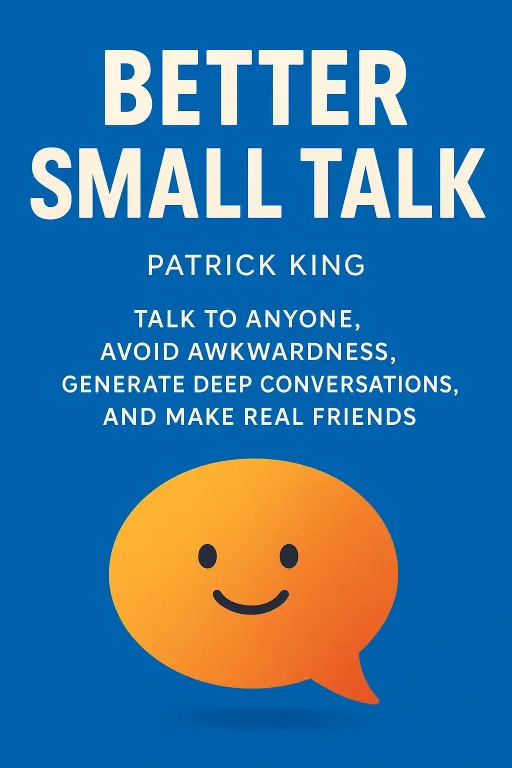
Nova: Exactly! That universal cringe. We’ve all been there, haven't we? That moment where you feel like you’re fumbling through a social minefield. Today, we're diving into a couple of remarkable guides that promise to transform those awkward moments into awesome interactions: Patrick King’s "Better Small Talk" and Vanessa Van Edwards’ "Captivate."
Atlas: That’s a powerful duo. King and Van Edwards. I'm curious, Nova, what's a standout detail about one of these authors that really makes their approach click?
Nova: Well, with Van Edwards, it’s her background. She actually started her career in a completely different field, digital marketing, and felt incredibly socially awkward herself. She approached social dynamics with a scientist's rigor, almost like a hacker trying to reverse-engineer human connection. It wasn't just theory for her; it was a personal quest born out of her own struggles, which I think makes her insights incredibly relatable and practical. She built her entire methodology on observable human behavior, almost like a social anthropologist.
Atlas: Oh, I like that. So it’s not just some charismatic person telling us to "be more confident," it’s someone who actually broke down the mechanics because they to. That resonates with anyone who’s ever felt like an outsider trying to understand the secret language of social cues.
Nova: Precisely. And that leads us perfectly into our first major area of exploration: the mechanics versus the psychology of social mastery.
The Mechanics of Conversation
SECTION
Nova: So, let's kick off with Patrick King and the mechanics of conversation. His book, "Better Small Talk," is like a user manual for social interactions. It’s less about being a different person and more about having a toolkit. Think of it as the 'how-to' guide.
Atlas: Okay, so a tactical playbook. What’s one of his standout techniques that listeners can immediately visualize?
Nova: One of my favorites, and it’s surprisingly simple yet profoundly effective, is what he calls "hot-button questions." We often fall into the trap of asking generic, dead-end questions like, "How was your weekend?" or "What do you do?" King argues these are conversation killers. Instead, a hot-button question is designed to tap into someone's passions, interests, or strong opinions. It's about finding that topic that makes their eyes light up.
Atlas: So, instead of "How was your weekend?" maybe something like, "What was the most unexpected thing you learned or experienced last week?" or "What's a project you're working on right now that you're genuinely excited about?"
Nova: Exactly! Imagine you’re at that networking event again, Atlas, the one you mentioned earlier, where the conversation died. Instead of the usual platitudes, you ask, "What's a skill you've picked up recently that totally surprised you?" or "If you could instantly become an expert in any one thing, what would it be and why?"
Atlas: Oh, I see. That immediately shifts the dynamic. It moves from obligation to genuine curiosity. It’s like you’re trying to find the hidden 'on' switch for their enthusiasm. It requires a bit more thought on my part, but it promises a much richer return.
Nova: The beauty is that it's less about brilliance and more about giving the other person permission to talk about what they love. When people talk about their passions, they become more animated, their body language opens up, and suddenly, you're not just having a conversation; you're sharing an experience.
Atlas: That makes perfect sense. It’s about leveraging their internal motivation. But what about the other side of the coin? What if you ask a hot-button question, and it still falls flat? Or what if you need to gracefully exit a conversation? Because that’s another common snag.
Nova: That's where King provides techniques for "exiting gracefully." He emphasizes the importance of having pre-planned exits. It’s not about being rude; it’s about being prepared. For example, you can say, "It was really interesting talking about. I'm going to grab another drink, but it was a pleasure meeting you." Or, "I need to go say hello to over there, but I really enjoyed our chat." The key is to have a reason, even a small one, and to end on a positive, specific note.
Atlas: So, it’s about having a polite, pre-meditated parachute. That’s actually incredibly helpful for someone who feels trapped in those situations. You’re giving them a script, a mental framework to navigate those potentially awkward moments without feeling rude or flustered.
Nova: Precisely. It's about giving you control and confidence in situations where many people feel completely out of their depth. It's a pragmatic, step-by-step approach to making conversations work.
The Psychology of Connection
SECTION
Nova: Now, moving from King's mechanics to Vanessa Van Edwards' "Captivate," we shift gears from the 'how' to the 'why.' Van Edwards delves into the psychology of attraction and connection, using a science-backed approach to teach us how to decode social cues and build instant rapport.
Atlas: So, if King gives us the lines, Van Edwards teaches us how to read the room and truly understand the unspoken script. That sounds like a much deeper dive into human behavior. What's a core concept she introduces that unlocks some of that psychological understanding?
Nova: One of her most compelling insights is around the concept of "mirroring." It’s a subtle, almost unconscious behavior where we imitate the body language, speech patterns, or even the breathing of someone we're connecting with. Van Edwards shows that this isn't just accidental; it's a powerful tool for building rapport.
Atlas: So, if someone leans forward, I subtly lean forward. If they speak a bit slower, I match their pace?
Nova: Exactly. It’s not about mimicking them obviously, which can feel creepy, but about subtly reflecting their posture, gestures, or vocal tone. Her research, and others she cites, shows that when people mirror each other, they feel a stronger sense of connection and trust. It signals to the other person, unconsciously, "I'm like you, I understand you, I'm safe."
Atlas: That’s fascinating. So, if I apply this in that dreaded networking scenario, after asking a hot-button question, I'm also subtly aligning my physical presence with theirs. It's almost like a non-verbal handshake that says, "We're on the same wavelength."
Nova: It is! And the beauty is, it often happens naturally when two people genuinely connect. But understanding it allows you to consciously employ it, especially in situations where you want to foster connection quickly. She also emphasizes decoding "microexpressions" – those fleeting facial expressions that reveal true emotions, even when someone is trying to hide them.
Atlas: Microexpressions. That sounds like something out of a spy movie! So, we're talking about incredibly subtle cues?
Nova: Very subtle. A flash of anger, a flicker of surprise, a moment of disgust – these last only a fraction of a second but are universal across cultures. Van Edwards argues that by training yourself to spot these, you gain a deeper, more accurate understanding of what someone is truly feeling, beyond their spoken words. It’s about becoming a human lie detector, in a way, but more importantly, an empathy detector.
Atlas: That’s incredible. For someone who feels like they often miss social cues, or misinterpret them, this would be a game-changer. It’s moving beyond just listening to what someone says, to truly seeing and understanding their underlying emotional state.
Nova: Precisely. It’s the 'why' behind the 'how.' King gives you the conversational tools, and Van Edwards helps you understand the psychological landscape you're navigating, allowing you to use those tools with greater precision and empathy. It’s about not just having a good conversation, but truly building a connection.
Synthesis & Takeaways
SECTION
Nova: So, Atlas, we’ve explored King’s practical mechanics of conversation and Van Edwards’ deep dive into social psychology. When you look at them side-by-side, what's the most profound takeaway for you?
Atlas: For me, it’s the realization that social mastery isn't some innate talent reserved for extroverts. It's a skill set that can be learned, practiced, and refined. King gives you the specific actions—the 'do this, say that'—while Van Edwards provides the underlying framework of human behavior. It’s like learning to play a musical instrument: you need the sheet music, but you also need to understand the theory of harmony and emotion to truly make it sing.
Nova: Beautiful analogy. And that's critical for our listeners, the aspiring communicators and confident builders, who value pragmatism and impact. They don't just want to read; they want to apply. Imagine that awkward social situation you described earlier. If you had King's "hot-button questions" in your back pocket, you could ignite a conversation. And if you had Van Edwards' understanding of "mirroring," you could subtly build instant rapport.
Atlas: Right. It’s about moving from feeling helpless to feeling empowered. From that deep question we posed earlier, about how a recent awkward interaction could have changed… suddenly you have not just one, but powerful lenses to re-evaluate it. It’s about seeing those past missteps not as failures, but as opportunities to apply these new techniques.
Nova: Exactly. It completely reframes the social landscape. It means those small, daily interactions aren't just random events; they're opportunities for growth, for connection, and for building confidence. It’s about taking those small steps that create big shifts, as our user profile emphasizes.
Atlas: That’s such an inspiring way to look at it. It’s not about becoming someone else; it’s about becoming a more skilled, more perceptive, and ultimately, more confident version of yourself in any social setting. It empowers you to build stronger bonds and connect on a deeper level.
Nova: Absolutely. And that’s what we hope our listeners take away from this discussion. The journey to social mastery is ongoing, and it starts with understanding both the practical tools and the underlying human psychology.
Atlas: That's a profound thought to leave us with. This is Aibrary. Congratulations on your growth!