The Invisible Currents of Influence and Desire
Golden Hook & Introduction
SECTION
Nova: That massive financial or career goal you are chasing right now? There is a very high chance it is not actually yours. You copied it from someone else, and you do not even realize it.
Atlas: That is a wild thought to start with. You are telling me my drive to climb the ladder and build a secure, wealthy future might just be a copy-paste job from my social feed?
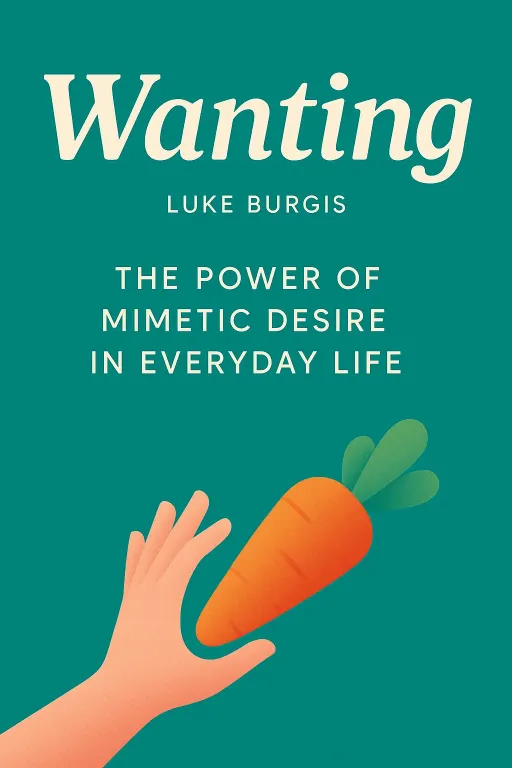
Nova: Exactly. Today we are diving into two groundbreaking books that expose the hidden forces shaping our ambitions and our mental performance. First, we have Wanting by Luke Burgis, which unpacks René Girard's theory of mimetic desire. Burgis has a fascinating background. He was a high-flying Silicon Valley entrepreneur and venture capitalist who realized he was chasing goals that made him miserable, which eventually led him to study philosophy and even spend time in a monastery. He shows us that we do not desire things independently. We copy what other people want.
Atlas: Oh, I know that feeling of looking around and suddenly wanting the exact lifestyle everyone else seems to be chasing. But how do we break free of that loop and actually get what we want?
Nova: That is where our second book comes in. Broadcasting Happiness by Michelle Gielan. She is a former CBS News anchor who realized that constantly broadcasting negative stories was paralyzing the public. She transitioned to positive psychology at the University of Pennsylvania to study how the stories we tell ourselves and our teams directly impact our success. Gielan gives us a practical toolkit, like her Fact-Checking technique, to neutralize stress and raise our performance.
Atlas: This sounds like the ultimate strategic blueprint. We figure out if we are chasing the right goals, and then we program our minds to actually achieve them. Let us dig into this copycat desire thing first, because that sounds like a massive trap.
The Copycat Trap of Desire
SECTION
Nova: It is a massive trap, and Luke Burgis calls it mimetic desire. The core idea is that human desire is not linear. It is not just you desiring an object or a goal. It is triangular. There is you, there is the object, and then there is the model. We look at the model to figure out what is worth wanting.
Atlas: Huh, so we are basically social mirrors. But wait, is that always a bad thing? I mean, copying successful people seems like a pretty smart shortcut to wealth and success.
Nova: It can be useful, but Burgis distinguishes between two very different types of desires. He calls them thick desires and thin desires. Thin desires are fleeting, status-driven targets that we copy directly from our immediate social circles or corporate culture. They are highly contagious, but they do not satisfy us. Thick desires, on the other hand, are deeply rooted in our core values, our unique history, and our long-term aspirations. They build lasting fulfillment and security.
Atlas: That makes a lot of sense. It is like the difference between wanting to build a sustainable, highly profitable business that gives you genuine freedom, versus just wanting to raise a massive venture capital round because all the startup founders on your timeline are doing it.
Nova: That is a perfect example, and it is exactly what Luke Burgis experienced. He was running a successful e-commerce company, raising millions of dollars, and living the classic startup dream. But he realized he was caught in a toxic mimetic cycle. He was competing with other founders for prestige, hiring metrics, and office space, rather than focusing on building a healthy, profitable business. He was miserable because he was living out a thin desire copied from the Silicon Valley ecosystem.
Atlas: That sounds incredibly exhausting. If we are constantly copying the desires of the people around us, how does that affect our relationships with those people? It seems like it would lead to a lot of friction.
Nova: You have hit on a crucial part of Girard's theory. Burgis explains that when we copy the desires of people who are close to us, like our peers, colleagues, or competitors, we inevitably end up wanting the exact same things. This leads to what he calls mimetic rivalry. We stop focusing on the actual goal and become completely obsessed with beating the other person. The rivalry itself becomes the focus, and it destroys collaboration and peace of mind.
Atlas: Oh, I have seen this play out in high-pressure corporate environments. People will fight tooth and nail for a specific promotion or a corner office, not because they actually want the extra work or even care about the role, but simply because their peer wants it. It is like a high-stakes game of keeping up with the Joneses, but with your career.
Nova: Exactly. And the tragedy is that even if you win that rivalry, the victory feels empty because the desire was never truly yours. You achieve the goal, you get the financial payout or the title, and then you feel a sudden wave of disappointment. Burgis notes that this is the classic signature of a thin desire. It evaporates the moment you touch it.
Atlas: So how do we protect ourselves from this? For anyone listening who is highly ambitious and wants to accelerate their financial growth, how do we make sure our wealth goals are thick and not just thin copies of someone else's lifestyle?
Nova: The first step is mapping your models. You have to identify who you are copying. Burgis suggests looking at your primary career or financial goals and asking yourself some tough questions. Where did this goal originate? Who was the first person you saw who had this, and how did you feel when you saw them? Are you pursuing this because it aligns with your core values of security and independence, or are you trying to win a silent argument with a former classmate or colleague?
Atlas: That is a really challenging exercise. It requires a lot of honest self-reflection. I imagine a lot of people might realize that their dream of owning a specific luxury car or hitting a certain net worth figure is actually just a reaction to a model they saw online or in their industry.
Nova: It is incredibly common. Once you identify those models, you can start to cultivate thick desires. These are the goals that persist even when nobody is watching. A great way to test this is to ask yourself: If I could never tell anyone about this achievement, and if I received absolutely zero public recognition for it, would I still want to do it? If the answer is yes, you are likely looking at a thick desire.
Atlas: That is a brilliant filter. If you would still build that business or invest in that asset even if you could never post about it or brag to your peers, then you know it is rooted in genuine value. It is about building real, quiet abundance rather than loud, fragile status.
Nova: Exactly. Real wealth is quiet. It provides security and options, which are classic thick desires. Thin desires are about the appearance of wealth, which often drains your actual financial security because you are constantly spending money to maintain a model's standards.
Rewriting the Crisis Narrative
SECTION
Atlas: Okay, let us say we have done the work. We have stripped away the thin desires and identified our true, thick goals. We want to build a secure, prosperous future. But the path to wealth and career optimization is full of setbacks, market volatility, and high-stress situations. How do we keep our minds sharp and focused when things get chaotic?
Nova: This is where Michelle Gielan's work in Broadcasting Happiness becomes essential. Gielan argues that we are all broadcasters. Every day, we are broadcasting stories to ourselves, our families, and our teams. The nature of that broadcast determines our cognitive processing power. When we broadcast negative, panic-driven stories, we actually shut down the prefrontal cortex, which is the part of the brain responsible for strategic decision-making and creative problem-solving.
Atlas: That sounds like a recipe for financial disaster. If you are panic-broadcasting during a market downturn or a career crisis, you are literally making yourself too stressed to find a way out.
Nova: Precisely. Gielan shares a powerful case study from the 2008 financial crisis. She worked with a major financial institution where the brokers were completely paralyzed by the negative news cycle. They were watching the markets crash, reading doom-and-gloom headlines, and broadcasting a story of total collapse to themselves and their clients. As a result, sales plummeted, and stress levels were off the charts.
Atlas: I can definitely relate to that feeling of freeze-state when the news is bad. So how did Gielan help them turn it around?
Nova: She did not tell them to ignore the reality or pretend everything was fine. Instead, she helped them shift from a crisis broadcast to a solution-focused broadcast. They trained the managers to acknowledge the market challenges, but immediately follow up with a specific, actionable plan. They focused the broadcast on what they could control, such as reaching out to clients to rebalance portfolios, rather than what they could not control, like the daily stock ticker. Within a few weeks, their revenues began to recover, and their stress levels dropped significantly.
Atlas: That is a crucial distinction. It is not about toxic positivity or stick-your-head-in-the-sand optimism. It is about choosing to focus on the actionable path forward. But what about those moments when the panic feels completely justified? How do we stop the emotional doom-loop in our own heads?
Nova: Gielan offers an incredibly effective tool for this called the Fact-Checking technique. When we encounter a setback, our brains naturally create a story to explain it. Often, that story is filled with emotional projections and worst-case scenarios. The Fact-Checking technique forces us to separate the raw, objective data from our emotional interpretations.
Atlas: Can you walk me through how that actually works? Let us say someone just lost a major client or missed out on a key promotion they were counting on for their financial goals.
Nova: Perfect scenario. In that moment, your brain might broadcast a story like: I am failing, I am going to lose my job, my career is stalling, and I will never reach financial independence. To run a Fact-Check, you take a piece of paper and draw two columns. In the first column, you write down your negative belief. In the second column, you list only the raw, indisputable facts.
Atlas: Okay, so the raw facts would be: I lost one client who represented fifteen percent of my revenue. I still have eighty-five percent of my revenue intact. My industry is still growing, and I have five years of specialized experience.
Nova: Exactly. Those are facts. They are objective, measurable, and neutral. The moment you list them, you realize that your emotional projection, that your career is over, is not supported by the data. You have isolated the actual problem, which is a fifteen percent revenue drop, from the existential panic of being a failure.
Atlas: That is incredibly grounding. It takes the emotional charge out of the situation. Once you have those raw facts, what is the next step?
Nova: Once you have the facts, you immediately pivot to a solution-focused action plan. You ask yourself: Based on these facts, what are three small, concrete actions I can take today to address this issue? For example, you could reach out to three existing clients for referrals, update your portfolio, or schedule a networking lunch. This shifts your brain out of the threat-response mode and back into the strategic, goal-oriented mindset.
Atlas: I love that because it is so practical. It is a direct route to building resilience. Instead of wasting energy worrying, you are immediately channeling it into productive action that builds momentum.
Nova: And momentum is everything. Gielan's research shows that even a small, positive action can trigger a cascade of successful outcomes. It changes the broadcast in your mind from one of helplessness to one of agency. You realize that while you cannot control every external event, you have complete control over your response and your strategy.
Synthesis & Takeaways
SECTION
Atlas: This brings us to a really powerful intersection between these two books. If we combine Luke Burgis's ideas on thick desires with Michelle Gielan's solution-focused broadcasting, we get a complete system for high-performance wealth creation.
Nova: They fit together beautifully. Mimetic desire helps us audit our goals to ensure we are chasing what actually matters to us, our true thick desires for security, freedom, and authentic success. Once we have those clear, value-aligned targets, Gielan's broadcasting techniques give us the mental resilience to pursue them without getting derailed by the inevitable noise and stress of the journey.
Atlas: It is like having a compass and an engine. The compass, which is understanding your thick desires, makes sure you are heading in the right direction and not just chasing someone else's horizon. The engine, which is your solution-focused broadcast and Fact-Checking, keeps you moving forward even through the roughest terrain.
Nova: That is a perfect analogy. And for our listeners who are focused on strategic growth and building a solid future, this is the ultimate competitive advantage. Most people are running on thin desires, constantly distracted by what their competitors are doing, and broadcasting panic to themselves every time the market shifts. If you can be the person who is anchored in thick desires and operating with a clear, fact-checked mind, you will consistently make better decisions and build sustainable wealth.
Atlas: This leads us directly to our deep question for today. Look at your current primary financial or career goal. Is it a thick desire rooted in your core values of security and abundance, or is it a thin desire you copied from peers, social media, or corporate culture?
Nova: It is a question that demands real honesty. True abundance is not about winning a mimetic race against your colleagues. It is about securing the freedom to live on your own terms.
Atlas: Absolutely. Let us make sure we are building wealth that actually belongs to us, not just chasing the ghost of someone else's expectations.
Nova: This is Aibrary. Congratulations on your growth!