Decoding the Blink: Data, Bias, and the Power of Snap Judgments
Golden Hook & Introduction
SECTION
Nova: What if I told you that a psychologist could predict, with over 90 percent accuracy, whether a married couple would still be together in fifteen years, just by watching them talk for fifteen minutes? Not by analyzing their history, their finances, or their values. Just by observing a single, brief conversation.
Valeria Chipana: That sounds like the kind of claim that would get a predictive model laughed out of a boardroom. The sample size is tiny, and the variables seem impossibly complex. It feels like it shouldn't work.
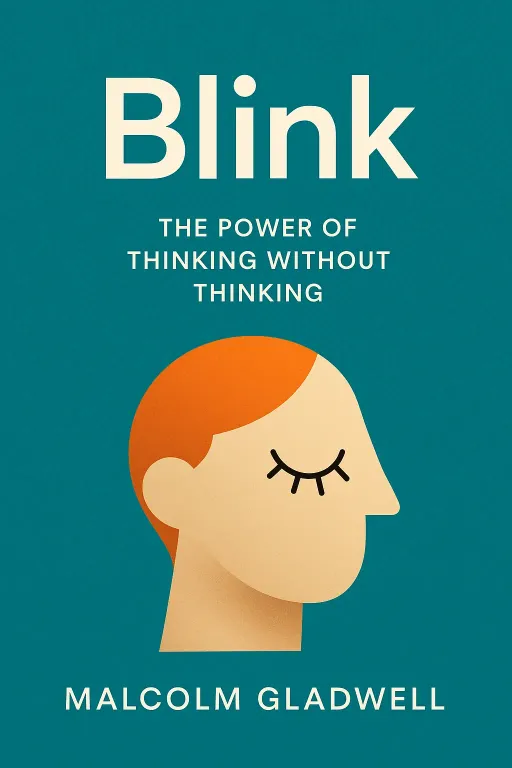
Nova: Exactly! It feels like it shouldn't work, but it does. And that's the fascinating, and sometimes frightening, world we're diving into today with Malcolm Gladwell's book, "Blink: The Power of Thinking Without Thinking." It's all about those snap judgments, those first impressions that happen in the blink of an eye. And I'm so thrilled to have you here, Valeria, because as a data analyst, you live in a world of conscious, deliberate analysis. This book challenges that in so many ways.
Valeria Chipana: It really does. It forces you to think about the brain as its own kind of data processor, one that's running algorithms we're not even aware of.
Nova: That's the perfect way to put it! And today, we're going to explore the two faces of that rapid cognition. First, we'll uncover the hidden genius of what Gladwell calls 'thin-slicing,' our brain's incredible ability to find patterns in a flash. Then, we'll confront its dangerous dark side, the 'Warren Harding Error,' where our instincts are hijacked by unconscious bias. Ready to peek behind the curtain of the mind?
Valeria Chipana: Absolutely. Let's do it.
Deep Dive into Core Topic 1: The Genius of the Thin Slice
SECTION
Nova: So let's start with that genius. How is it possible for that psychologist, John Gottman, to make such an accurate prediction? Well, in the 1980s, he set up what he called the "Love Lab" at the University of Washington. He'd bring in married couples, hook them up to sensors to measure heart rate and sweat, and then have them discuss a point of contention in their marriage—like a new dog, or chores.
Valeria Chipana: So he was collecting both qualitative and quantitative data. The conversation itself, and the physiological responses to it.
Nova: Precisely. And his team, using a system called SPAFF coding, analyzed every second of the interaction, assigning emotional codes. They were looking for a pattern, a signature. And what they found was that you didn't need to know everything about a couple. You just needed to find the right signals. He identified what he called the "Four Horsemen" of a bad relationship: defensiveness, stonewalling, criticism, and the most important one of all, contempt.
Valeria Chipana: Contempt. That's interesting. It's a very specific emotion.
Nova: It's the most important one. Gottman said contempt is the single most powerful predictor of marital problems. It's any statement made from a position of superiority. It's sarcasm, cynicism, eye-rolling. He found that if he could measure the amount of contempt in a couple's conversation, he didn't need much else. He had found the one variable that told him almost everything. And with that, he could make those stunningly accurate predictions. That's "thin-slicing."
Valeria Chipana: You know, this is fascinating because it's a perfect analogy for what we try to do in data science with feature selection. You might have a dataset with thousands of columns, thousands of potential variables. But a good model isn't one that uses all of them. A good model is one that finds the few, critical features that have the most predictive power.
Nova: So Gottman was, in a way, doing unconscious feature selection?
Valeria Chipana: Exactly. He was finding the signal in the noise. Most of the couple's conversation is just noise, but a moment of contempt—that's a powerful signal. It speaks to a fundamental breakdown in respect. It's a reminder that more data isn't always better. It's about finding the data, the most telling slice. His brain, through years of experience, learned to isolate that one variable almost instantly.
Nova: And Gladwell's point is that we all do this. Our unconscious is constantly thin-slicing the world, finding patterns without us even realizing it. It’s how an art expert knows a statue is a fake just by looking at it, even when scientific tests say it's real. It's an internal computer that's incredibly powerful.
Valeria Chipana: But computers and algorithms can have bugs. They can be biased. If the training data is flawed, the output will be flawed. I assume the same is true for our internal computer?
Nova: Oh, you have no idea. And that leads us perfectly to the glitch in the system.
Deep Dive into Core Topic 2: The Glitch in the System: The Warren Harding Error
SECTION
Nova: So if our brains are so good at this, why do we get things so spectacularly wrong sometimes? This brings us to the dark side of thin-slicing, what Gladwell calls the 'Warren Harding Error.' And the story is just incredible. Back in the early 20th century, a man named Harry Daugherty, a political operator, saw a man named Warren Harding and had an epiphany.
Valeria Chipana: What was the epiphany?
Nova: He said, "There is a man who looks like a President." And that was it. Warren Harding was tall, handsome, with a deep voice and a calm demeanor. He looked the part. The problem was, he was completely unsuited for the job. He was, by most accounts, intellectually lazy and had a string of scandals. His speeches were famously empty. One politician described them as "an army of pompous phrases moving over the landscape in search of an idea."
Valeria Chipana: That's a brutal but very vivid description.
Nova: Isn't it? But it didn't matter. Daugherty pushed him, and the American people, thin-slicing him on his appearance, agreed. They elected him president in a landslide. And his presidency was, predictably, a disaster, considered one of the worst in American history. That is the Warren Harding Error: our snap judgment is hijacked by a superficial detail, like appearance, and it stops us from thinking any further. Our internal computer sees "looks presidential" and spits out "is presidential," and the program ends.
Valeria Chipana: This is the concept of bias in a nutshell. The model is over-weighting a variable that isn't actually correlated with performance. In tech, we see this all the time. An idea is pitched by someone who is charismatic and fits the stereotype of a "visionary founder," and it gets funding. Meanwhile, a better idea from a less polished presenter gets overlooked. The "packaging" of the idea is mistaken for the quality of the idea itself.
Nova: And Gladwell shows just how deep this runs with something called the Implicit Association Test, or IAT. It's an online test that measures our unconscious associations. For example, it measures how quickly we associate male names with career words and female names with family words. And the results are sobering. The vast majority of people, even those who consciously believe in gender equality, have a pro-male-career bias. Our unconscious has been trained by a lifetime of cultural messages.
Valeria Chipana: That's the flawed training data I was talking about. Our unconscious builds its model based on the world it sees, and if that world is full of biased representations, our model will be biased. It's a huge challenge in AI ethics right now—how do you build fair algorithms when the historical data they learn from is inherently unfair?
Nova: Exactly. So, as someone in tech, an industry grappling with bias in algorithms and hiring, how do you even begin to guard against this 'Warren Harding Error' in a world that's supposed to be data-driven?
Valeria Chipana: You have to build systems that force you to be objective. It's about intentionally blinding yourself to the biasing information. For hiring, that means structured interviews where every candidate gets the same questions, or blind resume reviews where names and schools are removed. For evaluating a project, it means having a clear, pre-defined rubric of metrics for success, so you're not just swayed by a slick presentation. You can't just trust yourself to be unbiased. You have to create a structure that protects the decision from your own flawed instincts.
Nova: I love that. You create a structure to protect yourself from yourself. That's such a powerful, systems-driven way of thinking about it.
Synthesis & Takeaways
SECTION
Nova: So we have these two powerful, competing ideas from "Blink." On one hand, our unconscious is a brilliant thin-slicer, a master pattern-finder like John Gottman in his Love Lab. On the other, it's susceptible to the Warren Harding Error, getting tripped up by biases we don't even know we have.
Valeria Chipana: It seems the lesson isn't to simply "trust your gut" or to "only trust the data." It's about understanding that we have two decision-making systems. The fast, intuitive one is great for generating a hypothesis—"My gut tells me this couple has issues," or "This candidate seems promising." But you can't stop there. You then need the slow, deliberate, analytical system to validate that hypothesis and, most importantly, to check it for bias.
Nova: Use the blink, but don't be blinded by it.
Valeria Chipana: Precisely. For me, the real takeaway is that we need to be architects of our own decision-making environments. We have to build systems that allow the best of our intuition to surface while protecting us from our own worst instincts. It's not about having more willpower; it's about having better systems.
Nova: That's a perfect summary. So, what's the one question you're taking away from this, for yourself and for our listeners?
Valeria Chipana: The question I'm left with, and the one I'd encourage everyone to ask, is this: Where is the biggest 'Warren Harding Error' in my own work or life? What important judgment am I making based on how something, rather than what the evidence truly says? Identifying that is the first step to making a better decision.