Shaping the Future: Technology, Disruption, and Longevity
Golden Hook & Introduction
SECTION
Nova: You know, Atlas, there’s a fascinating thought experiment: If you could peek into the year 2050, what would be the single biggest change you'd expect to see, not in gadgets, but in how people actually work and live?
Atlas: Oh, that’s a juicy one, Nova. My gut says it wouldn't just be they work on, but or they work. I'm picturing a whole new definition of "colleague," probably with more circuits than synapses.
Nova: Exactly! And that's what we're wrestling with today: the seismic shifts coming our way thanks to technology and, surprisingly, our own longer lifespans. We’re diving into a trio of books that, when combined, paint a truly compelling, sometimes challenging, picture of the future.
Atlas: A trio, you say? Lay it on me.
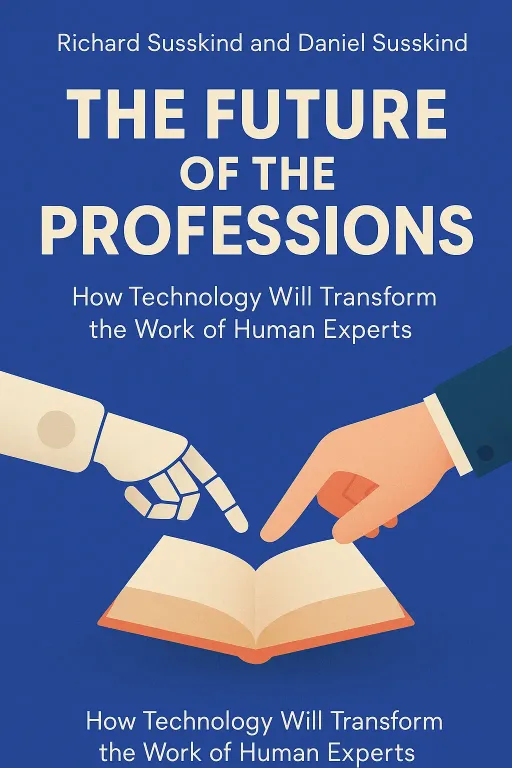
Nova: First up, we have "The Future of the Professions" by the father-son duo, Richard and Daniel Susskind. Richard Susskind, a prominent legal technologist, has been predicting the impact of AI on legal services for decades, and he and his son expand that vision across all professions. Then, Larry Downes and Paul F. Nunes give us "Big-Bang Disruption," a concept that really shook up how we think about market entry and collapse. And finally, Lynda Gratton and Andrew Scott's "The 100-Year Life," which completely redefines what a 'full' life looks like when you're living much, much longer.
Atlas: Wow, that’s quite the intellectual buffet. I can see how each of those alone would be thought-provoking, but putting them together… that’s where the real magic, or maybe the real challenge, begins. So, where do we start unraveling this future tapestry?
The AI Revolution and the Professions
SECTION
Nova: We start with the Susskinds and their vision of the professions. Their core argument is that artificial intelligence and increasingly capable systems will fundamentally change, and in many cases,, traditional professional tasks. They're not just talking about automation; they're talking about a complete re-architecture of how expertise is delivered.
Atlas: Okay, but wait. When I hear "replace professions," my mind immediately goes to doctors and lawyers. Are they saying AI is going to perform surgery or argue cases in court? That sounds a bit out there.
Nova: Well, they predict a future where tasks currently performed by humans are either into smaller, more manageable parts that AI can handle, or by AI to such an extent that the human role shifts dramatically. Think about it: diagnostic tools that can analyze medical images with superhuman accuracy, or legal research platforms that can sift through millions of precedents in seconds.
Atlas: That makes me wonder, if AI takes on the analytical heavy lifting, what's left for the human professional? Is it just the soft skills, the empathy, the judgment calls that are too nuanced for an algorithm?
Nova: Precisely. The Susskinds argue that the future professional will need to adapt. It's less about hoarding information and more about interpretation, collaboration, and applying uniquely human judgment where systems still fall short. They envision a world where people access professional services through increasingly sophisticated online platforms, often bypassing traditional gatekeepers. This isn't just about efficiency; it's about accessibility and affordability.
Atlas: So you're saying, for someone in product management, this means thinking beyond just "how can AI help my team," to "how might AI completely redefine the problem my product is trying to solve, or even the industry I'm in?"
Nova: Exactly. It's about anticipating that a new AI-driven solution might not just be a competitor, but a completely different for professional expertise. Their work, which has been widely acclaimed as a landmark contribution to understanding the future of work, really forces us to confront this. It’s not just a theoretical exercise; it’s a strategic imperative.
Atlas: That gives me chills, thinking about how quickly entire industries could pivot. It’s not just about incremental improvement anymore.
Big-Bang Disruption and Market Tectonic Shifts
SECTION
Nova: And that brings us perfectly to our second book, "Big-Bang Disruption" by Larry Downes and Paul F. Nunes. If the Susskinds show us will change, Downes and Nunes show us it can change. They argue that traditional models of market disruption, where new products slowly gain traction, are obsolete.
Atlas: So what's a "Big-Bang Disruption" then? Is it like, one day you have Blockbuster, the next you have Netflix, and Blockbuster is just… gone?
Nova: That's a perfect example! They identify how new technologies, often starting in niche markets, can achieve near-perfect quality and incredibly low prices almost simultaneously. This isn't a gradual climb; it's a sudden, overwhelming market takeover. Think about digital photography completely obliterating film, or smartphones consolidating dozens of single-purpose devices.
Atlas: Whoa. So the old "S-curve" adoption model, where a product slowly builds up, then explodes, then plateaus, is out the window? Now it's just a vertical line?
Nova: Pretty much. They call it a "shark fin" curve. A new product enters the market, often with superior features and at a fraction of the cost, and adoption happens almost instantly, with existing players having little or no time to react before their market share evaporates. It’s not just about being better; it’s about being and at the same time.
Atlas: That’s terrifying for anyone whose business relies on incremental innovation. It means you can't just keep an eye on your direct competitors; you have to be looking at completely different industries, different technologies, for something that could just wipe you out overnight.
Nova: Absolutely. For product managers, this means the long-term roadmap isn't just about iteration; it's about anticipating these "big bangs." It’s about scenario planning for what seems impossible today but could be ubiquitous tomorrow. Their research has been widely cited in business schools, challenging established strategic thinking and forcing companies to adopt a more agile, anticipatory mindset. It requires a radical shift in how we think about competitive advantage.
Atlas: It makes me wonder, if everything is moving so fast, how do you even plan for a career, let alone a product, that lasts for decades?
The 100-Year Life and Continuous Reinvention
SECTION
Nova: And that's where Lynda Gratton and Andrew Scott’s "The 100-Year Life" comes in. If technology is speeding everything up, our biology is doing the opposite: slowing down the end. With increasing longevity, the traditional three-stage life—education, work, retirement—simply won't cut it.
Atlas: Oh, I love this one. I’ve been thinking about this. So, if we’re living to 90 or 100, what does that mean for someone in their prime, thinking about a 30-year career? Now it’s more like a 60 or 70-year career?
Nova: Exactly! It means we can't just have one career, or even one skill set. They propose a multi-stage life, where people will move through different phases, not just work and retirement, but perhaps exploration, reinvention, skill acquisition, and even periods of "sabbatical" or "portfolio" work. The key is continuous learning and adaptation.
Atlas: So basically, you're always a student, always learning, always adapting your skills. It’s not just about upskilling; it’s about completely repurposing yourself multiple times. That sounds exhausting, but also incredibly liberating.
Nova: It’s both. Gratton and Scott emphasize the need for "intangible assets"—things like strong relationships, a diverse network, and deep self-knowledge—to navigate these transitions. They argue that financial capital alone isn't enough; you need vitality assets and productive assets to thrive over a much longer working life. This book has been incredibly well-received, sparking global conversations about pensions, education, and social structures.
Atlas: That’s actually really inspiring. It frames longevity not just as an extended period of decline, but as an opportunity for multiple chapters, multiple contributions. It’s about building a life that can evolve, just like a product roadmap needs to evolve.
Synthesis & Takeaways
SECTION
Nova: So, bringing it all together: the Susskinds reveal how AI will dismantle and reshape professions, forcing us to adapt. Downes and Nunes show us that market disruption won't be incremental, but sudden and all-consuming. And Gratton and Scott tell us we'll be living and working for far longer, meaning continuous reinvention isn't a choice, but a necessity.
Atlas: It’s clear these aren’t just separate forces; they’re converging. The deep question really becomes: how might the combined forces of technological disruption and increased longevity influence the long-term roadmap for product, and what new opportunities might emerge from these shifts?
Nova: For product managers, this isn't just about building the next feature; it's about building a product that can endure and evolve through constant "big-bang" shifts, powered by AI, while serving a user base that also needs to continuously reinvent themselves over a much longer lifespan. It’s about designing for fluidity, for adaptability.
Atlas: That gives me chills, but in a good way. It's not just about managing change; it's about actively shaping a future where products aren't just tools, but partners in our long, evolving journeys. It's about designing for a continuous human-AI dance.
Nova: Absolutely. The future isn't just happening to us; we are actively designing it. And understanding these books gives us a powerful lens to do that with foresight and intention.
Atlas: That’s such a hopeful way to look at it, Nova. It's a reminder that even in the face of massive disruption, there's incredible potential for growth and reinvention, both for our products and for ourselves.
Nova: This is Aibrary. Congratulations on your growth!