Navigating the Ethical Labyrinth of Medicine
Golden Hook & Introduction
SECTION
Nova: Atlas, I was today years old when I realized that sometimes, the greatest medical success can feel like the profoundest human failure.
Atlas: Whoa, that's a heavy opener, Nova. You’re saying that saving a life isn't always a win? That sounds a bit out there, isn't medicine all about fighting death?
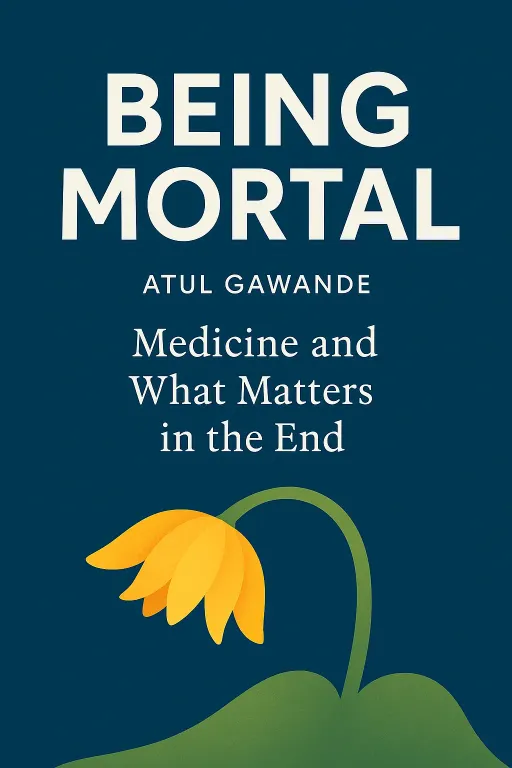
Nova: It is, on the surface. But today, we're diving into the ethical labyrinth of medicine, guided by some truly groundbreaking authors. We're talking about the human side of healing, the moments where science meets soul, and sometimes, they clash spectacularly. Specifically, we'll be discussing the incredible insights from Atul Gawande's "Being Mortal" and "Complications," and Anne Fadiman's "The Spirit Catches You and You Fall Down." These aren't just medical texts; they're profound inquiries into what it means to be human in the face of illness and mortality.
Atlas: Okay, so we're peeling back the sterile veneer of the hospital to look at the messy, complicated, and deeply personal realities. I'm curious, especially with Gawande's work. He's a surgeon, which makes his insights into the limits of medicine even more compelling. How does a surgeon come to terms with the idea that sometimes, less is more?
Nova: Exactly. Gawande, a highly acclaimed surgeon and public health researcher, brings an insider's perspective to these incredibly sensitive topics. "Being Mortal," for instance, wasn't just a book; it became a cultural touchstone, sparking a global conversation about end-of-life care that was long overdue. It won numerous awards for its profound impact and changed how many people, both medical professionals and laypeople, think about aging and dying. He really pushes us to consider that our system, designed to prolong life at all costs, often fails to provide a good death.
The Human Cost of Medical Progress and End-of-Life Care
SECTION
Atlas: That makes me wonder, Nova. For our listeners who are constantly striving for achievement and pushing boundaries, the idea of 'giving up' or accepting limits might feel counterintuitive. How does Gawande address that inherent conflict between our drive to overcome and the reality of mortality?
Nova: He tackles it head-on. In "Being Mortal," Gawande masterfully illustrates this by sharing deeply personal stories, including that of his own father. He shows us that modern medicine, with all its technological marvels, has shifted the paradigm from death being a natural, inevitable part of life to seeing it as a medical failure to be fought off at all costs. The problem isn't the science; it's our approach. We're so focused on extending days that we often forget about the quality of those days.
Atlas: So basically you’re saying we're so busy adding years to life, we're sometimes subtracting life from years.
Nova: Precisely. He gives a powerful example of a patient named Sara Monopoli, a young mother with advanced lung cancer. The doctors, driven by their training and the family's hope, continued aggressive treatments even as her condition worsened. More chemotherapy, more radiation, more invasive procedures. Each intervention, while technically possible, stripped away her ability to live her remaining time meaningfully. She spent her last months in hospitals, suffering, rather than with her children at home.
Atlas: That's heartbreaking, but I can see how it happens. Doctors want to help, families want hope, and there's a powerful narrative that you never give up. But what does Gawande suggest as an alternative to this relentless pursuit of more?
Nova: He advocates for what he calls "conversations that matter." It's about shifting the focus from simply preserving biological existence to preserving what makes life worth living for that individual. For Sara, it might have been more time at home, less pain, or simply the chance to say goodbye on her own terms. Gawande argues that we need to ask patients: "What are your priorities?", "What are your fears?", and "What are you willing to sacrifice, and what are you not?"
Atlas: That’s actually really inspiring. It sounds like he's pushing for a more human-centered approach to what can often feel like a very clinical, almost industrial process. It’s about listening, not just treating.
Nova: Exactly. He highlights how incredibly difficult these conversations are for everyone involved – doctors feel they're failing if they don't offer every possible intervention, and families struggle with the emotional weight of making such decisions. But the book shows that when these conversations happen early and honestly, patients often experience more peace, less suffering, and a greater sense of control over their final chapter. It's about empowering people to write their own ending, as much as possible.
Atlas: That gives me chills. It’s a profound shift from just extending quantity to prioritizing quality.
The Cultural Clash in Healthcare and the Imperative of Empathy
SECTION
Nova: And that naturally leads us to the second key idea we need to talk about, which often acts as a counterpoint to what we just discussed: the profound impact of cultural differences in healthcare. This is vividly explored in Anne Fadiman's "The Spirit Catches You and You Fall Down." This book, like Gawande's, received widespread critical acclaim and numerous literary awards for its powerful storytelling and incisive examination of cultural competence in medicine. Fadiman spent years immersing herself in the Hmong community, bringing a rare depth to her narrative.
Atlas: Oh, I've heard of that one. It's about a Hmong family and their epileptic daughter, isn't it? That sounds like a minefield of potential misunderstandings. How does Fadiman unpack such a delicate situation?
Nova: She does it with incredible sensitivity and journalistic rigor. The book chronicles the tragic story of Lia Lee, a Hmong child in Merced, California, who develops severe epilepsy. From the very beginning, there's a massive chasm between the Hmong family's spiritual understanding of her illness – they believe it's "quag dab peg," or "the spirit catches you and you fall down," possibly a sign of spiritual power – and the Western doctors' biomedical diagnosis of epilepsy.
Atlas: So you're saying the doctors are trying to treat a neurological condition, and the family sees it as a spiritual event that might even have positive connotations? That's not just a language barrier; that's a whole different worldview.
Nova: It's precisely that. For the Hmong, illness is often seen through a holistic lens, connected to the soul, family, and ancestors. Western medicine, on the other hand, isolates the disease from its cultural context. Fadiman shows how the doctors, despite their best intentions, struggled to understand why the family wouldn't consistently administer medications or follow certain treatment protocols. The family, in turn, felt their beliefs were disrespected and that the doctors were too aggressive, even causing more harm.
Atlas: That sounds rough. How does that play out in real life? Can you give an example?
Nova: Absolutely. Lia's parents, Foua and Nao Kao Lee, were deeply loving and dedicated, but they mistrusted the hospital environment and the medications, which often had severe side effects. They would sometimes give Lia only a fraction of her prescribed drugs, or mix traditional Hmong remedies with Western ones, believing they were protecting her spirit or balancing her body. From the doctors' perspective, this was non-compliance; from the family's, it was responsible care guided by their ancestral wisdom.
Atlas: So the doctors are thinking, "We need to control these seizures," and the family is thinking, "We need to protect her soul from the spirits and the harsh Western drugs." It's like two different languages trying to describe the same event, but neither can understand the other's fundamental grammar.
Nova: Exactly. The book highlights a critical point: 'doing good' from the medical perspective – aggressively treating a disease – can conflict profoundly with 'doing no harm' from a patient's cultural perspective, especially if that harm is perceived to be spiritual or familial. This ultimately led to Lia suffering severe brain damage after a grand mal seizure, a tragedy that many argue could have been averted if there had been better cultural understanding and communication.
Atlas: Wow, that’s heartbreaking. It really underscores that medicine isn't just about biology; it's about biography and culture. It forces you to ask: how can medical professionals integrate a patient's personal values and cultural background into a treatment plan when those values differ so significantly?
Nova: Fadiman doesn't offer easy answers, but she powerfully demonstrates the imperative of cultural humility. It's not just about learning facts about a culture; it's about recognizing the limits of your own perspective, being open to different worldviews, and building trust. It means seeing the patient not just as a collection of symptoms, but as a person embedded in a rich, complex cultural tapestry.
Uncertainty, Fallibility, and the Ethical Gray Areas of Clinical Practice
SECTION
Nova: And this idea of navigating complexity and uncertainty brings us to our third core topic, explored brilliantly in Atul Gawande’s "Complications." This book, a collection of essays, dives deep into the inherent uncertainties, the fallibility of doctors, and the ethical dilemmas faced in clinical settings. "Complications" was praised for its unflinching honesty and Gawande's ability to reveal the human side of medical practice, earning high praise for demystifying the often-opaque world of surgery and patient care.
Atlas: I mean, we expect doctors to be these infallible gods in white coats, right? They're supposed to know everything, fix everything. So hearing about their fallibility… that’s a bit unsettling, but also makes them more human.
Nova: That’s the beauty of "Complications." Gawande pulls back the curtain. He shows us that medicine is less about perfect science and more about navigating an ethical minefield under pressure, often with incomplete information. One of the most striking essays is "When Doctors Make Mistakes." He shares his own early surgical errors, moments where his inexperience led to complications, and the profound guilt and learning that followed.
Atlas: Wait, he openly admits to making mistakes? In print? That takes a lot of courage, especially in a profession where perfection is often the unspoken expectation.
Nova: Absolutely. He describes a case where, as a young surgical resident, he nicked a patient's aorta during a routine procedure. It was a terrifying moment, a near-fatal error. He vividly recounts the panic, the desperate scramble to correct it, and the lingering psychological impact. It’s a raw, honest look at how doctors, despite their training, are still human beings operating under immense pressure, with lives in their hands.
Atlas: That’s a powerful story. It makes me think about how we, as patients, often put doctors on such a pedestal. But if they're human, then uncertainty and error are inevitable. How does Gawande suggest we deal with that?
Nova: He argues that acknowledging fallibility is the first step towards improvement. He discusses the "culture of silence" around medical errors and advocates for transparency, for systems that allow doctors to learn from mistakes rather than hide them. He also explores the ethical dilemmas that have no easy answers, like balancing patient autonomy with what the doctor believes is best, or rationing care when resources are scarce.
Atlas: So it's not just about individual mistakes, but about the systemic pressures and the ethical tightropes doctors walk every day. Like, what if a patient demands a treatment that the doctor knows is futile, but it offers false hope? Or what about when a doctor has to decide who gets a limited resource?
Nova: Precisely. He delves into these 'clinical conundrums' with incredible nuance. In another essay, "The Education of a Knife," he describes the almost visceral learning process of becoming a surgeon, the trial and error, the mentorship, and the slow accumulation of judgment that goes beyond textbook knowledge. It’s about accepting that uncertainty is inherent in the practice of medicine. Doctors are constantly making decisions with imperfect information, in highly unpredictable human bodies.
Atlas: That’s a fascinating perspective. It’s less about having all the answers and more about being skilled at navigating the questions. It really reframes medicine as a constant process of learning, adapting, and making tough calls in the face of ambiguity.
Synthesis & Takeaways
SECTION
Nova: When you bring all these threads together, from Gawande's discussions on mortality and fallibility to Fadiman's insights into cultural clashes, what emerges is a profound understanding of medical ethics. It’s not just about rules and regulations; it's about navigating the human condition at its most vulnerable. It’s about empathy, cultural humility, and grappling with the profound decisions that affect life and death, dignity and suffering.
Atlas: It’s a powerful reminder that at the heart of every medical decision, no matter how scientific or clinical, there’s a human being with a story, beliefs, and values. The real challenge is to see and honor that person, not just the disease. It’s about embracing the complexity rather than trying to simplify it.
Nova: Absolutely. It’s a call for us, as a society, to engage in more honest conversations about what we truly value in life and death, and for medical professionals to cultivate an even deeper sense of empathy and cultural humility. It means slowing down, listening more, and recognizing that healing often requires more than just a prescription. It requires a profound connection.
Atlas: That's actually really inspiring. It means that everyone, from the patient to the doctor, has a role in navigating this labyrinth. It's not about finding a single path, but about understanding the terrain and walking it together.
Nova: Indeed. These books challenge us to rethink our expectations of medicine and to embrace the messy, beautiful, and often tragic complexities of human life. They remind us that the greatest impact often comes from understanding, not just intervening.
Atlas: Fantastic insights today, Nova. This conversation really drives home that medicine is an art as much as it is a science.
Nova: It truly is. This is Aibrary. Congratulations on your growth!