The Persuader's Paradox: Taming Anxiety in the Academic Arena
Golden Hook & Introduction
SECTION
Nova: Angela, let's start with a question for every high-achiever listening. Have you ever felt like your greatest strength—your drive, your ambition—is also your greatest source of stress? That the very engine pushing you forward is also the one flooding you with anxiety? It's a strange paradox, where the desire to succeed creates a paralyzing fear of failure.
Angela Nketiah: That's the central tension of so many people's lives, isn't it? Especially in environments like graduate school. You're surrounded by brilliant, driven people, and that energy is infectious, but it can also feel like you're all in a pressure cooker.
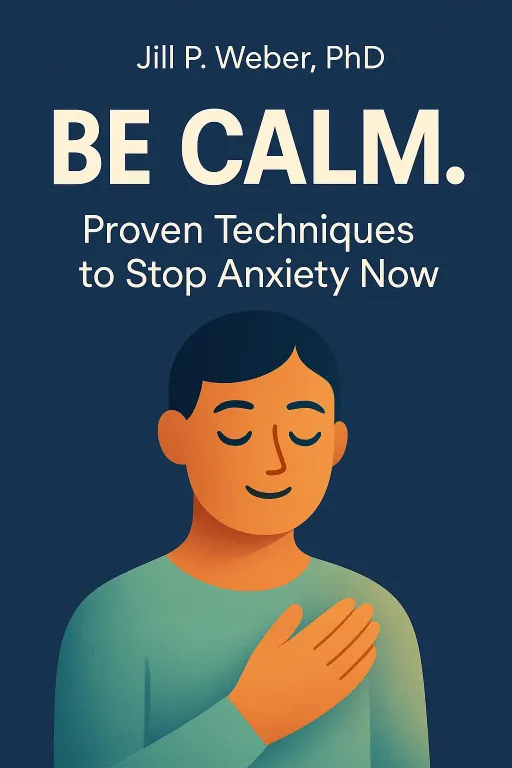
Nova: Exactly! And that's the core of what we're exploring today, using Dr. Jill P. Weber's fantastic book, 'Be Calm.' It's this incredibly practical guide to understanding and managing anxiety. And I'm so thrilled you're here, Angela, because as a graduate student in the field of Education, you have this unique double-perspective on the pressures people face.
Angela Nketiah: I'm excited to dive in. It feels like required reading for the modern world.
Nova: It really does. Today we'll dive deep into this from two powerful perspectives. First, we'll explore the two faces of anxiety to understand when it's a friend and when it's a foe. Then, we'll uncover the 'Avoidance Paradox'—the surprising reason why our attempts to escape anxiety often make it worse, and what we can do about it.
Deep Dive into Core Topic 1: The Two Faces of Anxiety
SECTION
Nova: So let's start with that first idea, Angela: the two faces of anxiety. The book makes this brilliant distinction between 'adaptive' and 'maladaptive' anxiety. I think of it like the difference between a smoke alarm that goes off when there's a real fire, and one that shrieks every single time you make toast.
Angela Nketiah: That is a painfully accurate analogy for my kitchen, and my brain sometimes.
Nova: Right? We all have that faulty smoke alarm. The book gives a great example of the helpful kind, the 'adaptive' anxiety. It tells the story of a student named Alex, who is determined to get into medical school. The MCAT exam is looming, and the fear of failure is very real. But that anxiety, that fear, is what motivates him. It pushes him to enroll in a prep course, to create a rigorous study schedule, to spend hours taking practice exams. His anxiety is a tool. It's his ally, and it helps him achieve a great score.
Angela Nketiah: That makes perfect sense. It's performance-enhancing anxiety. It narrows your focus, it boosts your energy. It's the feeling you get before a big presentation that makes you practice one more time.
Nova: Precisely. But then, the book shows us the other side of the coin with the story of a man named John. John is a 'Health Obsessive Worrier.' For him, a minor physical symptom, like a fleeting headache, isn't just a headache. His brain immediately jumps to the worst-case scenario: it must be a brain tumor. He doesn't use this feeling to take one reasonable action; he gets trapped. He spends hours researching symptoms online, he schedules frequent doctor's appointments, and even when tests come back negative, he remains convinced there's an undiagnosed illness. The threat is imagined, or at least wildly exaggerated, but his body's alarm system is screaming as if it's real. That's maladaptive anxiety.
Angela Nketiah: Wow.
Nova: As someone in the high-pressure world of academia, Angela, how does that distinction land with you? Does it resonate with what you see in students, or even feel yourself?
Angela Nketiah: It resonates completely. It's the classic imposter syndrome loop, laid bare. The anxiety is 'I want to do well on my thesis.' That's Alex, the medical student. It drives you to the library, it makes you seek feedback. But the spiral is John, the worrier. It sounds like this: 'This one paragraph isn't perfect, which means the whole chapter is a failure, which means I'm not cut out for this, and everyone's going to find out I'm a fraud.' The 'threat' is a minor critique, or just a moment of difficulty, but the brain treats it like a fatal diagnosis for one's entire career. The book's 'John' isn't just worried about his health; he's a perfect metaphor for a student worried about their intellectual survival.
Nova: That's such a perfect and powerful connection. You've just described the cognitive engine of so much academic stress. The stakes feel impossibly high because the alarm is broken.
Angela Nketiah: And you feel like you're the only one hearing it, which just makes it louder.
Deep Dive into Core Topic 2: The Avoidance Paradox
SECTION
Nova: Exactly. And what we when that maladaptive anxiety hits, when that faulty alarm starts blaring, is the key to everything. This brings us to our second, and maybe most counterintuitive, idea from 'Be Calm': The Avoidance Paradox. The book uses this incredible metaphor... the Chinese Finger Trap.
Angela Nketiah: Oh, I know this one. This is good.
Nova: It's perfect for this, right? For anyone who doesn't know, it's a little woven tube. You stick your index fingers in both ends, and your first, most powerful instinct is to pull your fingers out. But the harder you pull, the tighter the trap becomes. The only way to get free is to do the exact opposite of your instinct: you have to gently push your fingers, toward the center, toward the discomfort. That creates the slack you need to slide out.
Angela Nketiah: Such a simple toy, such a profound lesson.
Nova: Isn't it? The book argues that's exactly how anxiety works. Our instinct is to pull away from the anxious feeling, to escape it. But the more we struggle against it, the tighter its grip becomes. The author gives another great analogy: The Swimming Pool. Imagine you're standing at the edge of a pool on a hot day. You want to swim, but you're afraid of the initial shock of the cold water. So you hesitate. You pace. You dip a toe in and pull it back. The book points out that the longer you avoid jumping in, the bigger and more monstrous the fear of the cold becomes. The avoidance safe, but it's actually feeding the anxiety. You're nurturing the fear.
Angela Nketiah: You're giving the fear power by treating it as a legitimate threat that must be avoided.
Nova: Yes! And I have to ask you, Angela, as an ESTP, a 'Persuader'—a personality type known for being action-oriented and a pragmatic problem-solver—how does this idea of 'leaning into' discomfort, rather than 'solving' it by escaping, sit with you? It feels like a direct challenge to a problem-solver's mindset.
Angela Nketiah: It's a huge challenge, and that's why it's brilliant. It completely reframes what the 'problem' is. Procrastination is the ultimate example in my world. A student has a 20-page paper due. The thought of it creates anxiety. So, the student thinks the 'problem' is the paper. But it's not. The 'problem' is the. So what do we do? We 'solve' the feeling by avoiding the paper. We watch one more episode on Netflix, we suddenly decide our entire apartment needs to be deep-cleaned. We get that wonderful, short-term relief. The finger trap loosens for a second.
Nova: Ah, that sweet, sweet relief of avoidance.
Angela Nketiah: But it's a trap! Because now the deadline is closer, and the anxiety comes back even stronger. The finger trap is now even tighter. What the book is saying, and what's so powerful, is that the real 'action' a problem-solver should take is to tolerate the feeling, not escape it. The courageous action is to sit down, open the document, and write one bad sentence,. It's not about being passive. It's about choosing a different, more courageous, form of action: the action of non-avoidance. That's a radical shift for a 'doer.'
Synthesis & Takeaways
SECTION
Nova: That is a mic-drop moment right there. The action of non-avoidance. So we have these two huge ideas on the table from 'Be Calm.' First, we need to learn to recognize when our brain's fire alarm is just reacting to burnt toast, not a real fire. We have to distinguish adaptive from maladaptive anxiety.
Angela Nketiah: And second, once we realize it's a false alarm, our instinct to run out of the building is the very thing that keeps us in a state of panic. The real path to calm is to walk over, acknowledge the alarm, and maybe open a window.
Nova: Push into the finger trap, don't pull away. So for everyone listening, especially those of us who are driven and action-oriented, here's the challenge from 'Be Calm.' The next time you feel that powerful pull to avoid something—a difficult conversation, an intimidating task, that blank page—just pause for a second. Don't judge, just notice the urge.
Angela Nketiah: Be a scientist of your own mind.
Nova: I love that. Be a scientist. And ask yourself the question Angela framed so well: 'Am I trying to solve the real problem here, or am I just trying to escape a feeling?'
Angela Nketiah: Because just asking that question, just creating that tiny bit of space, can be the start of your own freedom.
Nova: Angela, this was fantastic. Thank you for helping us unpack these powerful ideas.
Angela Nketiah: Thank you, Nova. It was a pleasure. This is the kind of thinking that can genuinely change lives.