The Operator's Edge: Mastering Attention in High-Stakes Environments
Golden Hook & Introduction
SECTION
Nova: Imagine it. A call comes in. A panicked voice on the line. While you're getting the address, a new light flashes on your console—an officer needs backup. At the same time, a message pings—an ambulance is delayed. Your brain is juggling three critical, life-or-death tasks at once. We call it multitasking, but what if science says that's a dangerous myth?
Beth: That's not imagination, Nova. That's the job description. It's the reality I'm stepping into, and it's honestly the thing that's both most exciting and most daunting.
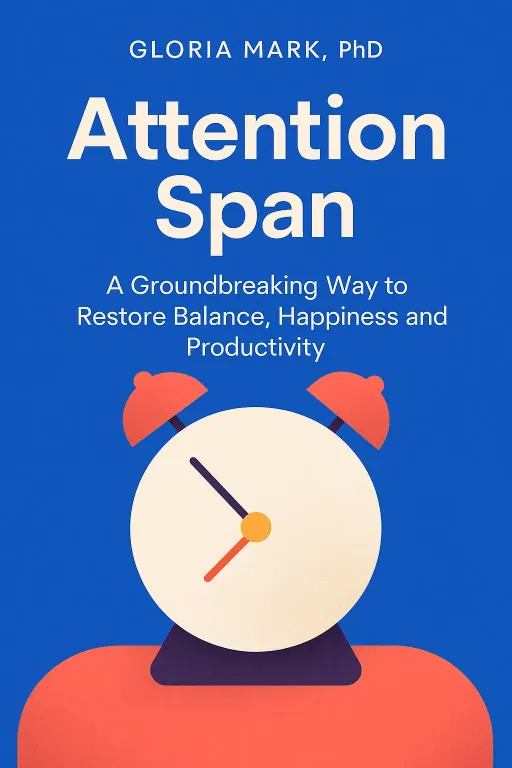
Nova: Exactly. And that's why we're so thrilled to have you here. Today we're exploring Gloria Mark's groundbreaking book, "Attention Span," from the perspective of someone who lives in that high-stakes world. With me is Beth, who is starting her new role as a 999 emergency communication officer. Welcome, Beth.
Beth: Thanks for having me. I've been thinking about these concepts a lot as I prepare, so this is perfect timing.
Nova: I can only imagine. The book's core idea is that our attention is this precious, finite resource, and our modern world is waging an all-out war on it. For most of us, that means we feel drained after a day of emails and social media. For you, the stakes are infinitely higher.
Beth: They are. Every bit of that "finite resource" has to be directed perfectly. There's no room for error.
Nova: Well, today we're going to arm you, and our listeners, with some science. Today we'll dive deep into this from two critical perspectives. First, we'll explore the hidden cognitive tax of multitasking and interruptions in high-stakes roles. Then, we'll shift to solutions, uncovering powerful strategies from the book to build resilience and regain control of our focus.
Deep Dive into Core Topic 1: The Cognitive Battlefield: Switch-Costs and Interruption Tax
SECTION
Nova: So Beth, that scenario you confirmed is real... it's what Dr. Mark's research is all about. Let's start with this idea of 'multitasking.' The book argues it's not real. What we're actually doing is switching our attention back and forth incredibly quickly. And every single switch comes with a price. It's called 'switch-cost.'
Beth: Like a mental transaction fee every time you change focus?
Nova: That's the perfect way to put it! A transaction fee. It takes time and mental energy to disengage from one task and load up the context for the next one. Dr. Mark's research shows that our average attention span on any single screen is now just 47 seconds. Forty-seven! We're paying that transaction fee constantly.
Beth: Wow. And in my role, those tasks aren't just screens. It's a voice, a map, a status update, a protocol list. The switching is constant.
Nova: And the book has this incredible story that shows just how high that cost can be, not just in performance, but in our well-being. Dr. Mark and her team ran this wild experiment at a company. They went to the executives and said, "We want to study the effect of email on your employees."
Beth: I can't imagine any boss agreeing to that.
Nova: Right? But they did! For one work week, they completely shut off email for a group of employees. No pings, no notifications, no inbox. And they had these employees wear heart-rate monitors to track their physiological stress.
Beth: Okay, I'm fascinated. What happened?
Nova: The results were staggering. Without the constant interruption of email, the employees' attention spans on any given task became significantly longer. They could focus more deeply. But here's the kicker: the heart-rate monitors showed that their stress levels measurably dropped. They were calmer, more focused, and they actually started talking to each other face-to-face more. It proved that the constant stream of interruptions was levying a real, physical 'interruption tax' on them.
Beth: That's incredible. And for us, we can't just turn off the "pings." A ping is a person in crisis or an officer needing help. So that 'tax' you're talking about is just a fundamental part of the job. The key, I'm guessing from the book, is how you manage the of it.
Nova: Exactly. You can't eliminate the interruptions, so you have to understand their effect. And you brought up something earlier that's so important here.
Beth: It makes me think about the 'Zeigarnik effect' the book mentions—that tension from an unfinished task. For me, that's not an unread email, it's an open 999 call. It's the call where you hear something worrying in the background, you've dispatched officers, but then the line goes dead.
Nova: Yes! Tell me more about that.
Beth: That 'unfinished' business, that unresolved situation... it doesn't just disappear from your mind when the next call comes in. It lingers. The book calls it a 'state of tension.' And I can see how that tension would absolutely eat into the cognitive resources I need to be fully present for the next person, the one who needs 100% of my focus right now.
Nova: That is the perfect, high-stakes example of the Zeigarnik effect. It was discovered by a psychologist named Bluma Zeigarnik who noticed that waiters in a cafe could remember complex, unpaid orders perfectly, but the moment the bill was paid, they forgot the details completely. The "unfinished" nature of the task kept it active in their minds. For you, that unfinished call creates a mental tension that drains your resources for the next person who needs you. It's a cognitive weight.
Beth: A weight is exactly right. And you have to learn how to set it down, or it will crush you over a 12-hour shift.
Deep Dive into Core Topic 2: Building Your Attentional Armor: Agency, Awareness, and Rote Recovery
SECTION
Nova: And that is the perfect pivot. So if we can't eliminate the interruptions, and we know they carry this cognitive weight, the book argues we have to get smarter about how we recover. This brings us to a really counter-intuitive idea, and maybe my favorite part of the book: the power of doing something... well, mindless.
Beth: Mindless? That sounds like the opposite of what you'd want in a job that requires so much thinking.
Nova: It does, doesn't it? We're taught to worship focus and 'flow'—that state of deep immersion. But Dr. Mark's research found something fascinating. She mapped people's attentional states throughout the day into four categories: focus, rote, boredom, and frustration. And guess which state was most highly correlated with happiness?
Beth: I'm going to guess... not focus?
Nova: Exactly! It was 'rote' attention. Those simple, repetitive, low-effort tasks. The book tells this wonderful story about the famous illustrator and author, Maira Kalman. She's this incredibly creative, brilliant mind. And what does she do when she's stuck or needs a break from the intensity of her work? She irons.
Beth: She irons?
Nova: She irons! Or she polishes silver. She describes it as a mechanical, meditative activity. And she says, "When there are so few things you can control, it can be extraordinarily soothing to find little things to be in charge of." It's not laziness; it's a strategic reset. She's replenishing her cognitive resources.
Beth: That's a huge shift in perspective for me. It makes me think of my old job as a scrub tech in ophthalmic surgery. There was a lot of rote work—methodically organizing tiny, delicate instruments, counting sponges. And you're right, it was calming. It was predictable. My brain could switch off the high-alert mode.
Nova: And you probably felt better after doing it, right? More ready for the next complex task.
Beth: Absolutely. I can see how finding a 'rote' activity, even for just 60 seconds between calls—like a specific breathing exercise, or just methodically organizing the pens on my desk—isn't avoiding work. It's preparing for the wave of focus. It's about consciously managing my own 'cognitive resources,' as the book calls them.
Nova: And that's the secret sauce! That's what Dr. Mark calls 'agency.' It starts with 'meta-awareness'—the ability to step outside yourself for a second and recognize, 'Wow, I'm feeling depleted,' or 'My brain feels like a pinball machine right now.' Once you have that awareness, you can make a conscious choice. You can choose your version of ironing.
Beth: So it's about being an active manager of your own brain, not just a victim of the next interruption. That feels empowering. As an ESFJ, I'm very aware of the emotional state of others, but this is about tuning into my own internal state with that same level of care.
Nova: Precisely. It's not about working less, it's about working smarter with the brain you have. It's about understanding that your attention works in rhythms, in peaks and valleys, and respecting that rhythm is the key to endurance.
Synthesis & Takeaways
SECTION
Nova: This has been so insightful, Beth. To bring it all together, what we've learned from Gloria Mark's "Attention Span" is that the 'multitasking' in a high-pressure role like yours isn't a superpower; it's a constant drain that carries a real cognitive tax, driven by switch-costs and the psychological tension of interruptions.
Beth: Right. And the solution isn't to just 'try harder' or 'be more disciplined,' which can feel like a personal failing. It's to build what the book calls agency.
Nova: Exactly. It's about becoming aware of our own mental state and then strategically using these moments of 'rote' activity, these mindful resets, to recover our cognitive energy. It's a complete reframe of what productivity and resilience look like.
Beth: It really is. For me, the biggest takeaway is giving myself permission to have that 'negative space' in my day, as the book puts it. To understand that a moment of quiet, structured, rote activity isn't a weakness or a sign of slacking off. It's a professional tool, just as important as the computer system or the headset.
Nova: I love that. A professional tool. So, as we close, what's the one thought you'd want to leave our listeners with, especially those who might be in their own high-pressure jobs?
Beth: I think it's a question they can ask themselves. Maybe the question isn't 'How can I be more productive?' but 'What's my version of ironing?' What's that one small, simple, mindless thing you can do to intentionally reset your brain, to let the stress subside, so you can come back stronger for the next challenge? Find your ironing.
Nova: Find your ironing. That's the perfect place to end. Beth, thank you so much for sharing your perspective. It's brought this book to life in a way that is just so powerful.
Beth: Thank you, Nova. This was incredibly helpful.