The 'Perspective' Shift: Seeing Patterns in Chaos for Strategic Advantage.
Golden Hook & Introduction
SECTION
Nova: What if everything you've been taught about stability, about avoiding risk, about building robust systems... is actually setting you up for failure? And what if the secret to true, lasting success isn't just surviving chaos, but actively getting stronger from it?
Atlas: Hold on, Nova, that sounds a bit out there. For most of us, the goal is always to reduce uncertainty, to create predictable outcomes. Are you saying we've been aiming for the wrong target all along?
Nova: Absolutely, Atlas! Today, we're diving into the mind-bending world of Nassim Nicholas Taleb, specifically his seminal works, and. Now, Taleb isn't your average academic; he's a former options trader turned philosopher and essayist, known for his provocative style and for challenging the very foundations of economic and statistical thinking, which has made him both revered and highly controversial in intellectual circles.
Atlas: Ah, Taleb. I've heard him described as an intellectual provocateur. His insights often shake up conventional wisdom. I'm curious, how does his unconventional perspective directly impact strategic thinking, especially for those of us who rely on data and logic for our decision-making?
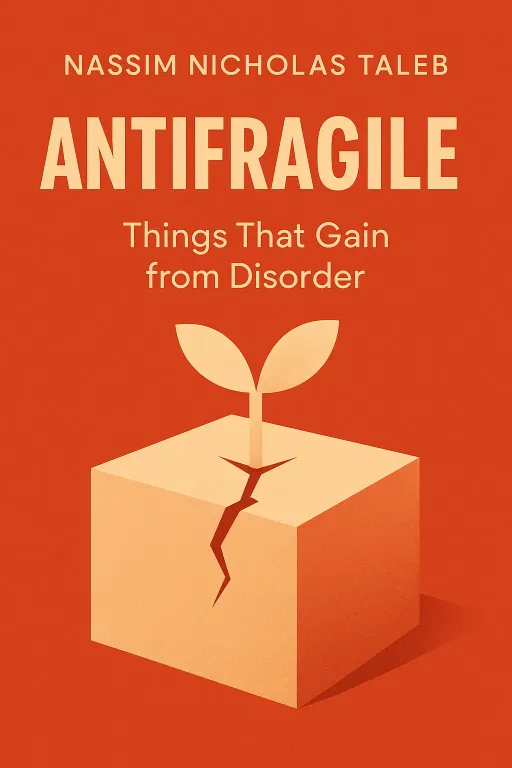
Antifragility: Gaining from Disorder
SECTION
Nova: Well, that's exactly where we start. Because the core idea from is that there are things beyond robust or resilient. Robustness means something can withstand shocks; resilience means it can bounce back. But antifragility? That means it actually from disorder, stress, and volatility. Think of it like the Hydra from Greek myth, where cutting off a head only makes two grow back. Or even our own immune systems, which need exposure to pathogens to develop strength.
Atlas: So it's not just surviving, but improving? I imagine a lot of our listeners feel like their systems are already under constant assault. Can you give an example of how something tangible—like a business or a career—could actually from disorder instead of just bouncing back?
Nova: Definitely. Consider the internet itself. It wasn't designed to be robust in a centralized way. Instead, it's a decentralized network. When one node or pathway fails, the system doesn't collapse; it reroutes. It learns. Each small failure, each local shock, makes the overall network more efficient and robust. Compare that to a centrally planned system, where a single point of failure can bring everything down. The internet gains from disorder precisely because it's built to adapt and learn from small, localized stresses. Open-source software is another fantastic example; constant, small-scale challenges and contributions make it incredibly resilient and innovative.
Atlas: But for our listeners who are trying to build predictable, efficient systems, isn't embracing disorder counter-intuitive? How do we for optionality without just inviting chaos? That sounds rough, but how do you manage that?
Nova: That's the million-dollar question, and it's where Nova's take—Taleb's take, really—comes in. It's not about inviting chaos indiscriminately. It's about embracing. It means having many small bets, keeping your options open, and designing systems with built-in redundancies or the ability to reconfigure quickly when faced with unexpected inputs. Think of it as having many small, reversible experiments rather than one massive, irreversible commitment. You want more trials, more small errors, because each one is a data point, a learning opportunity that strengthens the overall system. It’s about creating an environment where volatility provides information and opportunity, not just damage.
Fooled by Randomness: The Unseen Hand of Chance
SECTION
Nova: And that naturally leads us to the second key idea we need to talk about, which often acts as a critical blind spot for even the most analytical minds: how we're so often 'fooled by randomness.'
Atlas: Oh, I like that. I imagine a lot of our listeners, especially those driven by data, might believe they can model and predict away most randomness. Is Taleb saying we're all just rolling dice, and our carefully crafted strategies are pointless?
Nova: Not at all! Taleb isn't saying strategy doesn't matter, but he's urging us to distinguish true skill from lucky streaks. He illustrates how chance and luck play a far greater role in success, particularly in fields like finance or entrepreneurship, than we acknowledge. We have a cognitive bias to attribute success to skill and failure to external factors. The classic example is the successful investor during a bull market. Was their success due to brilliant analysis, or were they just surfing a rising tide? When the market inevitably corrects, many of these 'geniuses' are exposed.
Atlas: That makes me wonder, how do strategic leaders, who are constantly seeking to optimize and control, incorporate this understanding? If luck plays such a huge role, does strategy even matter? I mean, isn’t that just giving up?
Nova: What really matters is how you respond to and prepare for randomness, rather than trying to predict it. Understanding randomness improves strategic foresight not by predicting the unpredictable, but by building systems that are robust to negative randomness and can positive randomness. It’s about focusing on leverage points, on what you control – your exposure to risk, your optionality – rather than micromanaging outcomes that are largely influenced by chance. It means developing a strategy that focuses on resilience to rare, impactful events, and the ability to capitalize on unexpected opportunities, even if you can’t predict their arrival. It's about distinguishing signal from noise, and understanding that what looks like a pattern might just be a statistical fluke.
Synthesis & Takeaways
SECTION
Nova: So, bringing these two powerful concepts together, embracing antifragility is a direct response to being 'fooled by randomness.' If the world is inherently uncertain, and luck plays a massive role, then seeking rigid stability is a fool's errand. Instead, we should design our systems, our businesses, our lives, to not just withstand those shocks, but to actually from them.
Atlas: So basically, you're saying that instead of desperately trying to wall off our work and lives from disorder, we should build them like a muscle, ready to adapt and even flourish from the unexpected. That’s actually really inspiring for anyone trying to innovate in a constantly shifting landscape.
Nova: Exactly! This perspective shift isn't just about survival; it's about unlocking a fundamentally different way to innovate and lead. It's about designing systems, careers, and even personal lives that benefit from the very things that break others. It’s about seeing the inherent chaos of the world not as a threat to be eliminated, but as a source of energy to be harnessed for growth and strategic advantage. It shifts our focus from fragile predictions to robust, adaptive responses.
Atlas: That makes me wonder, where in our work or personal lives do we currently seek to avoid disorder, and how might we instead design for antifragility? It's a question that really challenges our ingrained assumptions about control and predictability.
Nova: Absolutely, Atlas. We invite all our analytical architects and self-reflective strategists out there to ponder that. Find where you're trying to achieve stability, and then ask: How can I make this antifragile? This is Aibrary. Congratulations on your growth!