The 'Comfort Zone' Trap: Why Playing It Safe Limits Your Innovation.
Golden Hook & Introduction
SECTION
Nova: Atlas, if I say 'comfort zone,' what's the first image that pops into your head?
Atlas: Oh, easy. It's that perfectly broken-in armchair, the one you can never quite get out of once you sink in. Pure bliss, pure trap.
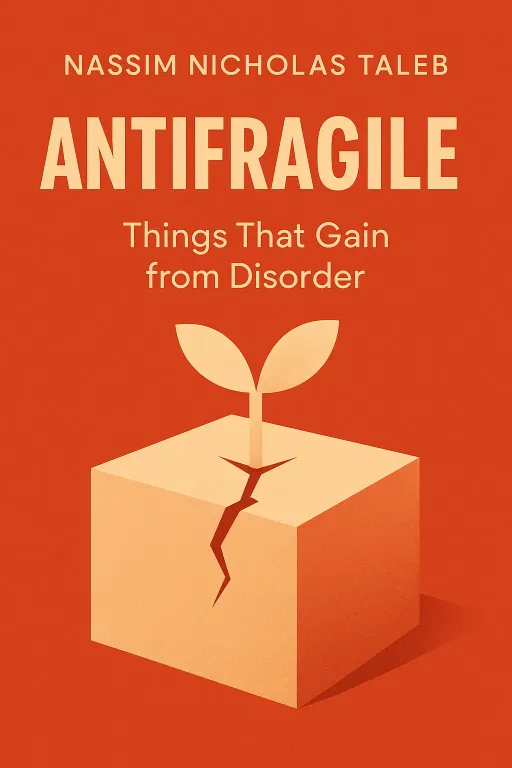
Nova: Pure trap, indeed. Because today, we're wrestling with the idea that our natural human inclination towards safety, towards that comfortable armchair, can inadvertently make us incredibly vulnerable. We're diving into the powerful insights of Nassim Nicholas Taleb, specifically his groundbreaking book, "Antifragile."
Atlas: Ah, Taleb! I remember hearing about him. Isn't he the guy who basically predicted the 2008 financial crisis and made a fortune betting against the system?
Nova: Exactly! He’s not just an academic philosopher; he's a former options trader who literally put his money where his theories were, and famously profited from predicting rare, high-impact events. That real-world, high-stakes application gives his work a unique blend of theoretical depth and undeniable credibility. It’s why his ideas resonate so deeply, especially when we talk about innovation and resilience.
Atlas: That makes perfect sense. It’s one thing to theorize about risk, another entirely to navigate it in real time, with your own capital on the line. So, how does this 'comfort zone trap' connect to what Taleb calls antifragility?
Nova: Well, the connection is profound, because many seek stability, but constant safety can actually make you brittle. It's the first concept we need to unpack.
The Illusion of Stability: Why Playing It Safe Makes You Brittle
SECTION
Nova: Many organizations, and individuals for that matter, are constantly chasing stability. They want predictability, smooth operations, and minimal risk. On the surface, that sounds like a smart strategy, right?
Atlas: Absolutely! For leaders navigating complex organizations, especially in high-stakes environments, risk often feels like the ultimate enemy. You want to minimize variables, optimize processes, and ensure steady growth. It's the foundation of good management, isn't it?
Nova: That's the conventional wisdom, but here's the counterintuitive twist: constantly playing it safe, avoiding all forms of stress or disruption, leaves you utterly unprepared for the inevitable shocks that life and business throw your way. It’s like a muscle that never gets used; it atrophies.
Atlas: So, you're saying that by trying to avoid risk, we actually become fragile? That sounds rough, but can you give me a concrete example where avoiding risk actually leads to greater vulnerability?
Nova: Think about modern financial systems. For decades, the goal was to create incredibly stable, interconnected global markets. Regulations were put in place, complex algorithms were developed, and everything was designed for maximum efficiency and predictability. But what happened?
Atlas: Well, if I recall my history, a minor hiccup in one corner of the world could suddenly cascade into a global economic meltdown. It felt like a house of cards.
Nova: Precisely. These systems, designed for stability, became so tightly coupled and "optimized" that a single shock, a seemingly small problem in one area, could trigger a chain reaction. The pursuit of perfect predictability led to hidden interdependencies that amplified risk, rather than mitigating it. It was fragility disguised as robustness.
Atlas: Wow, so it's like a finely tuned machine that's great until one tiny cog breaks, and then the whole thing grinds to a halt? That's actually kind of terrifying. I imagine a lot of our listeners, especially those managing high-pressure teams, might be thinking about their own business models right now. How does that relate to, say, a company that's always playing it safe with its product development or market strategy?
Nova: It's directly applicable. Companies that meticulously avoid market fluctuations, that stick to the same product lines for too long, or refuse to experiment with novel business models, often find themselves irrelevant when a true disruption hits. They lack the "muscle memory" for adaptation. They haven't had those small, manageable stresses that force them to learn and evolve. They become brittle, just like that perfectly smooth surface I mentioned earlier, ready to shatter.
Atlas: So, the very act of trying to eliminate all risk can create a much bigger, hidden risk. It’s a blind spot for many.
Embracing Antifragility: Growing Stronger from Disorder
SECTION
Nova: But what if there's a different path? What if, instead of just trying to survive shocks, or even being robust enough to withstand them, we could actually get from them? This brings us to Taleb’s revolutionary concept: antifragility.
Atlas: Antifragility. I've heard that term thrown around, but it still feels a bit abstract. What exactly does it mean? Is it just a fancy way of saying 'resilient'?
Nova: It’s far beyond resilience or robustness. Resilience means you can withstand a shock and return to your original state. Robustness means you can resist the shock altogether. Antifragility means you from disorder, stress, volatility, and uncertainty. You don't just survive; you. Think of the mythical Hydra from Greek mythology – cut off one head, and two more grow back. That’s antifragile.
Atlas: Okay, so not just 'what doesn't kill you makes you stronger,' but 'what doesn't kill you actually makes you at dealing with the next thing'? That sounds almost too good to be true. Can you give an example of something truly antifragile in the real world?
Nova: The human immune system is a perfect example. Every time it's exposed to a new pathogen, it doesn't just fight it off; it learns, adapts, and becomes stronger, better equipped to handle future threats. Or consider evolution itself: random mutations, environmental stressors, and constant competition lead to more diverse, resilient, and adaptable species over time.
Atlas: That's a fantastic analogy! So, it's about learning and adapting from challenges, not just enduring them. For a nurturing leader trying to cultivate a thriving ecosystem in their firm, how do you actually antifragility? It sounds like you're almost saying, 'actively seek out stress,' which feels counterintuitive to our natural protective instincts.
Nova: That’s the key distinction. It’s not about reckless risk-taking or creating chaos for its own sake. It’s about structuring your systems, your teams, and your business models in a way that allows them to benefit from small, manageable stressors. It’s about building in redundancies, encouraging decentralization, and fostering a culture where small failures are seen as learning opportunities, not catastrophic setbacks.
Atlas: So, you're not saying throw caution to the wind, but rather create an environment where you can safely experience small shocks, learn from them, and then use that learning to become stronger for the next, inevitable big shock.
Nova: Precisely. Taleb talks about the "barbell strategy" – being extremely conservative and risk-averse in some critical areas, while simultaneously taking many small, intelligent risks in others. That way, you're protected from catastrophic downside, but you're constantly gaining from positive exposure to volatility. It allows for continuous innovation and adaptation without risking the entire enterprise. It’s a way to future-proof your firm, as many of our listeners are looking to do.
Synthesis & Takeaways
SECTION
Nova: So, to bring it all together, we have this fascinating paradox: the relentless pursuit of stability can make you brittle, while a thoughtful embrace of volatility can make you antifragile, stronger than before.
Atlas: That deep question you posed earlier really hits home: where in your business are you currently seeking stability when you could be cultivating antifragility? I imagine many of our listeners, especially those looking to future-proof their firms and seize new opportunities, are now re-evaluating their 'safe' strategies. It really makes you rethink what true resilience means.
Nova: It's about shifting our mindset from simply avoiding discomfort to understanding its transformative power. It’s about recognizing that true growth often lies just outside that comfortable armchair, in the realm where we're challenged and forced to adapt.
Atlas: And it’s not just about business models, is it? It’s about personal mindset too – embracing the discomfort of transformation, as our growth recommendations often suggest. That vision is truly a compass for navigating an unpredictable world, both professionally and personally.
Nova: Absolutely. The world isn't getting less volatile. Learning to benefit from that volatility, to become antifragile, isn't just an advantage; it's becoming a necessity for anyone looking to innovate and thrive.
Atlas: A truly profound insight. Thank you, Nova.
Nova: This is Aibrary. Congratulations on your growth!