The 'Antifragile' Advantage: How to Build Agent Systems That Get Stronger with Stress.
Golden Hook & Introduction
SECTION
Nova: We often praise systems for being robust, for being resilient. We say, “Wow, that can really take a hit and keep going.” But what if the very things we design to 'withstand' stress are actually missing a fundamental truth about strength? What if the truly evolutionary systems aren't just built to survive shocks, but to on them, to actually get stronger because of the chaos?
Atlas: Whoa, that sounds almost… counter-intuitive. Are you saying being 'robust' isn't the ultimate goal anymore? Because I’ve spent my entire career trying to make things robust and resilient!
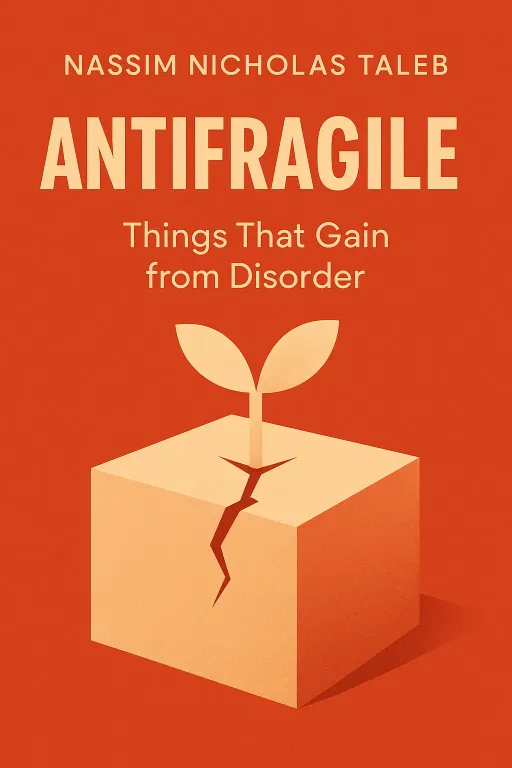
Nova: Exactly! And that's where we’re going today. We're diving into an idea that radically reshapes how we think about stability and strength, from the mind of Nassim Nicholas Taleb, in his groundbreaking book,. Taleb is famously known for his background as a former options trader, a statistician, and a philosopher, which gives him this incredibly unique lens on risk and uncertainty. He's not afraid to challenge deeply held beliefs across finance, science, and even daily life.
Atlas: I know Taleb loves to shake things up. His work always leaves you thinking differently. So, what's the fundamental shift here? What does "antifragile" even mean, beyond just resilience?
Understanding Antifragility: Beyond Resilience
SECTION
Nova: That's the crucial question, Atlas. Most people confuse antifragility with resilience. Resilience is about being able to return to your original state after a shock. Think of a spring: you compress it, it bounces back. It withstands. Fragile, of course, is a glass that shatters. But antifragile? That’s something that, when exposed to volatility, disorder, stress, and even errors, actually improves. It gets stronger. It’s a positive convex response to harm.
Atlas: So it's not just bouncing back to zero, it's about bouncing? Can you give me an example where something actually gets better because of a hit, not just recovers? That sounds a bit out there!
Nova: Absolutely. Think about your muscles. When you lift weights, you're intentionally putting them under stress. You're creating micro-tears. If you just lay on the couch, they wouldn't grow stronger. But because of that stress, they adapt, they grow back thicker and more powerful. Or consider the human immune system. Exposure to a pathogen, within limits, strengthens it, making it more prepared for future attacks.
Atlas: Right, like immunization for systems. So the key is exposure to, non-fatal shocks, not catastrophic ones. It's not about jumping off a cliff to strengthen your bones.
Nova: Precisely! It's about small, frequent, non-lethal doses of chaos. Taleb also points to the Hydra from Greek mythology – cut off one head, and two grow back. That's the ultimate antifragility. The postal service, for instance, is antifragile in some ways. The more packages they lose, the more they learn to improve their tracking and delivery systems. Every failure becomes a data point for betterment, not just a problem to be fixed.
Atlas: That makes perfect sense. So, for agent systems, our blind spot has been focusing solely on making them robust – able to handle expected loads, recover from known errors. But we might be missing the opportunity for them to actually evolve and get smarter from the.
Nova: Exactly. We design for predictable scenarios, for average conditions. But the real world, especially for agent systems interacting with it, is anything but average. It’s full of "Black Swans," as Taleb would say – rare, high-impact, unpredictable events.
Designing Antifragile Agent Systems: Practical Applications
SECTION
Nova: And that 'immunization' idea, Atlas, leads us directly to our next big question: How do we actually this into our agent systems? How do we design components that don't just recover, but improve from unexpected inputs or failures?
Atlas: Okay, now we're talking. As an architect, my first thought is, where do I even start? What's the first principle for an antifragile agent? Does it mean purposefully breaking things during development?
Nova: It's not about intentionally breaking, but it is about designing for the possibility of failure and, crucially, learning from it. One key principle is. It's not just about having a backup system that kicks in when the primary one fails. It's about having diverse, perhaps even slightly different, redundant components that can offer or interpretations when the primary one encounters an anomaly.
Atlas: Oh, I like that. So, instead of just a cold standby, maybe it's a warm standby that processes the same input in a slightly different way, and if the main agent gets stuck, the secondary one might find a novel solution that the main one then learns from?
Nova: Exactly! Another huge aspect is. Instead of one monolithic agent, imagine a swarm of smaller, specialized agents. When one encounters an unexpected input or fails, it doesn't crash the whole system. The others can adapt, learn from that failure, or even pick up the slack. This allows for small, contained failures that generate valuable learning data without bringing down the entire operation.
Atlas: That’s a great way to put it. For a multi-modal agent decision framework, does this mean intentionally feeding it ambiguous data, or letting it encounter unexpected sensor failures, and then seeing how it reconfigures its decision process? I’m also thinking about here.
Nova: You've hit on a critical point with feedback loops. Antifragile systems thrive on information from their environment, especially information about what work as expected. So, robust, rapid, and granular feedback loops are essential. Every error, every unexpected input, every deviation from the norm needs to be treated not as a bug to be simply fixed, but as a teaching moment for the agent. It’s about ensuring the agent can continuously learn from its mistakes and adapt its internal models.
Atlas: That makes me wonder about explainability and security. If an agent system is constantly changing and improving from stress, how do you build an antifragile system that you can still understand and trust? It sounds like a moving target.
Nova: That’s a brilliant question, Atlas, and it highlights a common misconception. An antifragile system doesn't mean a chaotic, unpredictable one. It means one whose are well-designed. In fact, by building in transparent learning from failure, you could potentially explainability. You could log a system adapted in a certain way after an unexpected input, providing a clearer audit trail of its evolution. For security, an antifragile agent system could learn from minor attack attempts, not just block them, but use them to harden its defenses and identify new vulnerabilities a major breach. It's like a sparring partner that makes you a better fighter.
Atlas: That’s actually really inspiring. So, it's not just about surviving a cyberattack, it's about becoming more resilient to the, unknown attack because of the previous ones.
Nova: Precisely. And finally,. Instead of trying to smooth out all variability, antifragile design welcomes it. It means designing components that can handle a wide range of inputs, not just the average. Think about how evolutionary processes work – they thrive on genetic variation and unexpected environmental pressures. We need to bake that kind of evolutionary capability into our agent systems.
Synthesis & Takeaways
SECTION
Nova: So, Atlas, what we're really talking about here is a profound philosophical shift for architects and innovators. It's moving from a mindset of prediction and control, to one of embracing the unknown as a fundamental source of strength and growth.
Atlas: This really challenges the 'perfect design' mentality. It’s less about building an impenetrable fortress that might crumble under an unforeseen attack, and more about cultivating a living, evolving organism that learns from every scrape and bruise. It’s about leveraging the very things we fear – volatility and uncertainty.
Nova: Exactly. For agent systems, that means every unexpected input, every small failure, every moment of chaos isn't a problem to be avoided, but a training signal. It's a chance to get smarter, faster, more robustly intelligent. It's about building systems that don't just exist in the future, but actively with it.
Atlas: That gives me chills. So, for all the future architects and innovation explorers out there, maybe the next component you design shouldn't just withstand the storm, but learn to dance in the rain. What's one small, non-fatal stressor you can introduce to your system today to see how it might gain?
Nova: This is Aibrary. Congratulations on your growth!