Stop Chasing Trends, Start Shaping Them: The Guide to Marketing Foresight.
Golden Hook & Introduction
SECTION
Nova: Atlas, rapid-fire: 'marketing trend.' What's the first image that pops into your head?
Atlas: Oh, easy. A hamster on a perpetually accelerating wheel, furiously pedaling towards... well, another hamster wheel. And then, poof, the wheel evaporates and a new, shinier wheel appears, and the hamster just sighs and starts running again.
Nova: That's... surprisingly poetic for a hamster. And it perfectly encapsulates the cold, hard fact we're tackling today. So many digital marketing strategies are exactly that: hamsters on wheels, constantly chasing the latest trend, reacting to every market shift instead of anticipating what's next. It leaves you incredibly vulnerable.
Atlas: Oh, I know that feeling. It's like you're always playing catch-up, always slightly behind the curve, and the moment you master one platform, a new algorithm drops, or a competitor does something completely unexpected. It's exhausting.
Nova: Exactly. And that's why today, we're diving into how to transcend that reactive cycle, how to "Stop Chasing Trends, Start Shaping Them." This isn't just a catchy title; it's a guide to marketing foresight, pulling profound insights from thinkers like Nassim Nicholas Taleb and Annie Duke. What's fascinating is that these aren't traditional marketing gurus; Taleb comes from the world of finance and risk, and Duke from professional poker. Their perspectives offer a uniquely powerful lens for building marketing systems that are resilient, adaptive, and capable of long-term innovation.
Atlas: That makes me wonder, how do you even begin to 'shape' a trend when everything feels so chaotic? Most of us are just trying to keep our heads above water.
Antifragility in Marketing: Thriving on Disorder
SECTION
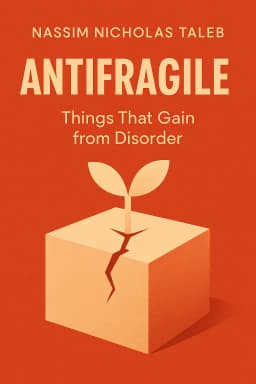
Nova: That's where Nassim Nicholas Taleb's concept of 'antifragility' comes in. It's a game-changer. Most systems are either fragile—meaning they break under stress—or robust, meaning they withstand stress. But antifragile? Antifragile systems actually from disorder, from volatility, from unexpected shocks. They grow stronger.
Atlas: Wait, you're saying my marketing strategy should chaos? That sounds a bit out there. Like, how does a marketing campaign benefit from a major platform outage or a sudden economic downturn? I'm imagining things getting stronger, but I'm just picturing a lot of panicked emails.
Nova: It's counterintuitive, right? Think of it like this: a fragile system is a delicate glass vase. A robust system is a solid steel box. An antifragile system, Taleb suggests, is like the Hydra from Greek mythology—cut off one head, and two grow back. Or even more simply, it's like our immune system. Exposure to certain stressors, in measured doses, makes it stronger and more adaptive.
Atlas: Okay, so it’s not about a catastrophe, but designing a system that, when a catastrophe inevitably happens, it doesn't just survive, it finds a way to leverage it. Can you give an example? Because for someone who's trying to build a robust understanding of this, it still feels a little abstract.
Nova: Absolutely. Take a brand that has built all of its customer engagement around one dominant social media platform. If that platform changes its algorithm drastically, or even collapses, that brand is fragile. A robust brand might have diversified across a few platforms, so they survive. But an brand? They might have actively experimented with niche communities, direct-to-consumer channels, and diverse content formats the platform shift. When the chaos hits, they might discover that their previously 'side' efforts suddenly become central, giving them a competitive edge and new audiences that their competitors, who were too focused on the one platform, can't reach. They actually market share.
Atlas: I can see that. So it's about building in optionality, almost like having multiple backup plans, but those backups aren't just for survival; they're for opportunity. That’s going to resonate with anyone who struggles with feeling blindsided by market shifts. For a strategic innovator, it sounds like permission to experiment more, to build redundancy that isn't just about safety, but about potential growth.
Nova: Exactly. It's about embracing redundancy and decentralization, not as inefficiencies, but as sources of strength. For your next marketing campaign, the tiny step we suggest is to identify three potential disruptions—maybe a new competitor, a shift in consumer privacy laws, or a technological breakthrough—and brainstorm how your strategy could not just survive, but from each. How could you pivot to discover new opportunities?
Atlas: That's a great way to put it. It moves from a defensive posture to an offensive one. It makes me think differently about those 'what-if' scenarios we often dread. So, if antifragility helps us build systems that thrive in chaos, how do we make decisions within that chaos? Because even the most antifragile system still needs good leadership.
Probabilistic Thinking: Making Robust Marketing Decisions
SECTION
Nova: That's where Annie Duke's "Thinking in Bets" becomes indispensable. Duke, a former professional poker player, argues that good decision-making isn't about being right every time, but about thinking in probabilities and embracing uncertainty. We often conflate the quality of a decision with its outcome. A good decision can lead to a bad outcome due to luck, and a bad decision can lead to a good outcome, again, due to luck.
Atlas: That’s a great way to put it. I imagine a lot of our listeners, especially focused achievers, are constantly striving for the 'right' answer, the guaranteed win. But what you're saying is, that's not always the best way to make decisions in a complex world?
Nova: Precisely. Duke helps us reduce cognitive biases by actively considering alternative outcomes. It's about recognizing that almost nothing in marketing is 100% certain. Instead of asking, "Will this campaign succeed?" we should be asking, "What's the probability of this campaign succeeding, and what are the probabilities of various outcomes if it doesn't?"
Atlas: So, you're saying it's not about predicting the future with certainty, but about understanding the odds? But how does that apply to, say, launching a new product or choosing a target demographic? Those feel like binary decisions. You either do it or you don't.
Nova: Not quite. It's about framing those binary choices as a series of bets. Before a product launch, a probabilistic thinker wouldn't just say, "This will be a success." They'd analyze: "There's a 70% chance of hitting our sales target, a 20% chance of moderate success, and a 10% chance of failure." And critically, they'd ask, "What are the and associated with each of those probabilities?" This allows for more robust decisions, because you've accounted for the downside and upside, not just the single desired outcome.
Atlas: I can definitely relate. It’s kind of like how weather forecasters don't say, "It will rain tomorrow." They say, "There's an 80% chance of rain." And you plan accordingly. So, for marketers, it means not just having a Plan A, but understanding the likelihoods of needing Plan B, C, or even D, and preparing for them. This framework helps you make more robust marketing decisions by actively considering alternative outcomes and reducing cognitive biases, especially when dealing with advanced analytics.
Nova: Exactly! It’s also incredibly valuable for ethical leadership. When you start thinking in probabilities, you're forced to consider the potential negative consequences of your decisions, not just the rosy best-case scenario. It builds a more responsible, more resilient decision-making muscle. It's about making peace with uncertainty and using it as an input, not a roadblock.
Synthesis & Takeaways
SECTION
Nova: So, bringing it all together, "Stop Chasing Trends, Start Shaping Them" is about integrating antifragility and probabilistic thinking. It's about moving from that hamster wheel of reactive marketing to building a system that actually thrives on market changes, and making decisions within that system by understanding the odds, not just hoping for the best.
Atlas: That’s actually really inspiring. It feels like it empowers marketers to trust their intuition more, but an intuition that’s been honed by a deep understanding of risk and opportunity, not just gut feelings. It's about mastery, about applying these concepts to build robust understanding, and ultimately, making a meaningful impact.
Nova: It's about transforming fear of the unknown into an advantage. True foresight isn't about perfectly predicting the next big trend; it's about building the capacity to thrive, no matter what trends emerge, and to be the one shaping them. It's about designing a marketing future where you don't just react to the world, you interact with it in a way that makes you stronger.
Atlas: And for anyone listening who's feeling that pressure to always be 'right' or to constantly catch the next wave, this is your permission to step back, analyze the probabilities, and purposefully build a strategy that gains from disorder. It’s not just about surviving; it’s about growing stronger with every challenge. So, for your next marketing campaign, identify three potential disruptions and brainstorm how your strategy could not just survive, but actively benefit from each. What 'disorder' can you learn to embrace?
Nova: This is Aibrary. Congratulations on your growth!