Stop Chasing Trends, Start Building Antifragility: Your Business Shield.
Golden Hook & Introduction
SECTION
Nova: Atlas, if you had to review 'Stop Chasing Trends, Start Building Antifragility: Your Business Shield' in exactly five words, what would they be?
Atlas: Oh, I love this! Hmm… Get stronger from chaos. Seriously.
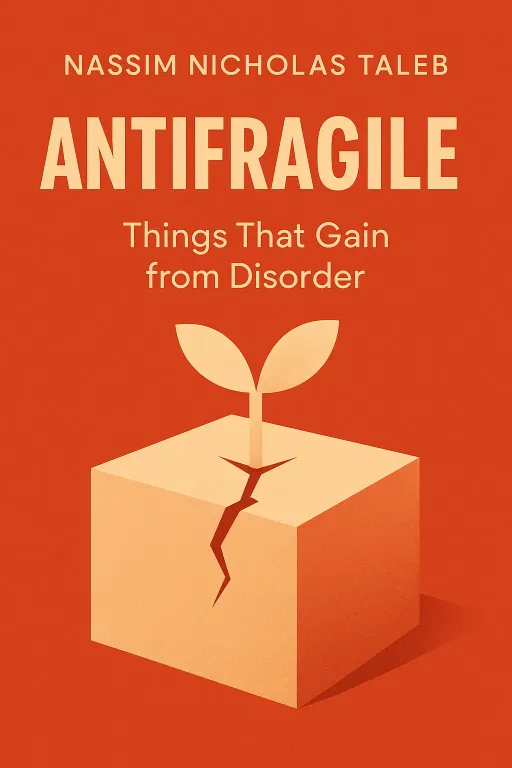
Nova: That's a perfect five words for what we're diving into today! We’re exploring the groundbreaking ideas of Nassim Nicholas Taleb, specifically his radical concept of 'antifragility' and how it completely flips our understanding of risk. Taleb, a former options trader and risk analyst, became a prominent voice after the 2008 financial crisis, arguing that many systems are far more vulnerable to rare, unpredictable events than we realize.
Atlas: Ah, Taleb. He's not one to shy away from shaking up conventional wisdom, is he? His work is celebrated for challenging the status quo, even if it makes some people uncomfortable, which I find fascinating.
Nova: Absolutely. And today, we're taking on that challenge head-on. Most of us strive for resilience, right? We want to bounce back from setbacks. But Taleb argues that's not enough. What if you could build a business, or even a life, that didn't just withstand shocks, but actually got stronger from them? That’s the essence of antifragility.
Deep Dive into Core Topic 1: Understanding Antifragility: Benefiting from Disorder
SECTION
Atlas: Wait, hold on. Stronger from shocks? So, you're saying I things to go wrong? That sounds a bit out there, Nova. My instinct is always to avoid problems, not invite them.
Nova: I know, it flies in the face of intuition! But think about it this way: a fragile system breaks under stress. A resilient system resists stress and returns to its original state. But an antifragile system from stress, disorder, and volatility. It literally improves.
Atlas: So, it's like... a human immune system? It needs exposure to germs to develop antibodies and get stronger.
Nova: Exactly! Or think of your muscles. You lift weights, you create tiny tears in the muscle fibers, and they repair themselves, growing back stronger. That's antifragility in action. The stressor, the shock, is necessary for growth. Taleb even references the Hydra from Greek mythology—cut off one head, and two grow back. That’s the ultimate antifragile entity.
Atlas: Oh, I like that! But how does that apply to, say, a business? It's easy to see with biology, but with balance sheets and strategies, it feels a bit more abstract. How can a company 'benefit' from a shock, beyond just surviving it?
Nova: Great question. Imagine a company that has built in redundancy – multiple small suppliers instead of one large one. If one supplier fails, the others pick up the slack, and the company learns invaluable lessons about diversification and contingency. Or a startup that launches many small, cheap experiments rather than one massive, expensive project. Each "failure" provides data, insights, and a stronger foundation for the next iteration. They actually gain knowledge and robustness from minor setbacks.
Atlas: So, instead of trying to predict every single failure point, you embrace a certain level of controlled chaos, almost, to uncover weaknesses and adapt. That makes me wonder, how does this align with those big, unpredictable events that catch everyone off guard?
Deep Dive into Core Topic 2: Black Swans and the Illusion of Predictability
SECTION
Nova: That's the perfect segue, Atlas, because those big, unpredictable events are precisely what Taleb calls "Black Swans."
Atlas: Black Swans. I’ve heard that term. Isn't that about those crazy, unlikely things that happen, and nobody saw them coming?
Nova: Precisely. Taleb argues that most models and predictions ignore these highly improbable, high-impact events. They have three key characteristics: they are rare outliers, they carry an extreme impact, and despite their rarity, we often concoct explanations for them the fact, making them seem predictable in retrospect. Think of major technological breakthroughs, or significant market crashes. They were almost impossible to predict, yet profoundly reshaped our world.
Atlas: Right. Like how everyone loves to say "I knew it all along" after a big event, even when they didn't. It seems like we're wired to look for patterns, even when there aren't any, and then we're blindsided. But if the biggest risks are unplannable, what's the point of planning at all? It sounds almost nihilistic.
Nova: That's the key distinction. Recognizing Black Swans isn't about predicting them; it's about building systems that are robust them and can even them. An antifragile approach acknowledges that these Black Swans exist and will happen. Instead of trying to prevent them, you design your system so that when a negative Black Swan hits, you're not just damaged, but you might even find an opportunity within the chaos. And conversely, you position yourself to capture the benefits of a positive Black Swan, which are just as unpredictable.
Atlas: So, it’s not about avoiding the storm, but learning how to surf the biggest waves, even the ones you never saw coming. I can see how that would require a massive shift in mindset for a lot of businesses and even individuals. What does that mean for our listeners who are navigating their own business challenges, or just life in general?
Synthesis & Takeaways
SECTION
Nova: It’s a profound shift, Atlas. It means moving away from a world obsessed with prediction and control, and embracing one where uncertainty is a feature, not a bug. The goal isn't to eliminate risk, but to make sure that when volatility hits, you're positioned to gain. You want to have "skin in the game" in a way that allows for upside, and limits downside, even if you can't predict the exact nature of the shock.
Atlas: That gives me chills. It’s a complete reframe of how we think about risk and opportunity. It’s like turning the fear of the unknown into a superpower. So, for our listeners, what's one small, tiny step they can take to start thinking in an antifragile way, especially when everything feels so uncertain?
Nova: I'd say this: identify one area in your current business, or even your personal life, where a small failure could lead to a large gain. How can you intentionally expose it to minor stresses? Maybe it's delegating a task you usually micromanage, knowing there might be small errors but also huge learning. Or trying a new, low-stakes marketing channel that might fail but could also open up a massive new lead source.
Atlas: That's actually really inspiring. It’s about creating a safe space for controlled failure to foster unexpected growth. It’s not about being reckless, but being strategically open to the lessons of disorder.
Nova: Exactly. It's about designing your world to thrive in the face of the unexpected, transforming potential threats into opportunities for innovation and growth.
Atlas: What a powerful idea.
Nova: This is Aibrary. Congratulations on your growth!