Stop Chasing Trends, Start Building Antifragility: Your Business as a Living System.
Golden Hook & Introduction
SECTION
Nova: What if I told you that trying to make your business unbreakable is actually making it weaker? That the very act of avoiding all risk is setting you up for catastrophic failure?
Atlas: Whoa, that's a bold claim, Nova. I imagine a lot of our listeners, especially early-stage founders, are actually trying to do the exact opposite. They're trying to build something, something that break under pressure. That's usually the goal, right?
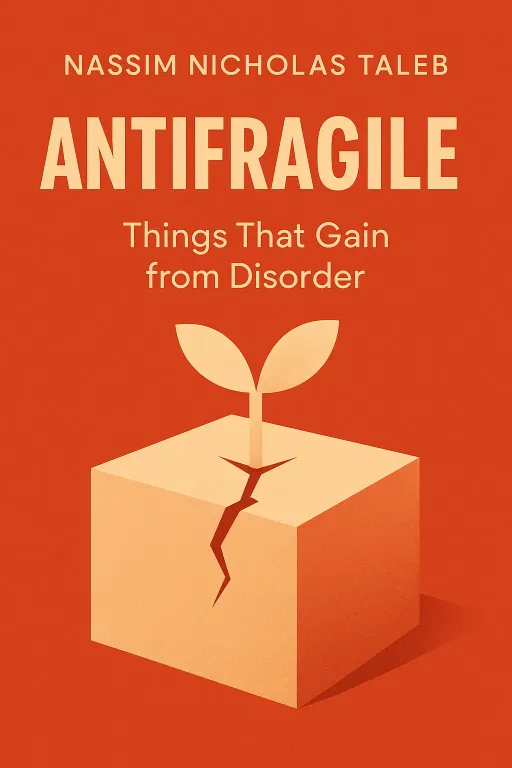
Nova: Absolutely, Atlas. And that's precisely the common wisdom that Nassim Nicholas Taleb challenges in his incredibly influential book, "Antifragile: Things That Gain from Disorder." Taleb is a fascinating figure, a former options trader who turned into this philosophical essayist, known for his incredibly provocative, often contrarian views on risk and uncertainty. He really developed these ideas after surviving major market crashes, which gives his work a very unique, battle-tested perspective.
Atlas: Right, I've heard his name. The book itself, it’s got a bit of a cult following, especially in tech and finance. Some people absolutely love it, others find his style a bit... abrasive. But it certainly makes you think.
Nova: It absolutely does. And today, we’re diving into the core of that thinking, because it offers such a powerful framework for anyone building a business in our increasingly unpredictable world.
The Illusion of Robustness vs. The Power of Antifragility
SECTION
Nova: So, Taleb introduces three distinct categories for how things respond to chaos: fragile, robust, and antifragile. Most of us intuitively aim for robustness. We want our business to be like a well-built brick wall, able to withstand the storm without collapsing. But he argues that simply resisting stress isn't the optimal state.
Atlas: Okay, so, fragile, robust, antifragile. Can you give us an analogy, Nova? How do those three differ in a way that really clicks?
Nova: Absolutely. Think about a ceramic coffee cup. That's fragile. Drop it, and it shatters. It breaks under stress.
Atlas: Got it. Like a new startup with no cash reserves, one bad quarter and it’s game over.
Nova: Exactly. Now, a robust system. Imagine a stainless steel travel mug. You can drop it, kick it, maybe even run over it with a bike, and it’ll probably just dent. It resists shocks, but it doesn't get from them. It just holds its form.
Atlas: Okay, that makes sense. That’s what most of us are trying to build, right? A resilient business, something that can take a hit and keep going. Like a large, established corporation with deep pockets and diversified revenue streams.
Nova: Precisely. But here's where Taleb flips the script. He says there's a third category: antifragile. This isn't just about resisting. It's about from disorder, volatility, and stressors. It's like a mythological creature that, when attacked, doesn't just heal, but grows stronger, sprouts new heads, or develops new abilities.
Atlas: Whoa. So, you're saying that chaos, which most people see as inherently bad, can actually be a thing for some systems? That sounds a bit out there, Nova. For an early-stage founder, chaos is usually the enemy.
Nova: That's the counter-intuitive brilliance of it. Consider evolutionary biology. Species don't just survive environmental pressures; they and adapt because of them. Or think about the internet itself. It was designed without a central point of failure, so local outages or attacks don't break it; they reveal weaknesses that are then patched, making the whole system ultimately more resilient and robust.
Atlas: I can see how that applies to complex natural systems or massive decentralized networks. But how does that translate to a startup? Are you suggesting a founder should just invite disasters to make their company stronger? Because that sounds like a recipe for bankruptcy, not growth.
Nova: Not at all! It's not about inviting catastrophic disasters, but about understanding that some level of volatility and stress is not just unavoidable, but beneficial. The issue is when we try to eliminate variability, aiming for perfect predictability. That often creates a system that is incredibly fragile to the it wasn't designed for. Taleb argues that predictability is largely an illusion, and trying to achieve it too rigidly makes us vulnerable.
Intentional Stressors: Learning and Growing Through Controlled Failure
SECTION
Nova: And that naturally leads us to the practical side: how do we actually an antifragile business? It involves intentionally introducing small, manageable failures or "controlled stressors" to learn and grow stronger.
Atlas: Okay, so how does an early-stage founder actually do this without risking the whole company? What kind of "stressors" are we talking about? Because when I think of 'stressors,' I think of market crashes and competitor attacks, not something I'd proactively invite.
Nova: That’s a great question. It's not about reckless abandon. Think of it like weightlifting. You intentionally put stress on your muscles, causing tiny tears. You wouldn't try to lift a car on day one, that would be catastrophic. But those small, controlled stresses, followed by recovery, make your muscles grow stronger. The same principle applies here.
Atlas: I like that analogy. So, in business terms, what does that look like? Give me a concrete example for a founder trying to build a product or a team.
Nova: For product growth, it could be rapid, iterative A/B testing, even with radical changes. Instead of spending months perfecting a feature, launch a rough version to a small segment of users, quickly collect feedback, and learn from what doesn't work. Those small "failures" in a limited scope provide invaluable data that helps the product evolve. Another example is delegating significant responsibilities to new team members, allowing them the autonomy to make small, low-stakes mistakes.
Atlas: Ah, so instead of micromanaging to prevent all errors, you're giving them the space to stumble a bit, learn, and then get stronger from that experience? That's really interesting for team building. Many founders struggle with letting go, wanting everything to be 'perfect' from the get-go.
Nova: Exactly. It's about building "skin in the game" for everyone involved. When people have direct consequences for their actions, even small ones, they learn much faster. Taleb often emphasizes that those who have "skin in the game" – who stand to gain or lose from their decisions – are the ones who truly understand and adapt. This creates robust feedback loops. For a product, it means putting it in front of real users early and often, even if it's imperfect. For a team, it means empowering them with real decision-making power, not just theoretical responsibility.
Atlas: It sounds like you're saying embracing imperfection and accepting small, frequent errors is key. That’s a huge mindset shift for many founders, who are often driven by a desire for flawless execution before they even get started. This is directly relevant to anyone trying to scale their product and their people.
Nova: It really is. It moves you away from trying to predict the future, which is impossible, and towards building a system that can to whatever the future throws at it, and even benefit from that unpredictability. It’s about building in optionality and redundancy, and celebrating the information gained from things not going perfectly.
Synthesis & Takeaways
SECTION
Nova: So, ultimately, antifragility isn't about avoiding failure, it's about leveraging it. It's a profound mindset shift from merely protecting what you have to proactively evolving through exposure to disorder.
Atlas: That’s a powerful distinction. It moves us from a defensive posture to a much more dynamic, almost offensive one. It makes me think of the deep question from the book content: where in your business could you intentionally introduce controlled stressors to uncover hidden strengths and build a system that gains from disorder?
Nova: That’s the challenge we want to leave our listeners with. Don't wait for chaos to find you. Identify one small area in your business this week – maybe a product feature, a marketing message, or a team process – where you can experiment with controlled stress. Put it out there, get feedback, and learn from the imperfections.
Atlas: Right, because growth isn't about avoiding disorder, but about how you respond to it, and even gain from it. It's about designing your business to thrive in uncertainty, not just survive it.
Nova: Absolutely. And that’s a game-changer for any founder.
Atlas: This is Aibrary. Congratulations on your growth!