Stop Chasing Trends, Start Building Antifragile Systems: The Guide to Resilient Accounting.
Golden Hook & Introduction
SECTION
Nova: Everyone says, "What doesn't kill you makes you stronger." We hear it everywhere, right? It's like a mantra for resilience.
Atlas: Absolutely. It’s the ultimate comeback story, the underdog narrative we all love. It implies enduring hardship leads to a tougher, better version of yourself.
Nova: Exactly. But what if that's completely wrong? What if what doesn't kill you actually makes you? And, even more provocatively, what if the real genius isn't just surviving chaos, but building systems that actually from disorder?
Atlas: Whoa. Okay, that’s a flip. That sounds like something straight out of a philosophical treatise, but applied to… everything? My brain is already doing backflips trying to square that with traditional thinking.
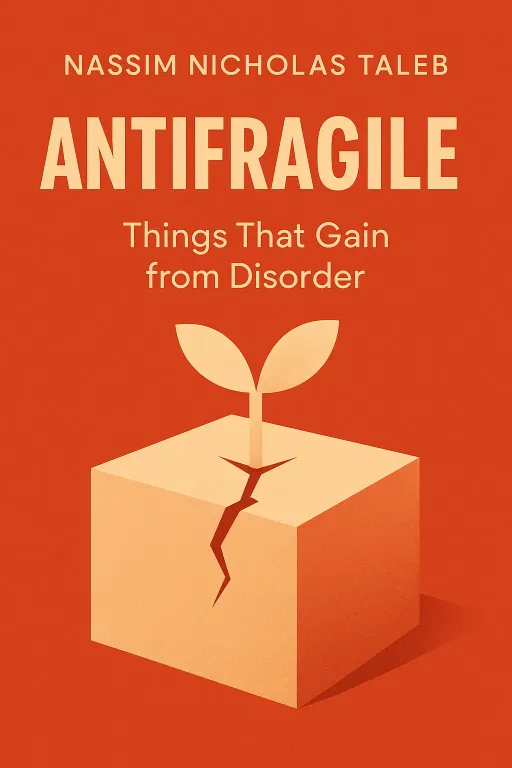
Nova: Well, it is! We're diving deep into the profound and often challenging ideas of Nassim Nicholas Taleb, particularly from his groundbreaking works, and. Taleb, a former options trader who famously challenged the very foundations of financial risk management, has offered insights that continue to shape how we think about uncertainty across every field—including, crucially, accounting. His background gives his theories a very practical, real-world grounding, even when they delve into abstract philosophy.
Atlas: That’s fascinating. A trader turned philosopher. So he’s not just talking theory, he’s seen the messy reality of markets. This isn't just academic musing then, this is battle-tested thinking. How does this radical idea of gaining from disorder even begin to apply to something as structured and precise as accounting?
Nova: That's the million-dollar question, isn't it? It forces us to rethink what "resilience" truly means in our financial systems.
Understanding Antifragility: Beyond Robustness
SECTION
Nova: Most of us aim for robustness, right? We want our accounting systems to be strong, to withstand shocks without breaking. Think of it like a reinforced concrete bunker. It can take a hit.
Atlas: Right. You build firewalls, backups, disaster recovery plans. The goal is to keep operating, keep the data safe, no matter what. That’s what we teach, that’s what we strive for in financial integrity.
Nova: Precisely. That's good. But Taleb argues there's a third category beyond fragile and robust. He calls it. An antifragile system doesn't just resist damage; it actually improves, strengthens, or even innovates because of volatility, shocks, stressors, and errors.
Atlas: So it’s not just surviving, or even just bouncing back. It’s bouncing? Gaining from the very thing that would destroy or merely test others? That sounds almost… mythical. Like a hydra growing two heads for every one cut off.
Nova: Exactly like a hydra! Taleb loves that analogy. Or think of the human immune system. Exposure to pathogens makes it stronger, more prepared. Or even a well-managed restaurant that, after a few negative reviews highlighting slow service, overhauls its kitchen workflow, trains staff better, and ends up with faster, higher-quality service than before the criticism. The stress made it better.
Atlas: I see. So for accounting, it wouldn't just be about having redundant servers to prevent data loss. It would be about something in the system from a data breach, for example, not just patching it up, but fundamentally redesigning its security protocols in a way that makes it vulnerable and more efficient against threats. Not just reacting, but evolving proactively.
Nova: You've got it. Let's take a concrete accounting example. Imagine a traditional, manual reconciliation process. It's fragile. A sudden, unexpected surge in transaction volume? It breaks down. Errors proliferate, deadlines are missed.
Atlas: Been there. It's a nightmare of spreadsheets and late nights. Definitely fragile.
Nova: Now, a robust system might be highly automated reconciliation software. It can handle the volume, it processes everything, it doesn't break. Good, right?
Atlas: Much better. Standard practice for any modern accounting firm.
Nova: But an accounting system, facing that same unexpected transaction surge, wouldn't just process it. Perhaps its AI-driven anomaly detection module, instead of just flagging outliers, actually uses the unusual patterns from the surge to refine its algorithms, to identify new types of fraud or inefficiencies it hadn't encountered before. It learns to anticipate new data structures, optimizes its processing speed, and even suggests new ways to categorize transactions that make future reporting more insightful. The stress didn't just pass through it; it left it smarter, faster, and more capable.
Atlas: Wow. That's a profound shift. It moves accounting from being a reactive, record-keeping function to an active, learning, and strategic asset. For someone focused on AI and automation in accounting, this isn't just about efficiency; it's about building intelligence that with challenges. It's about designing systems that, when faced with an unexpected data format or a new type of financial product, don't just process it, but that new information to become more versatile.
Black Swans and the Imperative for Antifragile Accounting
SECTION
Nova: And this concept of antifragility becomes absolutely critical when we talk about what Taleb calls "Black Swan" events.
Atlas: Ah, the highly improbable, the unpredictable. The events that, in hindsight, seem obvious, but no one saw coming. Like the 2008 financial crisis, or the sudden rise of a disruptive technology.
Nova: Exactly. A Black Swan is an event that has three characteristics: it's an outlier, completely outside normal expectations; it carries an extreme impact; and despite its outlier status, human nature makes us concoct explanations for its occurrence the fact, making it appear predictable. The key insight is that you can't predict them. You can't model them.
Atlas: So, if you can't predict them, what’s the point? How do you prepare for something unknowable in accounting, where precision and forecasting are so highly valued? We spend so much time trying to predict earnings, market shifts, regulatory changes.
Nova: That's precisely where the antifragile mindset comes in. The point isn't prediction; it's. It's about structuring your accounting and financial systems so that when a Black Swan hits—whether it's a sudden global pandemic, an unforeseen regulatory overhaul, or a disruptive technology that changes how transactions are even recorded—your system doesn't just absorb the shock. It finds a way to benefit.
Atlas: Give me an example of how an accounting system could from something as devastating as a Black Swan. That feels counterintuitive.
Nova: Let’s consider a regulatory Black Swan. Imagine a completely unexpected, sweeping global change to tax laws or sustainability reporting standards. Most accounting departments would be in crisis mode, scrambling to comply, facing fines, massive costs, and reputational damage. This is a fragile response. A robust system might have a large compliance team that quickly adapts, but at a huge cost.
Atlas: And the antifragile one?
Nova: An antifragile accounting system, or the firm that builds one, might have already integrated flexible, modular reporting frameworks designed to adapt rapidly to new data input or output requirement. They might have a culture of continuous learning and experimentation with new reporting technologies, perhaps even blockchain-based systems for traceability. When the Black Swan regulation hits, instead of playing catch-up, they are among the first to fully comply, perhaps even offering new consulting services to other struggling companies. They use the disruption to gain market share, enhance their reputation as innovators, and even influence the future direction of the regulations because their system proved superior.
Atlas: So, it's not about having a crystal ball to predict the specific regulation, but about having the underlying architecture and mindset that allows you to pivot and even profit during the upheaval. This resonates deeply with the idea of integrating ESG and sustainability reporting. If new, unexpected environmental regulations come out, an antifragile accounting system already has the data capture and reporting capabilities to not just comply, but to quickly demonstrate leadership, potentially attracting new investment or customers who value that transparency. It sounds like strategic growth through embracing uncertainty, rather than avoiding it.
Nova: Exactly. It’s about being prepared for the. It’s about building in optionality and redundancy in smart ways, not just for safety, but for opportunity. It’s about having a diverse portfolio of processes and technologies that, if one fails spectacularly, others are poised to capitalize on the new landscape.
Synthesis & Takeaways
SECTION
Atlas: This is a powerful idea. It fundamentally shifts the conversation from merely managing risk to actively leveraging uncertainty for growth. It makes me think about how we design our financial reporting and analysis tools. Are we building them to predict, or to adapt and gain?
Nova: Precisely. The pursuit of antifragility in accounting isn't just about survival; it's about a fundamental shift in mindset. It’s moving from trying to control an uncontrollable future to structuring our systems to extract value from the inevitable shocks. It's about transforming threats into opportunities, seeing volatility not as a bug, but as a feature of a dynamic world.
Atlas: So, for our listeners, the strategic synthesizers and analytical architects out there, this means looking beyond the traditional risk assessments. It means asking, "How can this unexpected event not just avoid breaking us, but actually make us better?"
Nova: Absolutely. True strategic growth in accounting comes not from eliminating all risk—which is impossible—but from structuring systems to extract value from the inevitable shocks, transforming what others see as threats into genuine opportunities for innovation and competitive advantage. It’s about building a financial nervous system that learns and evolves with every jolt it experiences.
Atlas: I love that. So, here's a tiny step for everyone listening: identify one area in your current accounting process that feels fragile. Now, instead of just thinking about how to protect it, brainstorm how an unexpected pressure or shock in that area could actually make it stronger, more efficient, or even reveal a new strategic direction for your team.
Nova: A brilliant challenge. That's the antifragile mindset in action.
Atlas: This is Aibrary. Congratulations on your growth!