Stop Chasing Perfection, Start Building Resilience: The Guide to Antifragile Systems.
Golden Hook & Introduction
SECTION
Nova: Atlas, rapid-fire word association for "perfection." Ready?
Atlas: Oh, I like this. Go!
Nova: Fragile.
Atlas: Porcelain.
Nova: Predictability.
Atlas: Illusion.
Nova: Failure.
Atlas: Opportunity.
Nova: Antifragile.
Atlas: ... Wait, what? That's not a word association; that's a whole concept! My brain just blue-screened.
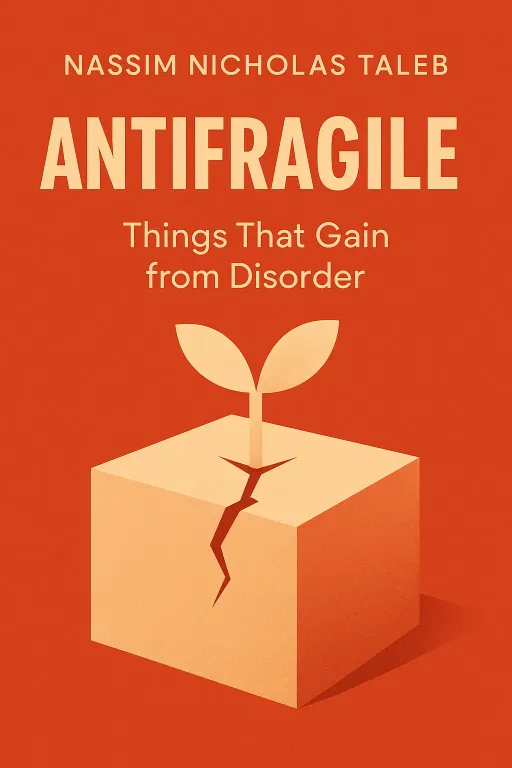
Nova: Exactly! And that, my friend, is precisely why we're diving into a fascinating and incredibly insightful body of work today. We're exploring the ideas at the heart of "Stop Chasing Perfection, Start Building Resilience: The Guide to Antifragile Systems." While the book itself draws heavily from the groundbreaking concepts laid out by Nassim Nicholas Taleb, particularly in his seminal works "Antifragile" and "The Black Swan."
Atlas: Ah, Taleb! I know Taleb. He's the guy who completely redefined how we think about risk and uncertainty, isn't he?
Nova: He absolutely is. What's particularly striking about Taleb is his background. He wasn't some ivory tower academic; he was a former options trader and a risk analyst. This isn't just theory for him; it's a worldview forged in the unpredictable, chaotic furnace of financial markets. His practical experience gives his philosophical concepts a grounded, real-world edge that you just don't find everywhere.
Atlas: That's a great point. It means he's seen firsthand how conventional wisdom often fails under pressure. So, what's this "antifragile" concept that broke my word association game?
Nova: Well, it starts with what he calls "The Blind Spot." The core of our podcast today is really an exploration of how to shift our mindset and design our systems to thrive, not just survive, in an unpredictable world. Today we'll dive deep into this from two perspectives. First, we'll explore why our natural instinct for stability can be a dangerous blind spot, then we'll discuss the groundbreaking concept of antifragility and how we can actually gain from disorder.
Deep Dive into Core Topic 1: The Blind Spot – Why Stability Can Lead to Fragility
SECTION
Nova: Our natural instinct, Atlas, is to avoid uncertainty, to seek stability, to control everything. We build robust systems, we create detailed plans, we optimize for efficiency. It feels safe, right? It feels smart.
Atlas: Absolutely! Especially for anyone who's ever had to manage a complex project or a team. The whole goal is to minimize variables, reduce risk, and achieve predictable outcomes. That's what we're taught.
Nova: And that's precisely the blind spot. Taleb argues that in complex systems, this relentless pursuit of stability and optimization can actually make us. Imagine a perfectly optimized, lean supply chain. Every component arrives just in time, there's no excess inventory, no waste. It's incredibly efficient under normal conditions.
Atlas: Sounds like a dream for a strategist. Maximum output, minimum overhead.
Nova: Exactly. Until one minor disruption hits. A container ship gets stuck, a factory has a power outage, a key material becomes scarce. Suddenly, that perfectly optimized, lean system collapses. There are no buffers, no redundancies. It's brittle. It's fragile.
Atlas: Wow. That's a counterintuitive thought. So, by trying to make things perfectly stable, we inadvertently make them more vulnerable? That's going to resonate with anyone who constantly strives for flawless execution.
Nova: Precisely. We often confuse "robust" with "antifragile." A robust system can withstand shocks, it resists damage. But a fragile system breaks. And a system that's been optimized for stability often has no capacity to absorb unexpected blows. It's like building a skyscraper that's incredibly strong against vertical loads, but completely rigid against lateral forces. One earthquake, and it's gone.
Atlas: But why is seeking stability so deeply ingrained in us? For our listeners who are managing high-pressure teams, or building complex tech solutions, the entire ethos is about control and predictability. How do you even begin to prepare for things you don't even know exist?
Nova: That's the crux of Taleb's argument in "The Black Swan." He emphasizes the profound impact of these rare, unpredictable events – the "unknown unknowns" – that defy normal expectations. Our traditional risk management often focuses on known risks, on what we can model and predict. But the world-changing events, the ones that truly reshape industries or lives, are often the ones we never saw coming. They are the Black Swans.
Atlas: So, the very act of trying to eliminate all uncertainty, of making everything perfectly predictable, removes the very mechanisms that might allow us to adapt to the truly unpredictable. That sounds a bit out there, but I can see how constant optimization for efficiency could remove necessary buffers, making systems brittle.
Nova: It absolutely does. When you remove redundancy, when you streamline everything to the absolute edge of efficiency, you also remove the slack, the flexibility, the "fat" that allows a system to absorb unexpected stress and learn from it. It becomes fragile. It's optimized for a world that doesn't exist – a world without surprises.
Deep Dive into Core Topic 2: Embracing Antifragility – Gaining from Disorder
SECTION
Nova: Now, this leads us to the truly revolutionary concept, the one that broke your word association: Antifragility. Taleb argues that there's a third category beyond fragile and robust. Antifragile systems actually from disorder, volatility, stress, and even errors. They don't just cope with uncertainty; they grow stronger because of it.
Atlas: Okay, so it's not just bouncing back, it's bouncing back? That's a huge leap from traditional resilience. Give me an example of something that actually being stressed. This feels like it defies logic for many of our listeners, especially those in structured, high-stakes environments.
Nova: Think of the mythological Hydra. You cut off one head, and two more grow back. That's antifragile. In the real world, biological systems are a prime example. Your immune system gets stronger by being exposed to pathogens. If you live in a sterile bubble, your immune system atrophies. Your bones get stronger under stress; they remodel and reinforce themselves. Without stress, they weaken.
Atlas: So, the human body is inherently antifragile in many ways. That's a great analogy. It makes me think about how an innovator might approach a project. They don't fear failure; they learn from it, they iterate, they pivot. The "failures" actually make the final product stronger.
Nova: Exactly! Consider the process of evolution itself. Species adapt and evolve through environmental pressures, through random mutations, through constant challenges. The very disorder of the environment drives the creation of stronger, more adaptable life forms. Or think about the startup world. Rapid prototyping, constant feedback loops, even outright failures – these aren't just tolerated, they're often seen as essential steps to learning and ultimately building a more robust and successful product or company.
Atlas: That resonates with the "Innovator" mindset. It's about taking those hits, learning, and then coming back stronger. But how does this apply to larger, more established organizations or projects that value structure and predictability? You can't just tell a major corporation to embrace chaos, can you? How do you design for this "benefiting from chaos"?
Nova: You're right, it's not about inviting reckless chaos. It's about designing systems that for it at certain levels and from it. This means building in optionality, decentralization, and strategic redundancies. For example, instead of one single, highly efficient supplier for a critical component, you might have multiple smaller, less efficient ones. That seems redundant, but if one fails, the others can pick up the slack, and the overall system is stronger.
Atlas: So, it's about diversified redundancy rather than streamlined efficiency at all costs. I can see how that would make a system more robust, but how does it make it? How does it actually from the disruption?
Nova: The gain comes from the and. When one supplier fails, you not only survive, but you learn about vulnerabilities, you discover new suppliers, you might even innovate new internal processes to mitigate future risks. The system isn't just restored; it's improved. It's about creating an environment where small, localized stressors and failures are not just tolerated, but are actively used as information to strengthen the larger system. It's about allowing for experimentation, for trial and error, knowing that those "errors" are actually building blocks for future strength.
Atlas: That's a paradigm shift. It moves from a defensive posture against risk to an offensive one, almost. It's about actively seeking opportunities within disorder, rather than just bracing for impact.
Synthesis & Takeaways
SECTION
Nova: And that's the profound insight here. True strength doesn't come from trying to eliminate every possible threat or achieve an impossible ideal of perfection. It comes from designing for a world that be unpredictable, not trying to control it. Antifragility is the idea that some things benefit from shocks, rather than being harmed by them. It's the ultimate form of resilience, where you don't just survive, you actually thrive because of volatility.
Atlas: This completely redefines how I think about risk and planning. For anyone who's been striving for that perfect, unshakeable plan, this is a call to rethink everything. It shifts the focus from avoiding problems to building a system that can from them.
Nova: Exactly. And the deep question Taleb's work poses to us is: where in your projects, your team structure, or even your personal life, can you introduce elements of "antifragility" to benefit from unexpected disruptions? Where can you stop chasing an illusion of perfection and start building systems that actually gain from disorder?
Atlas: That's a powerful challenge. I imagine a lot of our listeners, especially those who are architects, strategists, and innovators, are now thinking about where they can intentionally build in some of that "beneficial chaos." I'm inspired to start looking at my own projects through this lens.
Nova: It's an invitation to embrace the unknown not as a threat, but as a source of growth. So, we encourage all of you to look around. Where can you allow for more optionality? More redundancy? More small, safe-to-fail experiments? Where can you let things break a little, so they can heal stronger?
Atlas: We'd love to hear your thoughts on this! What antifragile systems have you observed or even built into your own work or life? Share your insights and examples with us.
Nova: This is Aibrary. Congratulations on your growth!