Stop Chasing Perfection, Start Building Resilience: The Guide to Antifragile Growth.
Golden Hook & Introduction
SECTION
Nova: What if I told you that "what doesn't kill you makes you stronger" isn't just a cliché, but a profound understatement? What if not breaking isn't enough, and true mastery actually requires you to actively seek out chaos?
Atlas: Wait, actively seek chaos? Nova, isn't the goal for most of us to avoid it? I mean, for an aspiring innovator, you're usually trying to minimize variables, not introduce more.
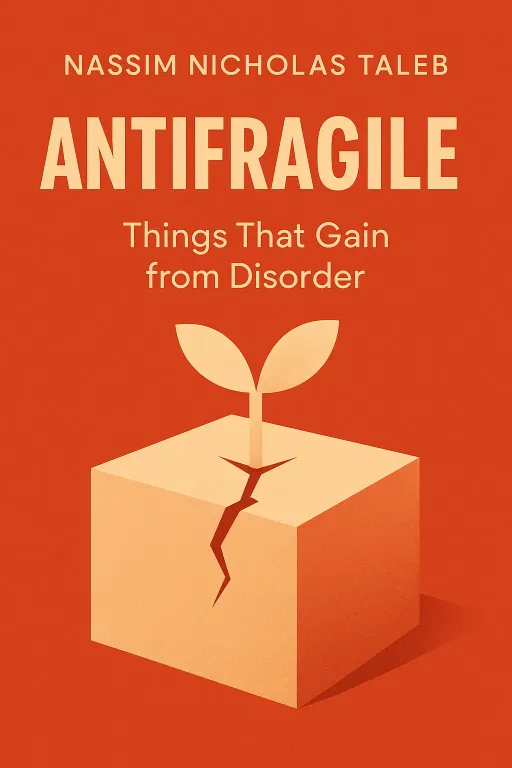
Nova: Exactly, Atlas, and that's precisely the "blind spot" we're diving into today, inspired by Nassim Nicholas Taleb's groundbreaking work, "Antifragile: Things That Gain from Disorder." Taleb isn't just an academic; he's a former options trader, a scholar, and a philosophical essayist, known for his incisive, often provocative, critiques of conventional wisdom. His theories aren't just thought experiments; they're battle-tested in the volatile world of finance.
Atlas: So he's not just talking theory, he's lived through the chaos. And he's saying that some things don't just resist damage, or even bounce back from it, they actually get better because of it? That's a huge shift in perspective for anyone trying to innovate.
Nova: Absolutely. Most of us aim for robustness, hoping to withstand shocks without breaking. Or maybe resilience, where we bounce back to our original state. But antifragility means you actually improve, you grow, you become stronger when exposed to volatility, randomness, and stressors. It's about gaining from disorder.
Beyond Resilience: The Antifragile Mindset
SECTION
Atlas: Okay, so it’s not just bouncing back, but bouncing? That's a huge shift in perspective for anyone trying to innovate, especially if you're constantly pushing boundaries. But how do you even tell the difference? Most of us are just trying to keep things from breaking. How do you know if you're building a muscle or just tearing it irreparably?
Nova: That's a brilliant question, and it's where the nuance lies. Think of it like this: a fragile system, like a delicate glass vase, shatters under stress. A robust or resilient system, like a sturdy plastic container, might dent but generally returns to its original shape. But an antifragile system, that's like your immune system. Exposure to small doses of pathogens makes it stronger and more capable of fighting off future, larger threats. Or a human bone, when it breaks and heals, often becomes stronger at the point of the fracture.
Atlas: Right, like the body adapts. So it's not about avoiding all stress, but understanding that some forms of stress are actually essential for growth. I imagine a lot of our listeners, particularly those striving for mastery, might find this counterintuitive. We're often taught to create stable environments, to minimize variables.
Nova: Precisely. We have this "blind spot" where we mistakenly believe that avoiding all disruption is the path to success. But for true mastery, especially in innovation, it's about actively seeking environments that allow you to learn and grow from every challenge. The insights from Taleb reveal that the path to mastery isn't about avoiding failure, but about actively refining your system through exposure to manageable challenges.
Atlas: That sounds great in theory, but for an aspiring innovator, isn't it incredibly risky to intentionally invite disorder? We're often trying to risk, not increase it, especially when you're talking about high-stakes projects.
Nova: And that’s a valid concern. It’s not about inviting catastrophic, existential threats. It’s about managing your exposure to beneficial stressors. Think of it as a spectrum. You don't jump into a lion's den to build courage. Instead, you might engage in public speaking, which is a small, manageable stressor that builds confidence. This is where Annie Duke's work, "Thinking in Bets," perfectly bridges the gap between Taleb's theory and practical application.
Cultivating Antifragility: Embracing Uncertainty and Learning from Failure
SECTION
Atlas: Okay, so if Taleb gives us the "what"—the concept of antifragility—then Duke gives us the "how." She shows how embracing uncertainty and probabilistic thinking is key. But probabilistic thinking... that sounds a bit academic. What does a professional poker player have to teach an innovator about antifragility? Are we talking about bluffing your way through a project?
Nova: Not bluffing, but rather making smarter decisions when you don't have all the facts, which is the innovator's constant reality. Duke argues that we often confuse a good outcome with a good decision, and a bad outcome with a bad decision. Poker is the perfect analogy: you can play your hand perfectly, with the best possible strategy, and still lose because of the cards dealt. Conversely, you can play terribly and still win.
Atlas: So it's like, you can play your hand perfectly and still lose, but that doesn't mean it was a bad decision. That's a huge mental shift. How do you apply that to, say, a new product launch that fails? Most companies would see that as a bad outcome, full stop.
Nova: Exactly. Duke encourages us to separate the quality of the decision from the quality of the outcome. An antifragile approach means analyzing the product failed. Was it a fundamentally flawed idea? Or was it a good idea executed well, but the market wasn't ready, or a competitor launched something similar simultaneously? By embracing the uncertainty and dissecting the outcome, you learn, you adapt, and your decision-making process becomes stronger for the next venture. You're gaining from that disorder, from that "failure."
Atlas: I imagine a lot of our listeners, especially those driven by mastery, might find this hard. We're often taught to avoid mistakes at all costs, to always deliver perfection. How do you shift that internal narrative to one that actively seeks out these "small stressors" you mentioned?
Nova: It starts with intentionally introducing those small stressors. If you're developing an advanced skill, it could mean seeking out challenging feedback, deliberately taking on projects slightly beyond your current capability, or even engaging in rapid prototyping where failure is not just expected but the process. Each "failure" is a data point, an opportunity to learn, a way to become more robust, and eventually, antifragile. It's about creating a system where disorder makes you stronger, not weaker. It’s about actively iterating and evolving.
Atlas: So it's not about being fearless, but about being smart about how you engage with fear and uncertainty. It's about designing your process to learn from every hit, every unexpected turn. That's a powerful idea for anyone looking to make a lasting impact.
Synthesis & Takeaways
SECTION
Nova: Ultimately, the journey to mastery isn't about avoiding failure, but about actively seeking environments that allow you to learn and grow from every challenge, becoming stronger with each one. It's a fundamental shift from merely surviving to truly thriving.
Atlas: And it means reframing how we view setbacks. They’re not just bumps in the road; they're crucial data, an integral part of the growth process. So, Nova, for our listeners who are aspiring innovators and resilient learners, what's the one thing you hope they take away from this?
Nova: I hope they recognize that perfection is often the enemy of antifragility. The pursuit of a flawless, stable path actually leaves you more vulnerable. True strength comes from engaging with complexity and uncertainty.
Atlas: That's a profound thought. So, where in your own advanced skill development can you intentionally introduce those small stressors, not to break, but to truly become stronger? Think about it, because that’s where real growth happens.
Nova: This is Aibrary. Congratulations on your growth!